

Start here
Why Home Systems Knowledge Matters
Next
Electrical System Basics
Then
Plumbing and Water Systems
Continue
Heating, Ventilation, and Cooling (HVAC)
When you're ready
Knowing When to Call a Professional
Why Home Systems Knowledge Matters
Owning or renting a home means inheriting a set of interconnected mechanical and electrical systems you may never have thought about before. Unlike a car, where most people at least know where the gas cap is, a home can feel like a sealed black box — until something goes wrong.
The good news is that you don't need a contractor's license to be a knowledgeable homeowner. You simply need to understand what each system does, where its key components are located, and what signals point to a problem. That foundation alone will save you money, reduce stress, and help you protect the investment you've made.
Think of this guide as your first walkthrough. For ongoing care, the annual home audit checklist is a natural next step once you're comfortable with the basics. And if you're also setting up routines for the first time, starting a household routine from scratch will help you build habits around regular system checks.
Main service panel
The metal box, usually called a breaker box or fuse box, that receives electricity from the utility company and routes it to circuits throughout your home.
Circuit breaker
A safety switch inside the panel that automatically shuts off a circuit when it draws too much power, preventing overheating and fire.
GFCI outlet
A special outlet with built-in protection that cuts power in milliseconds if it detects electricity flowing somewhere it shouldn't — used in wet areas to prevent shock.
Main shut-off valve
A valve — usually near where the water line enters the house — that stops all water flowing into the home when turned off.
Pressure-relief valve
A safety device on a water heater that opens automatically to release excess pressure if the tank overheats, preventing a dangerous buildup.
HVAC
Short for Heating, Ventilation, and Air Conditioning — the combined system that heats, cools, and circulates air throughout your home.
Electrical System Basics
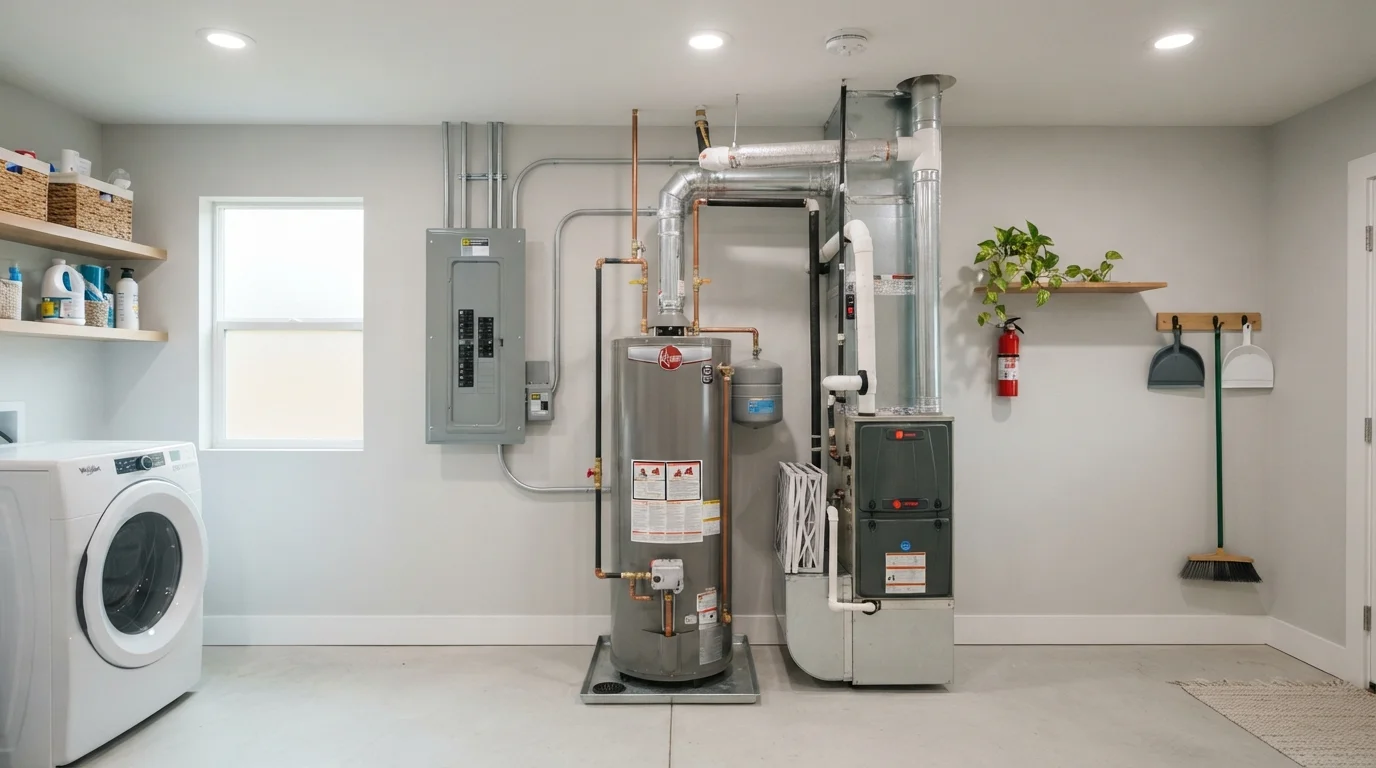
Your home's electrical system starts at the main service panel — often called the breaker box — typically mounted on an interior wall of a garage, basement, or utility room. This panel receives power from your utility provider and distributes it through individual circuits to outlets, appliances, and lighting throughout the house.
Each circuit is protected by a circuit breaker, a safety switch that automatically trips (shuts off) when a circuit is overloaded. If a room's outlets suddenly stop working, check the panel first. A breaker in the middle position — neither fully on nor fully off — is tripped. Reset it by pushing it firmly to OFF, then back to ON.
Ground Fault and Arc Fault Protection
Look for GFCI outlets (Ground Fault Circuit Interrupter) in bathrooms, kitchens, garages, and outdoor areas. These outlets have small TEST and RESET buttons and protect against electric shock near water. If an outlet in these rooms stops working, press the RESET button on the nearest GFCI outlet — they often protect several downstream outlets.
AFCI breakers (Arc Fault Circuit Interrupter) protect against electrical fires caused by damaged wiring. Newer homes are required to have them in bedrooms and living areas; older homes may not.
Label Your Breakers on Day One
Many panels have breakers with vague or missing labels. Walk through your home with a helper and switch breakers one at a time to map which breaker controls which area. Label each clearly with a marker or the sticker sheet often included in the panel door. This ten-minute task will save you real time and confusion during any future outage or repair.
Electrical work beyond outlet replacement or fixture swaps — especially anything involving the panel, new circuits, or wiring inside walls — requires permits and a licensed electrician in most US jurisdictions. Never attempt to work inside the main panel yourself.
Plumbing and Water Systems
Your plumbing system has two sides: supply (clean water in) and drain-waste-vent (used water out). The supply side operates under pressure; the drain side relies on gravity and proper venting.
The single most important thing to locate in your first week: your main water shut-off valve. In a plumbing emergency — a burst pipe, a stuck open toilet valve — turning this off stops water damage immediately. Know where it is before you need it.
Water Heater
Most US homes have a tank-style water heater (40–50 gallons is common) fueled by gas or electricity, located in a utility room, basement, or garage. It has a thermostat — typically set between 120°F and 140°F — and a pressure-relief valve, a safety device that releases pressure if the tank overheats. Test the relief valve annually by briefly lifting its lever; if water drains, it's functional. If it leaks continuously after testing, call a plumber.
Sediment builds up in tanks over time, reducing efficiency. Flushing a few gallons from the drain valve at the bottom once a year is a simple maintenance task most homeowners can handle.
Gas Leaks Require Immediate Action
If you smell a sulfur or rotten-egg odor anywhere in your home, do not use light switches, open flames, or any electrical device. Leave the house immediately, keep doors open as you go, and call your gas utility's emergency line from outside or from a neighbor's home. Do not re-enter until cleared by the utility company or emergency services.
Gas plumbing, sewer line repairs, and water-main connections are not DIY territory. If you smell gas — a sulfur or rotten egg odor — leave the house immediately, avoid switches and flames, and call your gas utility's emergency line from outside.
Heating, Ventilation, and Cooling (HVAC)
Your HVAC system (Heating, Ventilation, and Air Conditioning) controls your home's temperature and air quality. In most US homes this means a furnace or heat pump for heating, a central air conditioner or the same heat pump for cooling, and a network of ducts and vents to distribute air.
The single highest-impact maintenance task any homeowner can do: change the air filter regularly. A clogged filter forces the system to work harder, raising energy costs and shortening equipment life. Check your filter monthly and replace it on a schedule appropriate for your filter type — typically every 1–3 months.
Thermostat and Registers
Your thermostat is the control center. Programmable and smart thermostats allow you to schedule temperatures automatically, which can reduce energy use meaningfully over time. If you're interested in building out connected home systems, see our guide on setting up a smart home hub — thermostats are often the best first smart-home upgrade.
Supply registers (where air comes out) and return vents (where air goes back to the system) should be kept unblocked by furniture or drapes. Blocked returns are a leading cause of HVAC inefficiency and uneven heating or cooling.
Schedule a professional HVAC tune-up once a year. Technicians check refrigerant levels, clean coils, test safety controls, and catch issues before they become full breakdowns — usually at the worst possible time of year.
Knowing When to Call a Professional
Confident home ownership isn't about doing everything yourself — it's about knowing what's within your reach and what isn't. A useful rule of thumb: if a task involves gas, structural elements, main electrical wiring, roofing, or requires a permit, hire a licensed professional. In most US jurisdictions, unpermitted work on these systems can create liability issues and complicate home sales.
For everything else, build your skills gradually. Start with filter changes, GFCI resets, and water heater flushes. As you get comfortable, you might move to caulking, weatherstripping, or minor fixture replacements. The household management hub is a good place to find guidance organized by task type.
When hiring contractors, get at least two written estimates, verify licenses and insurance through your state's licensing board, and ask specifically what is and isn't covered by any warranty offered. Understanding your systems — even at a basic level — helps you ask better questions and recognize when something doesn't add up.
As you grow more confident at home, you might also be building skills in other areas of ownership. Our primer on what no one tells you about owning your first car applies a similar mindset to vehicle ownership.
This article is for general informational and educational purposes only. It is not a substitute for advice from a licensed contractor, electrician, plumber, or HVAC technician. Always verify local permit requirements and consult qualified professionals before undertaking any work that may pose safety risks or require regulatory compliance.
Frequently Asked Questions
Start with the three that affect safety most directly: your electrical panel, your main water shut-off valve, and your HVAC unit. Knowing where these are and what normal operation looks like gives you a foundation for everything else.
Most HVAC manufacturers and contractors recommend a professional tune-up once a year — typically in spring for cooling systems and fall for heating. Filter changes are typically needed every one to three months depending on filter type and household conditions.
A tripped breaker means a circuit drew more power than it was designed to handle, and the breaker switched off to prevent overheating. Unplug some devices from that circuit, then firmly push the breaker to the full OFF position before flipping it back to ON. If it trips again immediately, stop and call an electrician.
In most US homes the main shut-off is near where the water line enters the house — often in the basement, crawl space, utility room, or garage. In warmer climates it may be outside near the street. Locate it during your first week and make sure everyone in the household knows where it is.
Work involving the main electrical panel, gas lines, structural elements, or anything that requires a permit is generally not appropriate for DIY. These jobs carry real safety risks and, in many jurisdictions, unpermitted work can affect your insurance coverage and home resale.
General service life varies widely by system and maintenance history: water heaters typically last 8–12 years, furnaces 15–20 years, central air conditioners 15–20 years, and electrical panels 25–40 years. These are rough benchmarks — a licensed inspector can assess your specific equipment.
The content on this site is for informational purposes only and is not a substitute for professional advice. Always consult a qualified professional for guidance specific to your situation.