

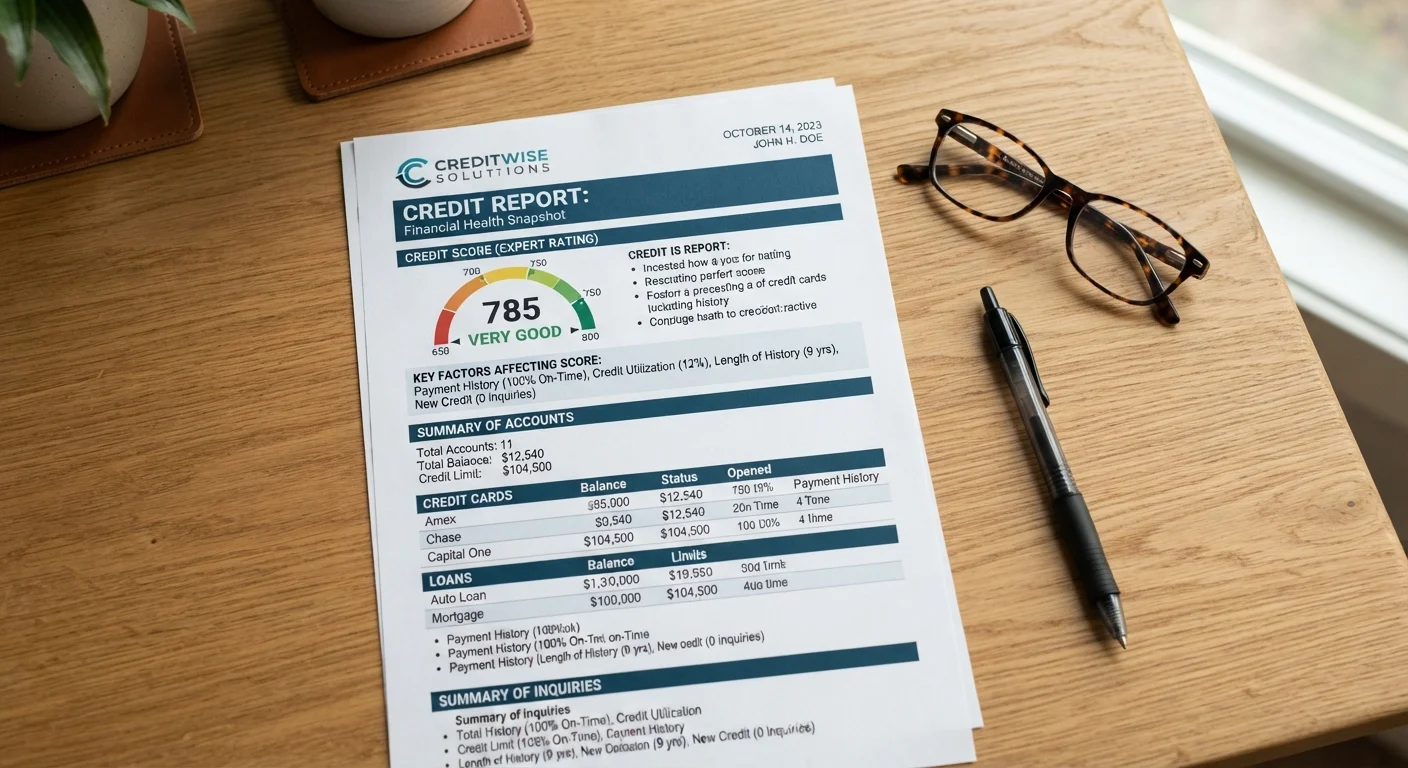
What a Credit Report Is — and Why It Matters
Your credit report is a structured financial history document maintained by the three major credit bureaus: Equifax, Experian, and TransUnion. Lenders, landlords, and sometimes employers use it to evaluate your financial reliability. Understanding what each section contains — and what it signals — is foundational to managing credit effectively.
Federal law under the Fair Credit Reporting Act (FCRA) entitles every U.S. consumer to a free credit report from each bureau once every 12 months via AnnualCreditReport.com, the only federally authorized source. Reports from each bureau may vary slightly because not all creditors report to all three.
| Number of major U.S. credit bureaus | 3 (Equifax, Experian, TransUnion) |
| Free annual reports per bureau | 1 per year (via AnnualCreditReport.com) (Fair Credit Reporting Act (FCRA)) |
| How long bankruptcies stay on report | 7 years (Chapter 13) / 10 years (Chapter 7) |
| How long collections accounts stay | Up to 7 years from original delinquency |
| Hard inquiry lifespan on report | Up to 2 years |
| Bureau dispute investigation window | Typically 30 days (FCRA requirement) |
This article is for general informational and educational purposes only. It is not financial, legal, or credit counseling advice. Consult a licensed financial professional or credit counselor for guidance specific to your situation.
Section-by-Section Breakdown of a Standard Credit Report
Every standard credit report is organized into four main sections. Here is what each one contains and what to check within it.
1. Personal Information
This section includes your name (and any variations or former names), current and previous addresses, date of birth, Social Security number (partially masked), and employment information. This data does not affect your credit score — its purpose is identification. Errors here, such as a misspelled name or an address you don't recognize, can sometimes indicate mixed files or fraud.
2. Account History (Trade Lines)
This is the largest and most score-influential section. Each account — credit cards, auto loans, mortgages, student loans — appears as its own entry, called a trade line. Each trade line typically shows the creditor name, account type, date opened, credit limit or loan amount, current balance, payment history (usually as a monthly grid), and account status (open, closed, in collections, etc.). Payment history is the single largest factor in most scoring models, so reviewing this section carefully for inaccuracies is essential.
Trade Line
An individual credit account entry on your report. Each loan or credit card you hold appears as a separate trade line with its own payment history and status.
Hard Inquiry
A credit check triggered by a formal application for credit. Hard inquiries are visible to lenders and can slightly reduce your credit score for a period of time.
Soft Inquiry
A credit check that does not affect your score, such as checking your own report or a lender running a pre-approval screening.
Collections Account
A debt that has been transferred to a collection agency after the original creditor gave up on collecting it. Collections accounts are a negative mark on your report.
Derogatory Mark
Any negative item on your credit report — including late payments, collections, or bankruptcies — that signals elevated risk to potential lenders.
Credit Bureau
A company that collects and maintains credit data on consumers and compiles it into credit reports sold to lenders and other authorized parties.
3. Credit Inquiries
Inquiries are logged when someone requests your credit file. There are two types:
- Hard inquiries: Generated when you apply for credit. They can modestly lower your score and typically remain on your report for two years.
- Soft inquiries: Generated by you checking your own report, pre-approval screenings, or background checks. These do not affect your score and are visible only to you.
Multiple hard inquiries for the same type of loan (mortgage, auto) within a short window — typically 14 to 45 days depending on the scoring model — are usually treated as a single inquiry to accommodate rate shopping.
4. Public Records and Collections
This section historically included bankruptcies, civil judgments, and tax liens. As of mid-2017, the three bureaus removed civil judgments and most tax liens from reports. Bankruptcies remain and can stay on your report for 7 to 10 years depending on the type. Collections accounts — debts sold to or assigned to collection agencies — also appear here or within the account history section and can remain for up to seven years from the original delinquency date.
If you are starting fresh with no history yet, see our guide to building credit from scratch for a step-by-step approach to establishing a file responsibly.
Disputing Errors and Monitoring Your Report
Errors on credit reports are more common than many people expect. Common issues include accounts that don't belong to you, incorrect balances or credit limits, duplicate accounts, and payments incorrectly marked late. Under the FCRA, you have the right to dispute inaccurate information directly with the bureau, which must investigate and respond — typically within 30 days.
You can file disputes online through each bureau's website, by mail (with documentation), or by phone. Keeping copies of all correspondence is strongly recommended. If the creditor cannot verify the information, it must be corrected or removed.
1 in 5
Americans with a credit report error
According to a Federal Trade Commission study, approximately one in five consumers had an error on at least one of their three credit reports.
35%
Of FICO score from payment history
Payment history is the single largest component of a standard FICO credit score, underlining why late payments have an outsized impact.
Reviewing all three reports regularly — not just one — is good practice, because errors at one bureau may not appear at another. Free weekly online reports became available through AnnualCreditReport.com following temporary pandemic-era expansions, though availability and policy may change; check the site directly for current access terms.
For a different perspective on how history-based reports work in another context, the driver's guide to vehicle history reports offers a useful comparison of how structured record systems work across different financial and consumer decisions.
The content on this site is for informational purposes only and is not a substitute for professional advice. Always consult a qualified professional for guidance specific to your situation.