

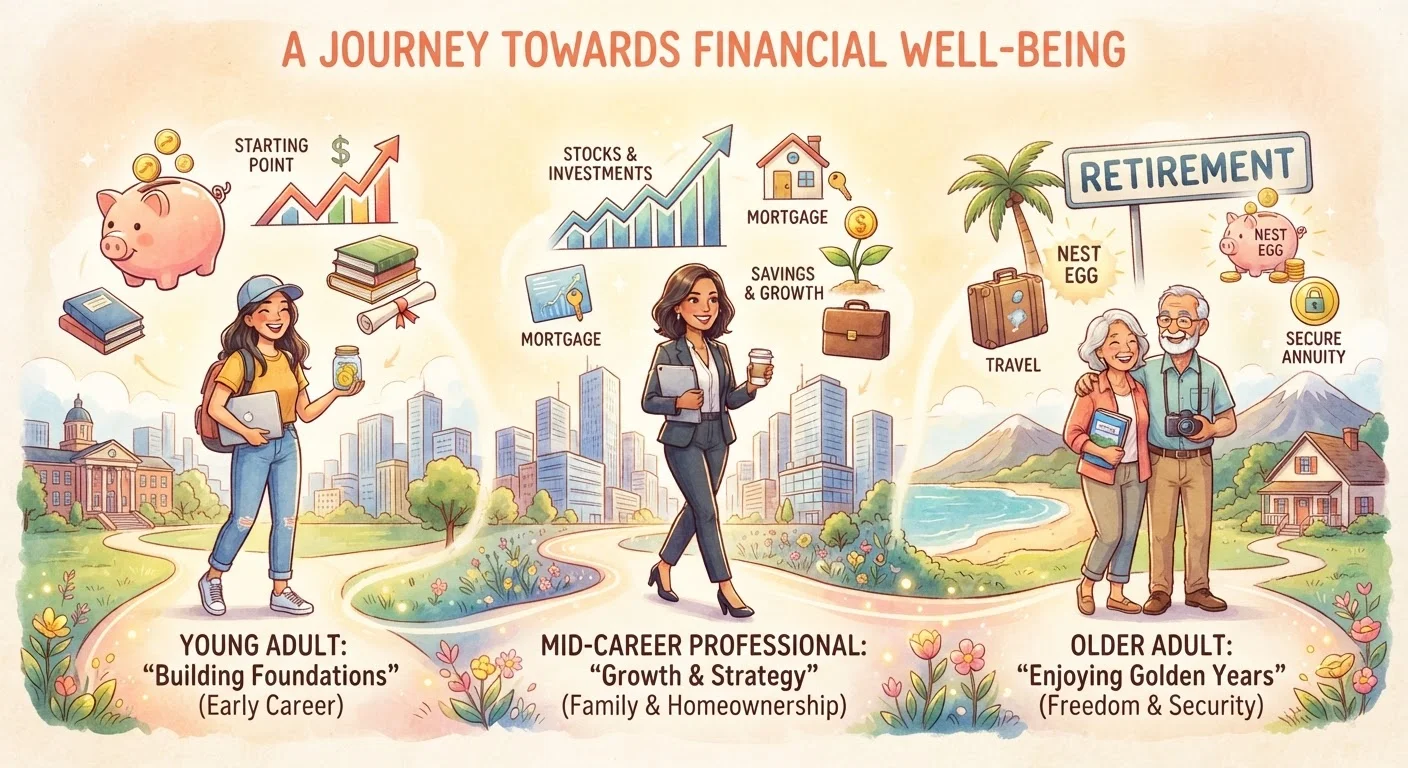
Why Life Stage Shapes Your Savings Approach
Saving money is not a one-size-fits-all activity. The strategies that make sense for a 24-year-old just entering the workforce look very different from those that matter most to a 58-year-old approaching retirement. Income levels, family responsibilities, debt loads, time horizons, and financial goals all change — and your approach to saving should change with them.
This does not mean starting over at each stage. It means building on what you have established and adjusting emphasis as circumstances evolve. Understanding how saving needs shift helps you make more intentional decisions rather than applying generic advice that may not fit your situation. For a deeper look at where saving ends and long-term wealth-building begins, see our guide to saving and building wealth.
Below are five key savings strategies organized around life stages — from early adulthood through retirement preparation — each with actionable frameworks you can apply now.
Early Adulthood (20s): Build the Foundation
The most valuable asset in your 20s is time. Even modest contributions made consistently in this decade benefit from decades of potential growth in tax-advantaged retirement accounts. But before thinking long-term, the foundational priority is liquidity: build an emergency fund covering three to six months of essential expenses.
With often-limited income, the key is establishing the habit rather than optimizing the amount. Even saving a small fixed percentage of each paycheck creates a behavioral pattern that scales as income rises. If your employer offers a retirement contribution match, contributing at least enough to capture the full match is generally considered a high-priority step — passing it up is leaving part of your compensation unused.
At this stage, also pay close attention to budgeting fundamentals, since a clear picture of cash flow is what makes consistent saving possible in the first place.
In your 20s, building the saving habit matters more than the size of the contribution.
Late 20s to Early 30s: Manage Competing Priorities
This period often introduces major financial complexity: student loan repayment, a first home purchase, relationship and family costs, and career transitions. Saving does not stop, but it must be balanced against legitimate near-term financial demands.
A useful framework here is to categorize goals by time horizon. Short-term goals — a home down payment, a car, a wedding — benefit from liquid accounts separate from your emergency fund. Long-term goals, including retirement, should continue receiving consistent contributions even when other demands feel pressing. Our goal-setting frameworks for personal finance article outlines structured methods for prioritizing across multiple simultaneous goals.
Resist the temptation to pause retirement contributions to fund short-term goals unless absolutely necessary — the cost of lost compounding time is difficult to recover later.
Pausing retirement contributions to fund short-term goals carries a long-term cost that is hard to recover.
Mid-Career (40s): Accelerate and Diversify
For many people, the 40s represent peak earning years — and therefore the most significant opportunity to meaningfully accelerate savings. If earlier decades involved modest retirement contributions, this is the period to increase them substantially. Tax-advantaged accounts typically allow higher contributions starting at age 50, but building toward those limits in your 40s sets the stage.
Mid-career is also a good time to reassess how savings are structured. Consider whether your emergency fund has kept pace with your current lifestyle cost, whether you have a clear plan for any lump-sum windfalls like bonuses or inheritances, and whether your account types reflect the balance between accessibility and growth appropriate for your goals.
Lifestyle inflation — spending rising in step with income — is the primary threat to savings progress in this decade. Directing a defined portion of each raise directly to savings before it becomes available to spend is a discipline worth building.
Directing a portion of every raise to savings before spending it is one of the most effective mid-career habits.
Pre-Retirement (50s): Consolidate and Stress-Test
With retirement potentially ten to fifteen years away, the 50s are the right time to shift from accumulation focus to projection and planning. That means getting a realistic picture of what you have saved, what you are likely to need, and whether a gap exists that requires action.
Take-advantage of catch-up contribution limits available in most tax-advantaged retirement accounts after age 50, which allow higher annual contributions than the standard limits. Consolidating accounts from previous employers simplifies management and reduces oversight gaps.
It is also worth evaluating where your savings are held. Our comparison of high-yield vs. traditional savings accounts can help you ensure the liquid portion of your savings is working as efficiently as possible. For personalized projections and tax-planning strategies, consulting a licensed financial adviser is strongly recommended at this stage.
The 50s are the right decade to stress-test your retirement projections and close any savings gap.
Retirement Preparation (60s): Shift Toward Income Planning
As retirement nears, the emphasis moves from accumulation to distribution — ensuring your savings translate into reliable income. This is less about new saving habits and more about structuring what you have built. Key questions include when to begin drawing on Social Security, how to sequence withdrawals across different account types, and what level of liquid reserve to maintain to avoid selling long-term assets at unfavorable times.
Maintaining some savings buffer even in retirement is advisable, since unexpected healthcare costs or major expenses do not stop occurring. The behavioral principles behind lasting saving habits continue to apply — regular review and modest ongoing contributions where possible help preserve financial resilience well into retirement.
This stage also benefits most from professional guidance. A fee-only financial planner can help model income scenarios and adjust the plan as circumstances change.
Near retirement, the question shifts from 'how much can I save?' to 'how do I turn savings into income?'
Putting It All Together
Savings strategies work best when they are specific, time-bound, and aligned with where you actually are in life — not where you think you should be. If you find broad goals are stalling your progress, our article on why vague savings goals rarely work offers practical reframing tools.
The Power of Consistent, Automated Saving
Regardless of life stage, automating transfers to savings accounts removes the decision from daily life — reducing the chance that competing spending crowds out savings. Even small automated amounts, increased incrementally over time, tend to outperform larger but irregular contributions. Review your automation settings whenever your income or expenses change significantly.
No matter your stage, automating your savings is one of the most reliable ways to make consistent progress without relying on daily discipline. And if you are balancing both near-term needs and distant goals, the framework in our short-term vs. long-term savings guide can help you structure a plan that covers both.
This article provides general financial information and education only. It is not personalized financial, investment, tax, or legal advice. Please consult a qualified financial professional for guidance specific to your circumstances.
The content on this site is for informational purposes only and is not a substitute for professional advice. Always consult a qualified professional for guidance specific to your situation.