

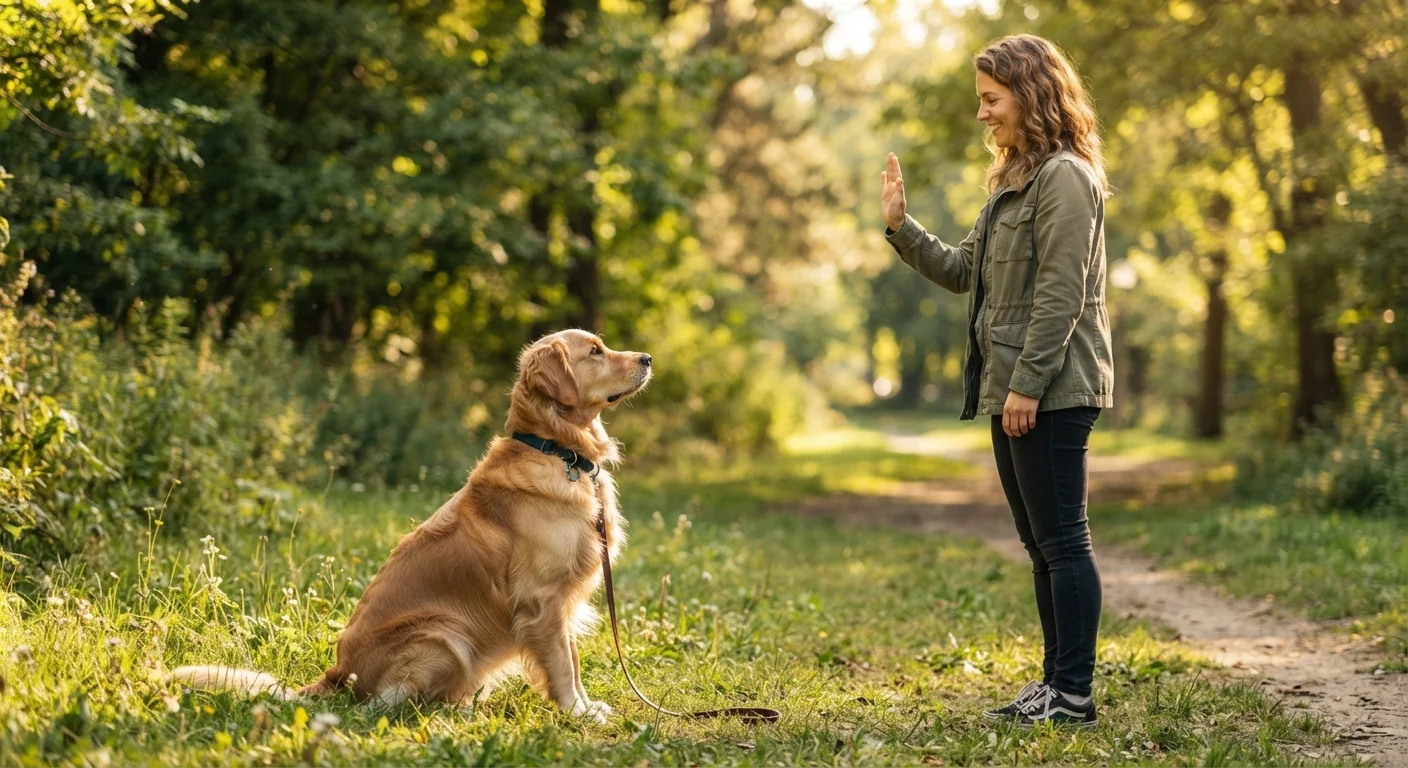
Why 'Stay' Is More Than a Single Command
Many owners teach a dog to pause briefly on cue and consider the job done — only to find the behavior collapses the moment a squirrel appears, a stranger approaches, or they step more than a few feet away. That gap between a practiced stay and a reliable one comes down to three variables that behavioral science calls the three D's: Duration, Distance, and Distraction.
Duration is how long the dog holds position. Distance is how far you move from the dog. Distraction is the competing stimuli in the environment. Each one places a separate cognitive demand on the animal. Training them simultaneously — or skipping steps — is the most common reason stays fail in the real world.
Before starting, it helps to understand what your dog is communicating during training. Subtle stress signals — lip licks, yawning mid-session, or a tucked tail — are meaningful feedback. See our guide to reading dog body language for a practical breakdown of these cues.
If you've recently brought a new dog home, note that rushing obedience commands before a bond is established can undermine long-term reliability. The first 30 days with a new dog article explains why trust comes before training.
What you will need
Step-by-Step: Building a Reliable Stay
Follow the steps below in order. Progress only when your dog succeeds at the current level around 80–90% of the time — a threshold behavioral trainers commonly use as a marker of fluency before raising criteria. Keep sessions to 5–10 minutes, and always end on a successful repetition.
Introduce the Stay Cue With Zero Duration
Ask your dog to sit or lie down. The moment they settle, say 'stay' once in a calm, even tone, immediately mark the behavior with your clicker or verbal marker, and reward. At this stage, you are simply pairing the word with the position — not asking them to hold it for any meaningful time.
Repeat 5–8 times per session. Duration here is measured in one to two seconds. You are teaching the dog that 'stay' predicts a reward for being stationary, before adding any real challenge.
Build Duration Before Anything Else
Begin extending the time between the stay cue and the marker/reward. Work in small increments: 3 seconds, then 5, then 8, then 12, and so on. Use a variable schedule — sometimes reward at 5 seconds, sometimes at 10 — so the dog doesn't learn to anticipate a release at a fixed point.
Your goal at this stage is a solid 30-second stay with you standing directly in front of the dog. Do not move away from the dog yet. Introduce your release word consistently at the end of every repetition to mark the moment the stay is officially over.
Add Distance in Small Increments
Only after duration is reliable do you begin moving away. Take a single step back, pause one second, step forward, mark, and reward — then release. Gradually increase to two steps, then three, working up to being able to walk a full room's length away while the dog holds position.
Move at a normal pace, not a slow, dramatic shuffle. Exaggerated movement can increase arousal and trigger breaks. Practice moving in different directions — stepping to the side or briefly turning your back — once direct-line distance is solid.
Introduce Mild Distractions Deliberately
Return to low duration and short distance when you first add distraction. Start with mild stimuli: someone walking slowly past in the distance, a toy placed on the floor nearby, or a low-level noise. Mark and reward for maintaining position despite the distraction.
Gradually increase the intensity of distractions over multiple sessions. A dog that can stay while you toss a treat on the floor near them has reached a meaningful milestone — this level of impulse control takes consistent practice to build.
Generalize to Real-World Environments
A stay trained exclusively in one room is a stay that exists in one room. Take the behavior to new locations — the backyard, a quiet sidewalk, a friend's home — and reset your expectations each time. Start with easy criteria (short duration, close distance, low distraction) in every new setting and build back up.
Generalization is not a failure of training — it is a normal feature of animal learning. Each new environment essentially requires the dog to confirm the cue still applies here, too.
Use a Release Word Every Single Time
The release word is what ends the stay — not you moving, not the dog deciding, not the reward appearing. Without a consistent release cue, dogs learn to self-release when they feel like it. Choose one word and use it every repetition from the very first session.
Troubleshooting Common Breakdowns
Even dogs that perform well in training sessions will occasionally break a stay. The most important rule: do not repeat the cue after a break. Simply guide the dog calmly back to position, reduce the difficulty, and set up a success. Repeating the word trains the dog that multiple cues are required.
If breaks are happening consistently, identify which D is causing the failure. Is the dog breaking after a certain time? The issue is duration. Are breaks tied to your position? That's distance. Is a specific stimulus reliably triggering breaks? That's the distraction to address in controlled increments.
For owners deciding between clicker and verbal marker training during this process, our article on clicker training vs. verbal markers can help you pick the right feedback signal for your style.
Older dogs can absolutely learn or refine a stay, though motivation and physical comfort may require adjustments. How behavioral needs shift with age covers this in depth.
Avoid Combining All Three D's Too Early
Asking for a long duration, at a great distance, with high distractions all at once is the fastest way to undermine months of progress. When you raise one variable, temporarily lower the others. This isn't babying the dog — it's how systematic learning is structured for lasting results.
The content on this site is for informational purposes only and is not a substitute for professional advice. Always consult a qualified professional for guidance specific to your situation.