

The Instinct Behind the Pull
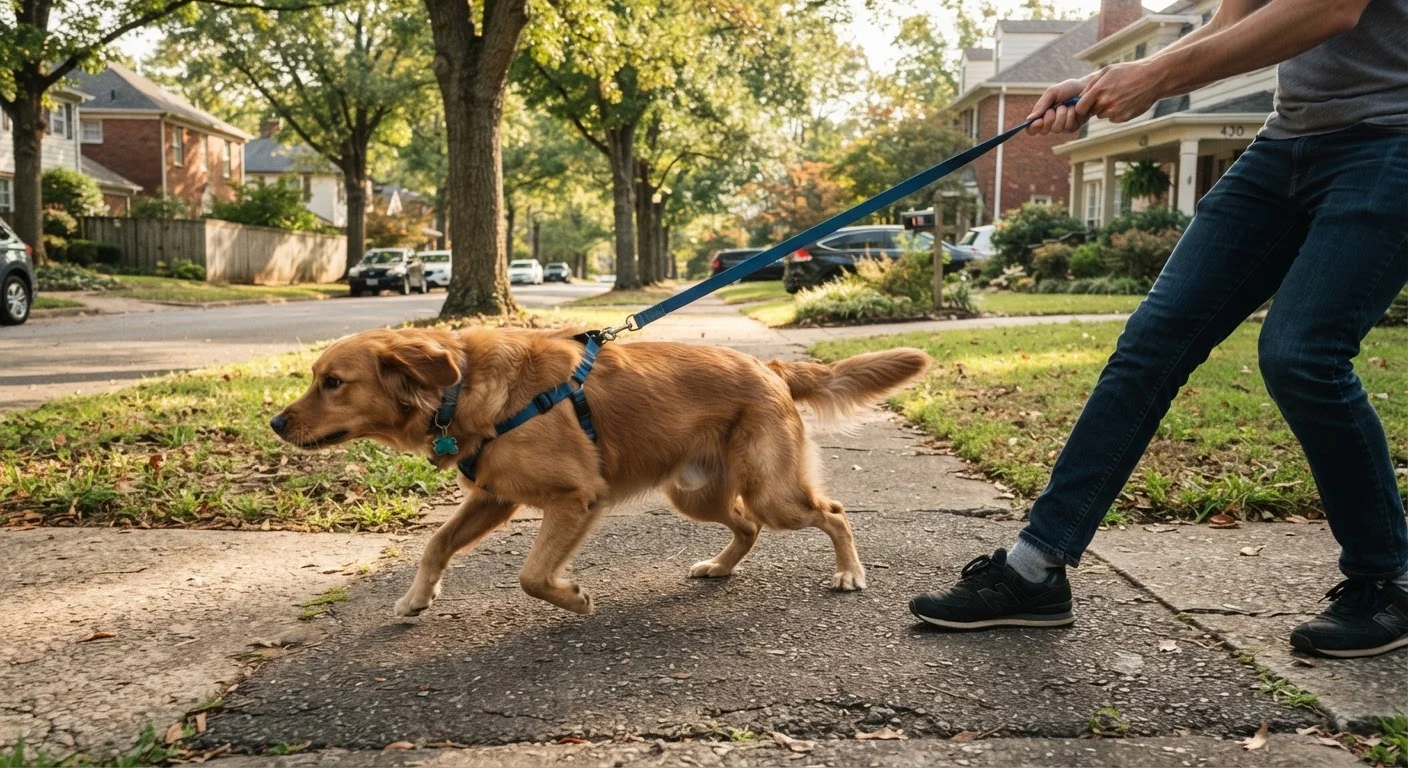
When a dog hits the end of the leash and strains forward, most owners assume they're dealing with a willful, poorly trained animal. The reality is far less dramatic — and far more grounded in biology.
Dogs experience the world primarily through scent. A single fire hydrant or patch of grass holds layered olfactory information: which animals passed by, when, and their rough physiological state. To a dog, that data is urgent and compelling. The walk is not exercise in the human sense; it is an information-gathering expedition. Forward movement is how they access it.
Added to this is a phenomenon called opposition reflex — a natural tendency in many mammals to push or pull against pressure applied to their body. When a leash tightens, the instinctive response is often to pull harder in the same direction, not to stop. This reflex alone explains why yanking back rarely produces a calmer walk.
Opposition Reflex Is Not a Training Failure
The opposition reflex — the tendency to push against pressure — is a physiological response, not willful defiance. Understanding this helps owners avoid interpreting normal canine reactions as stubbornness. It also explains why simply pulling back on the leash rarely produces the calm walking behavior owners want.
Why Pulling Gets Reinforced — Often by Accident
Behavior that produces a desired outcome is repeated. This is one of the most fundamental principles in behavioral science, and it explains why leash pulling persists in dogs who have been corrected for it hundreds of times.
Here's the mechanics: the dog pulls forward, the handler follows, and the dog reaches the smell, the dog, or the patch of grass it was targeting. From the dog's perspective, pulling worked. The behavior has been reinforced — not by the owner's intention, but by the outcome. Over hundreds of walks, that association becomes deeply ingrained.
This cycle is why reward-based training methods emphasize teaching the dog what to do instead of simply punishing what not to do. Suppressing a behavior without replacing it leaves the dog without a clear alternative — and the drive to pull doesn't disappear just because pulling causes discomfort.
#1
Most common owner-reported dog behavior problem
Leash pulling consistently ranks as the top behavior complaint in surveys of dog owners conducted by veterinary and training organizations.
~80%
Dogs not receiving formal obedience training
Estimates from veterinary behavior literature suggest the majority of pet dogs in the U.S. have not completed a structured training program, leaving leash manners largely untrained.
4–6 weeks
Typical initial progress window with consistent training
Behavioral professionals generally note that owners who apply loose-leash training consistently and correctly begin seeing measurable improvement within this window, though full reliability takes considerably longer.
What's Actually Going On in the Dog's Brain
It helps to understand the role of arousal. When a dog encounters a novel scent, another animal, or an exciting environment, its sympathetic nervous system activates — heart rate increases, attention narrows, and impulsive behavior becomes more likely. This is not disobedience; it is neurological reality.
High-arousal states make it genuinely difficult for dogs to respond to cues they know perfectly well in a calm environment. A dog that sits reliably in the living room may appear to forget that skill entirely on a busy street. This is not selective compliance — it reflects how arousal affects cognition and behavioral flexibility.
Understanding this helps owners reframe frustration. The dog is not ignoring you out of spite. It is experiencing a level of stimulation that temporarily overrides trained responses. This is also why viral training shortcuts so often fail — they underestimate the neurological complexity of what's happening on a walk.
Principles of Addressing Pulling Humanely
Effective loose-leash walking training rests on a few consistent principles rather than any single technique. First, the environment matters enormously. Training in low-distraction areas first — then gradually increasing stimulation — mirrors how behavioral change actually works. Expecting a dog to walk calmly through a crowded dog park before it can do so on a quiet street is setting both owner and dog up for failure.
Second, consistency is non-negotiable. If pulling is sometimes tolerated and sometimes corrected, the behavior is placed on a variable reinforcement schedule — which, paradoxically, makes it more persistent, not less. Every member of the household must respond the same way.
Third, the dog needs to be taught an explicit alternative — typically, walking with a loose leash or orienting toward the handler — and rewarded reliably for it. This takes repetition measured in weeks and months, not days. Behavioral change in dogs, as in humans, is gradual.
For dogs whose pulling is accompanied by reactivity, anxiety, or other behavioral concerns, working with a certified professional trainer or veterinary behaviorist is advisable. Dogs showing broader behavioral challenges — including signs of anxiety beyond the walk — often benefit from a more comprehensive behavioral assessment rather than leash training alone.
Start Training Where the Dog Can Succeed
Begin loose-leash training in the lowest-distraction environment available — indoors or in a quiet yard — before moving to the street or park. Building the behavior where the dog can focus makes it far more likely to transfer to harder environments over time. Skipping this step is one of the most common reasons progress stalls.
This article is for general informational purposes only and does not constitute professional veterinary or behavioral advice. Consult a certified trainer or veterinary behaviorist for guidance specific to your dog's needs.
Frequently Asked Questions
No. Pulling is a normal canine behavior driven by curiosity and instinct, not a power struggle. Dogs have no concept of dominance over their human in the way popular culture suggests. It simply means the dog has learned that pulling gets them where they want to go.
Highly stimulating environments — parks, busy streets, areas with strong animal scents — amplify a dog's natural urge to move forward quickly. The stronger the environmental pull, the harder it is for the dog to self-regulate. This is a normal response to sensory overload, not misbehavior.
Yes. While habits formed over years take longer to change, adult and senior dogs are fully capable of learning new leash manners through consistent positive reinforcement. The process may require more repetitions than with a young puppy, but it is absolutely achievable.
No-pull harnesses can reduce the physical force of pulling and make walks more manageable, but they do not teach the dog an alternative behavior. They work best as a management tool used alongside structured training, not as a standalone solution.
Timelines vary widely depending on the dog's age, breed, history, and how consistently training is applied. Some dogs make noticeable progress in a few weeks; others require months of patient work. There is no universal timeline, and outcomes cannot be guaranteed.
Correction-based tools like choke chains and prong collars apply discomfort to suppress pulling, but research increasingly points to risks including physical injury and increased anxiety. The current scientific consensus favors reward-based methods. Always consult a certified professional before using any aversive equipment.
The content on this site is for informational purposes only and is not a substitute for professional advice. Always consult a qualified professional for guidance specific to your situation.