

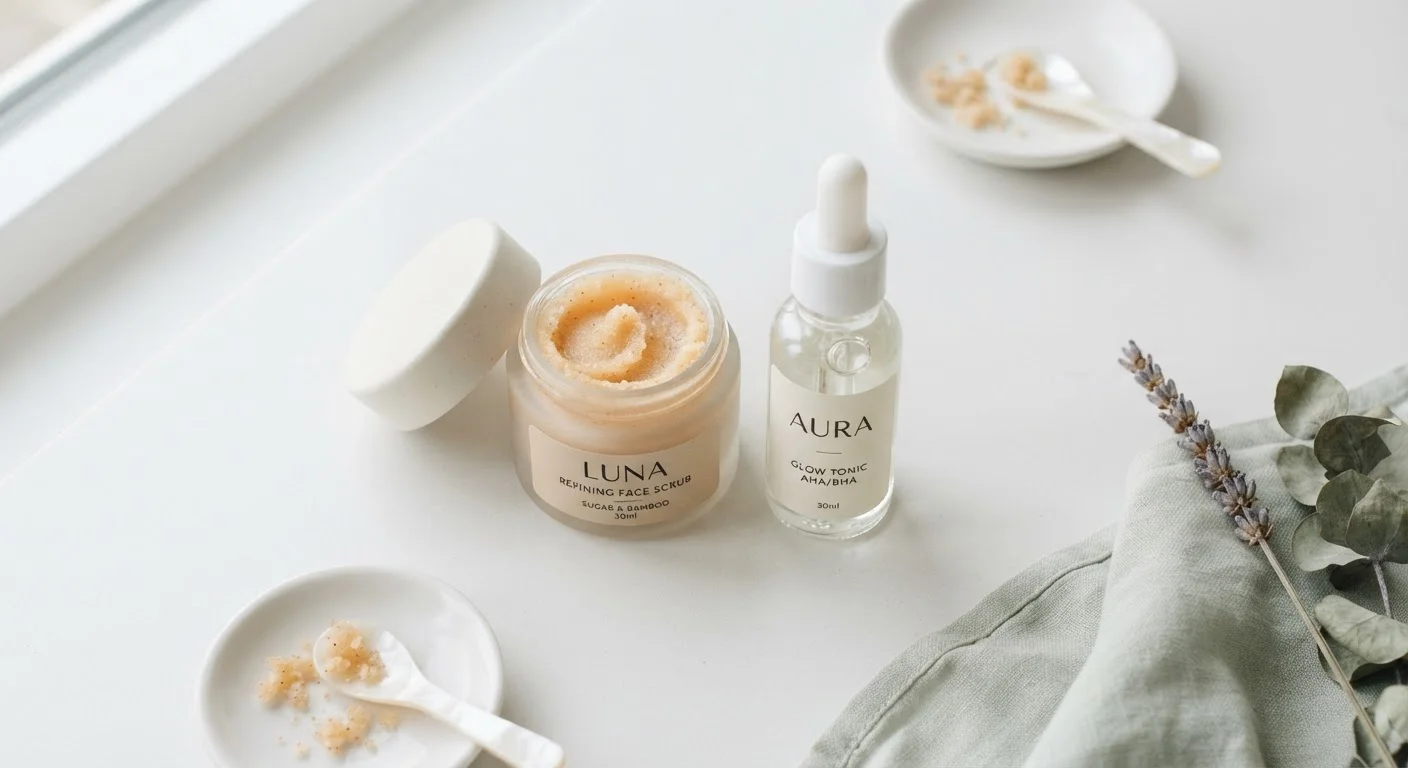
Option A
Chemical Exfoliants
The science-backed, skin-dissolving approach.
Best for: Best for those dealing with uneven tone, clogged pores, or sensitivity who want consistent, controlled exfoliation.
Option B
Physical Scrubs
The hands-on, instant-gratification classic.
Best for: Best for those with normal to oily skin who prefer a tactile cleansing experience and immediate smoothness.
How Each Method Actually Works
Exfoliation is about removing dead skin cells that accumulate on the surface — but the two main methods go about it in very different ways. Understanding the mechanism helps you pick the right tool for the job.
Physical scrubs work mechanically. They contain abrasive particles — think sugar granules, ground oat husks, or synthetic microbeads (now largely banned in the U.S. due to environmental concerns) — that physically dislodge dead cells when you massage the product across your face. The result is immediate: skin tends to feel smoother right away. The downside is that the friction is hard to control precisely, and scrubbing too hard can create small tears in the skin surface, especially on thinner or more reactive complexions.
Chemical exfoliants work differently — no scrubbing required. They use acids or enzymes to break the bonds that hold dead skin cells to the surface, allowing them to shed more naturally. The most common types are AHAs (alpha hydroxy acids) like glycolic, lactic, and mandelic acid, which work on the skin's surface; and BHAs (beta hydroxy acids) like salicylic acid, which are oil-soluble and can penetrate deeper into the pore. If you're new to these terms, our skincare terms glossary breaks them all down in plain language.
| Criterion | Chemical Exfoliants | Physical Scrubs |
|---|---|---|
| How it works | Acids/enzymes dissolve dead cell bonds | Abrasive particles manually buff skin |
| Common ingredients | AHAs, BHAs, PHAs, fruit enzymes | Sugar, salt, ground seeds, oat husks |
| Results timeline | Gradual improvement over days/weeks | Immediate surface smoothness |
| Sensitive skin suitability | Generally good at low concentrations | Risk of irritation with friction |
| Pore-clearing ability | High (especially BHAs) | Surface-level only |
| Risk of over-exfoliation | Moderate if overused or stacked | Higher with aggressive pressure |
| Sun sensitivity increase | Yes — especially with AHAs | No |
| Ease of use | Requires reading concentrations/timing | Intuitive; apply and rinse |
Matching the Method to Your Skin Type
Neither approach is universally better — your skin type is the most important variable. If you're not sure which type you have, it's worth reading our guide on what your skin type really means for your routine before diving into exfoliation.
Oily and acne-prone skin tends to respond well to BHAs, which cut through excess sebum and help keep pores clearer. AHAs can also help with post-blemish marks over time. Physical scrubs can be used on oily skin but should be chosen carefully — coarser particles or excessive pressure can aggravate active breakouts.
Dry and flaky skin can benefit from lactic acid, a gentler AHA that also has mild humectant (moisture-attracting) properties. Physical scrubs may feel satisfying on flaky patches, but if the skin barrier is already compromised, abrasion can worsen dryness.
Sensitive skin generally fares better with chemical exfoliants at low concentrations, or PHAs — the gentlest chemical exfoliant category. If you're building a routine around actives for the first time, our piece on introducing actives safely to sensitive skin is a practical starting point.
~30 days
Skin cell turnover cycle
The skin naturally sheds and renews its outer layer roughly every four weeks; exfoliation helps facilitate this process when it slows with age.
2–3×
Max recommended exfoliation frequency per week
Dermatologists generally advise limiting exfoliation to a few times per week to avoid compromising the skin's protective barrier.
~70%
Glycolic acid skin penetration advantage over lactic acid
Glycolic acid has the smallest molecular size among common AHAs, allowing deeper surface penetration — though this also makes it more likely to irritate sensitive skin.
Frequency, Safety, and What Over-Exfoliating Looks Like
One of the most common skincare mistakes is exfoliating too often. More is not more here — both physical and chemical exfoliation disrupt the skin's surface, and the barrier needs time to recover and regenerate between sessions.
For most skin types, one to three times per week is a reasonable range for either method — though individual tolerance varies widely. Signs you may be overdoing it include persistent redness, increased sensitivity, a tight or stinging sensation, breakouts in areas that are normally clear, or skin that looks shiny in an irritated rather than healthy way.
It's also worth noting that you generally shouldn't combine both methods in the same session. Using a physical scrub followed immediately by a chemical exfoliant — or vice versa — compounds the disruption to the skin barrier and increases the likelihood of irritation. Choose one approach per session, and if you want to incorporate both into your weekly routine, alternate them on separate days.
Sun sensitivity is a genuine consideration with AHAs in particular: they can increase the skin's sensitivity to UV exposure, which is why applying SPF in the morning is especially important on days you use them. This isn't a reason to avoid AHAs, but it's a practical step that shouldn't be skipped.
This article is for general informational purposes only and is not a substitute for personalised advice from a dermatologist or licensed skincare professional. If you have a skin condition or significant skin concerns, consult a qualified healthcare provider before introducing new exfoliating ingredients.
The content on this site is for informational purposes only and is not a substitute for professional advice. Always consult a qualified professional for guidance specific to your situation.