

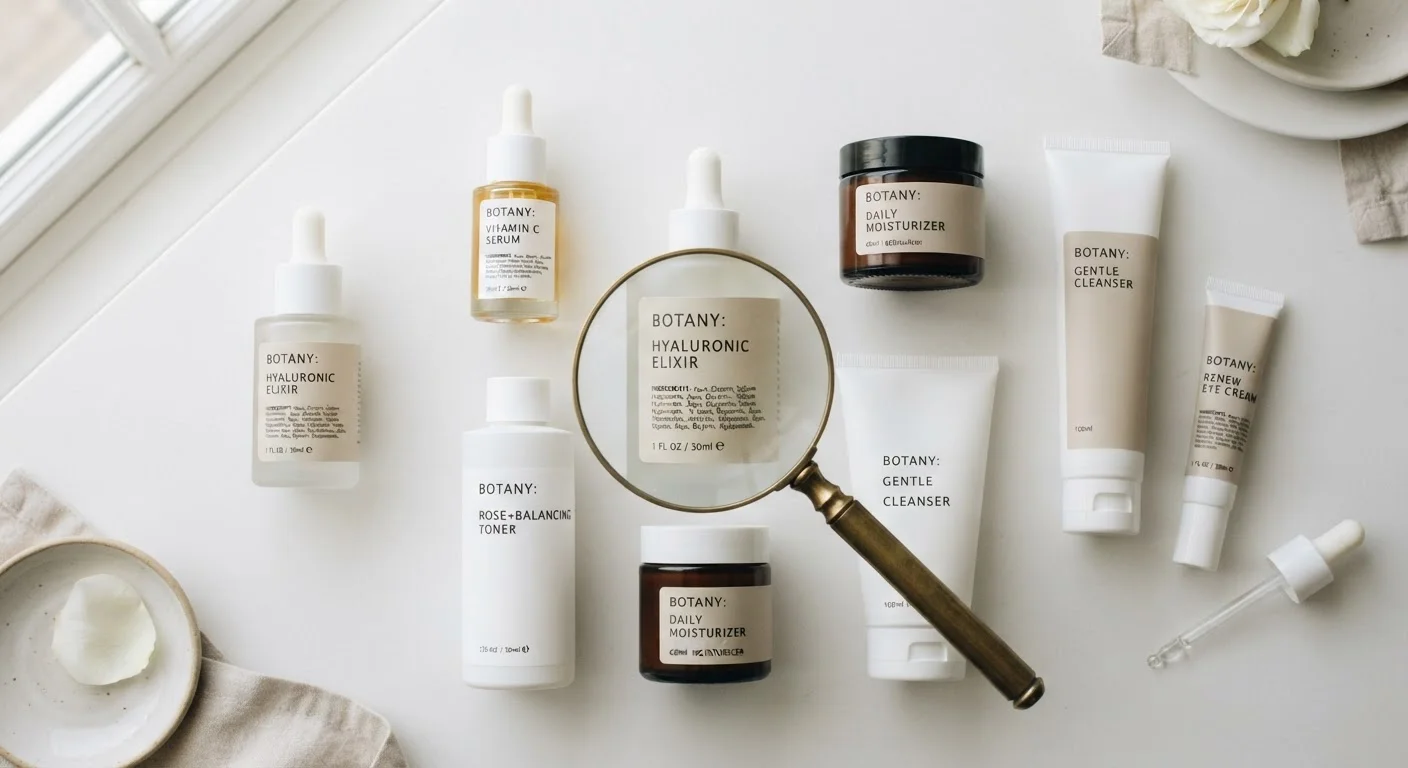
Why the Ingredients List Is Your Most Honest Source
The front of a skincare package is pure marketing. Words like "revitalizing," "youth-boosting," or "clinically proven" are crafted to attract attention, not to inform you. Flip the bottle over, and the INCI ingredients list — required by U.S. law on all cosmetics — is where the real story lives.
Reading it doesn't require a chemistry degree. Once you understand a few basic rules, you can quickly gauge whether a product is likely to deliver on its claims and whether it contains anything your skin tends to dislike. For a broader reference on the terms you'll encounter, our skincare terms glossary is a handy companion to keep nearby.
11+
Skincare products the average American uses daily
Environmental Working Group survey data has consistently found that Americans use multiple personal care products each day, adding up to significant cumulative ingredient exposure.
1%
Threshold below which ingredient order is flexible
U.S. and EU cosmetics regulations allow ingredients present at or below 1% concentration to be listed in any order after higher-concentration ingredients.
The Concentration Rule: Position Tells a Story
The single most useful thing to understand is that ingredients are listed in descending order of concentration — from most to least. The first three to five ingredients typically make up the vast majority of a formula. If water (aqua) is first, the product is water-based. If a plant oil leads, you're holding an oil-heavy formula.
Here's where it gets nuanced: once you drop below roughly 1% concentration, manufacturers may list the remaining ingredients in any order. This means that a celebrated active — say, a peptide or a botanical extract — appearing near the end of a list isn't necessarily ineffective. Some actives do meaningful work at concentrations well under 1%. Others, like vitamin C (ascorbic acid), generally need to be present at higher levels to show results. Knowing which is which requires a bit of research on the specific ingredient.
A Quick Patch-Test Habit Worth Building
Before applying any new product to your face, try it on a small area — like the inside of your wrist or behind your ear — for a day or two. This simple step can flag potential sensitivities before they affect a larger area. It's especially useful when you're trying a formula with a long or unfamiliar ingredients list.
Decoding INCI Names: Common Culprits and Heroes
INCI names can look intimidating but they follow patterns. Here are a few worth knowing:
- Aqua / Water — the base of most water-based products; its presence isn't a quality concern.
- Glycerin — a widely used humectant that draws moisture to the skin; generally well-tolerated.
- Niacinamide — a form of vitamin B3, studied for its role in supporting skin tone and barrier function.
- Tocopherol — vitamin E, often used as an antioxidant and skin-conditioning agent.
- Cetearyl Alcohol — a fatty alcohol (not the drying kind) that acts as an emulsifier and texture agent.
- Phenoxyethanol — a common preservative that keeps products safe from microbial growth.
- Parfum / Fragrance — a blanket term for a scent blend; worth noting if your skin is reactive.
For deeper dives into specific actives, our article on retinol and who it suits is a good example of how one ingredient deserves its own conversation.
Marketing Language vs. Regulated Claims
U.S. regulations draw a clear line between cosmetics and drugs. A cosmetic can only claim to affect appearance — it cannot legally claim to change the structure or function of the skin. Terms like "firms," "hydrates," and "brightens" are cosmetic claims. Terms like "treats acne" or "repairs skin" move into drug territory and trigger stricter FDA oversight.
Words like "natural," "clean," "non-toxic," and "organic" have no standardized regulatory definition in the U.S. cosmetics space ("certified organic" ingredients may follow USDA standards, but the product label as a whole is not regulated the same way food is). These terms reflect brand positioning, not a safety guarantee. The only way to assess a product honestly is to look at the actual ingredients.
Cosmetics vs. Drugs: A Meaningful Distinction
In the U.S., the FDA regulates cosmetics and drugs under different frameworks. If a product claims to treat, cure, or prevent a condition (like acne medication), it may be classified as a drug and subject to stricter ingredient and labeling requirements. Over-the-counter drug products — like sunscreens and acne treatments — carry a "Drug Facts" panel rather than a standard cosmetics ingredients list.
Once you're comfortable reading labels, pairing that knowledge with an understanding of your skin type makes your routine even more targeted. Our explainer on what your skin type means for your routine is a natural next step.
Frequently Asked Questions
Yes, order reflects concentration. Ingredients at the top make up the bulk of the product. However, some active ingredients are effective at very low percentages, so their position near the bottom doesn't automatically mean they're ineffective — it depends on the ingredient.
Fragrance is a catch-all term that can represent a blend of dozens of undisclosed compounds. This is worth noting if you have sensitive or reactive skin, since fragrance is one of the more common skin sensitizers. Fragrance-free options are widely available.
Not necessarily. 'Natural' and 'clean' are unregulated marketing terms with no standardized meaning in the U.S. Some natural ingredients (like essential oils) can cause irritation, while some synthetic ingredients are well-studied and gentle. What matters more is the specific ingredient profile and how your own skin responds.
Free resources like the CosIng database (maintained by the European Commission) and the U.S. FDA's ingredient reference pages list INCI names alongside their common names and functions. A quick search of the INCI name plus 'function' usually surfaces reliable information fast.
Not at all. A longer list isn't inherently a red flag — it may simply reflect a complex, well-formulated product. What matters is whether the individual ingredients suit your skin type and concerns, not the total count.
The content on this site is for informational purposes only and is not a substitute for professional advice. Always consult a qualified professional for guidance specific to your situation.