

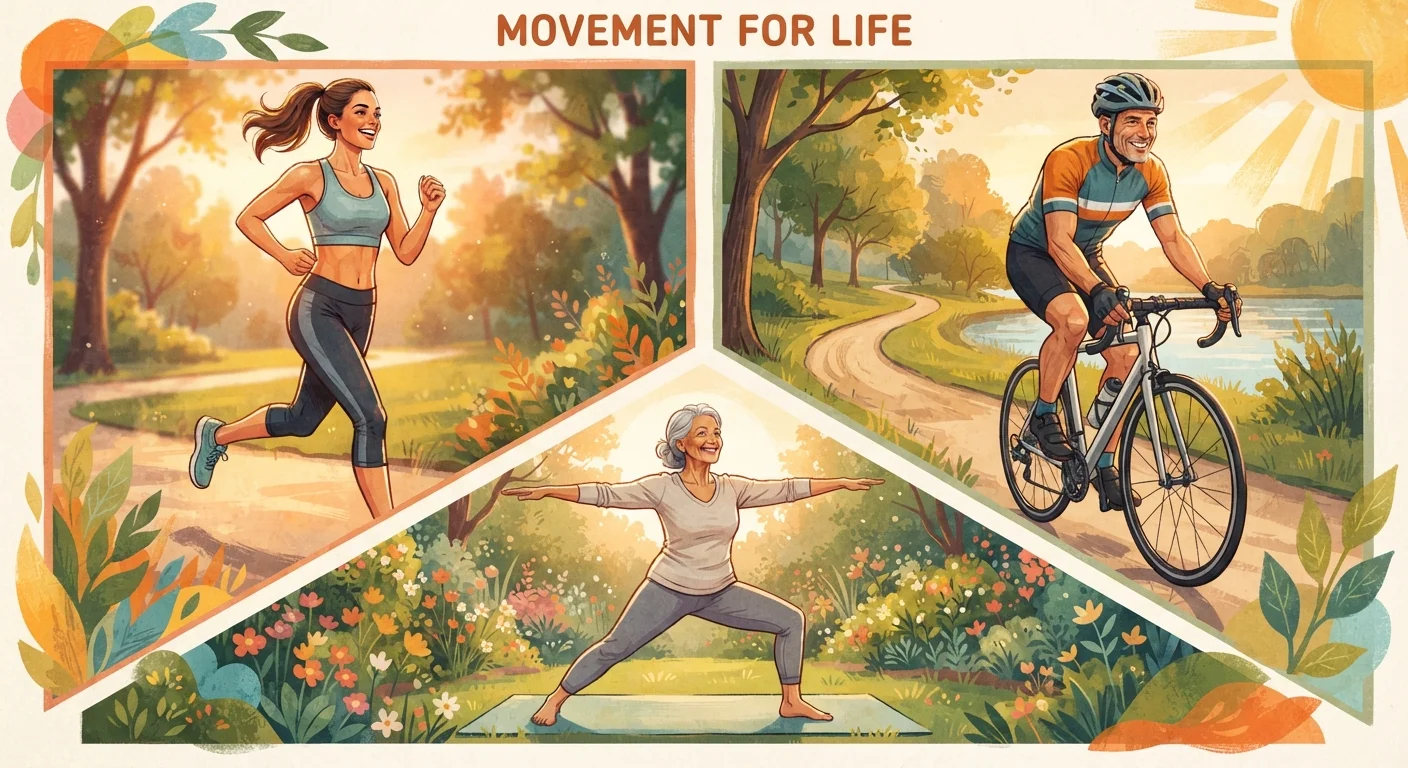
Why Exercise Needs Change With Age
Physical activity is one of the most consistently supported factors in long-term health - but the type, intensity, and focus of that activity should evolve as your body does. What serves you well at 25 may not be the most effective - or even the safest - approach at 55.
Several physiological shifts drive these changes. Muscle mass naturally declines after about age 30, a process called sarcopenia, which accelerates if not actively countered. Bone density peaks in early adulthood and then gradually decreases. Joints accumulate wear. Recovery time between hard efforts tends to lengthen. Hormonal changes - particularly around menopause and andropause - further affect how the body builds and maintains muscle.
Understanding these changes isn't cause for alarm. It's a prompt to be intentional. The good news is that the body remains remarkably responsive to physical activity throughout life, even into the 80s and 90s.
150 min
Recommended weekly moderate aerobic activity for adults
Per the U.S. Department of Health and Human Services' Physical Activity Guidelines for Americans.
~3-8%
Muscle mass lost per decade after age 30 without intervention
According to research on sarcopenia published in peer-reviewed gerontology literature.
36 million
Falls reported among U.S. adults aged 65+ annually
According to the U.S. Centers for Disease Control and Prevention (CDC) fall data.
Your 20s and 30s: Building a Foundation
These decades represent a physiological window of peak capacity. Cardiovascular fitness, muscle-building response, and bone density are all at or near their highest points. This makes early adulthood an ideal time to establish habits that will pay dividends for decades.
The U.S. Department of Health and Human Services' Physical Activity Guidelines for Americans recommends at least 150 minutes of moderate-intensity aerobic activity per week (or 75 minutes of vigorous activity), plus muscle-strengthening activities on two or more days per week - guidance that applies to most healthy adults across age groups.
In your 20s and 30s, the emphasis might naturally skew toward aerobic fitness and strength - running, cycling, team sports, resistance training. These are worthwhile pursuits. However, two areas often neglected at this stage - flexibility and injury prevention - matter more than most young adults realize.
In your 20s and 30s, invest in learning proper movement mechanics - squat form, hinge patterns, overhead positioning - even before loading up with weight. Poor form compounds over decades into chronic pain.
Biomechanical inefficiencies that feel harmless at 28 often manifest as persistent injuries by the mid-40s. Early correction is far easier than rehabilitation.
Add at least one dedicated mobility or flexibility session per week in your 30s, even if it feels unnecessary. This habit becomes dramatically harder to establish later when stiffness has already set in.
Flexibility declines gradually and often imperceptibly until it limits daily function - proactive investment pays off in both athletic performance and everyday comfort.
For those navigating packed schedules, see our guide to building a sustainable exercise habit for realistic strategies that don't require overhauling your routine.
Your 40s and 50s: Adapting to Shifting Physiology
The 40s and 50s are often when people first notice that their body doesn't respond to exercise quite the way it used to. Recovery takes longer. Injuries linger. Weight management may feel harder despite similar effort. These changes are real - and they call for a recalibrated approach, not retreat.
Strength training becomes especially critical in this window. Research consistently shows that resistance exercise can slow - and in some cases partially reverse - age-related muscle loss. Aim to include it at least twice weekly, focusing on compound movements that engage multiple muscle groups.
Don't Push Through Joint Pain
Discomfort during exercise is common, but sharp, persistent, or swelling-related joint pain is not something to work through. In your 40s and 50s, tendons and cartilage recover more slowly than in younger years. Ignoring pain signals in this stage can turn minor issues into chronic injuries. Consult a physical therapist or sports medicine physician if pain persists beyond a few days.
Hormonal shifts in this stage - declining estrogen in women and gradually declining testosterone in men - affect body composition, bone density, and cardiovascular risk profiles. This makes both strength and cardiovascular exercise complementary priorities rather than competing ones.
Many people in their 40s and 50s also benefit from paying closer attention to recovery: sleep quality, post-exercise nutrition, and programming rest days intentionally. Physical activity at this stage is less about peak performance and more about sustained capacity.
Exercise and mental wellness are closely intertwined across adulthood. Our companion guide on mental wellness across the lifespan explores how emotional needs evolve alongside physical ones.
60s and Beyond: Prioritizing Function and Independence
For adults in their 60s and older, the goals of physical activity shift meaningfully toward maintaining functional independence, reducing fall risk, and supporting quality of life. This doesn't mean light effort only - many older adults safely engage in vigorous activity - but it does mean the composition of a fitness routine often needs to broaden.
Balance training becomes a genuine priority. Falls are a leading cause of injury among older adults in the U.S., and exercises that challenge stability - such as single-leg standing, tai chi, or certain yoga poses - have solid evidence supporting their role in fall prevention.
Start With a Simple Balance Test
Try standing on one foot for 10 seconds with your eyes open, then closed. If you struggle, balance training deserves a prominent place in your routine. Simple daily practices like standing on one leg while brushing your teeth can meaningfully improve stability over time.
Flexibility and mobility work also deserve more attention in this stage. Range of motion tends to decline with age, affecting everyday activities from bending to reach something on a low shelf to turning the neck while driving. Gentle stretching, yoga, or Pilates can help preserve and even restore functional movement.
Aerobic activity remains important for heart health and cognitive function. Walking remains one of the most accessible and well-studied forms of exercise for older adults, requiring no equipment and adaptable to most fitness levels. Strength training continues to matter for bone health and fall prevention.
Older adults with chronic conditions, recent surgeries, or mobility limitations should consult a healthcare provider or physical therapist before starting or significantly changing an exercise program.
General Principles That Apply at Every Age
Despite the real differences between life stages, several principles hold true across the board:
- Consistency outweighs intensity. A moderate routine sustained over years produces far greater health benefits than intermittent intense effort.
- Some movement is always better than none. Even short bouts of activity - a 10-minute walk, a few minutes of stretching - contribute meaningfully to overall health.
- Listen to your body. Pain that persists or is sharp, joint swelling, or unusual fatigue are signals to pause and consult a professional.
- Variety reduces injury and boredom. Mixing cardio, strength, flexibility, and balance work covers more physiological bases and sustains motivation.
Physical activity is not a one-size-fits-all prescription. It is a lifelong relationship between you and your body - one that benefits from regular reassessment and, when appropriate, professional guidance.
“Exercise is the closest thing we have to a wonder drug. At every age, it reduces risk for dozens of chronic diseases, improves mood, sharpens the mind, and extends healthy life - but only if it's appropriate for where you are right now.”
— Dr. I-Min Lee, Professor of Medicine, Harvard Medical School, and leading researcher in physical activity and health
This article provides general health information and education only. It is not a substitute for personalized medical advice. Consult a qualified healthcare professional before making significant changes to your exercise routine, especially if you have any health conditions or concerns.
The content on this site is for informational purposes only and is not a substitute for professional advice. Always consult a qualified professional for guidance specific to your situation.