

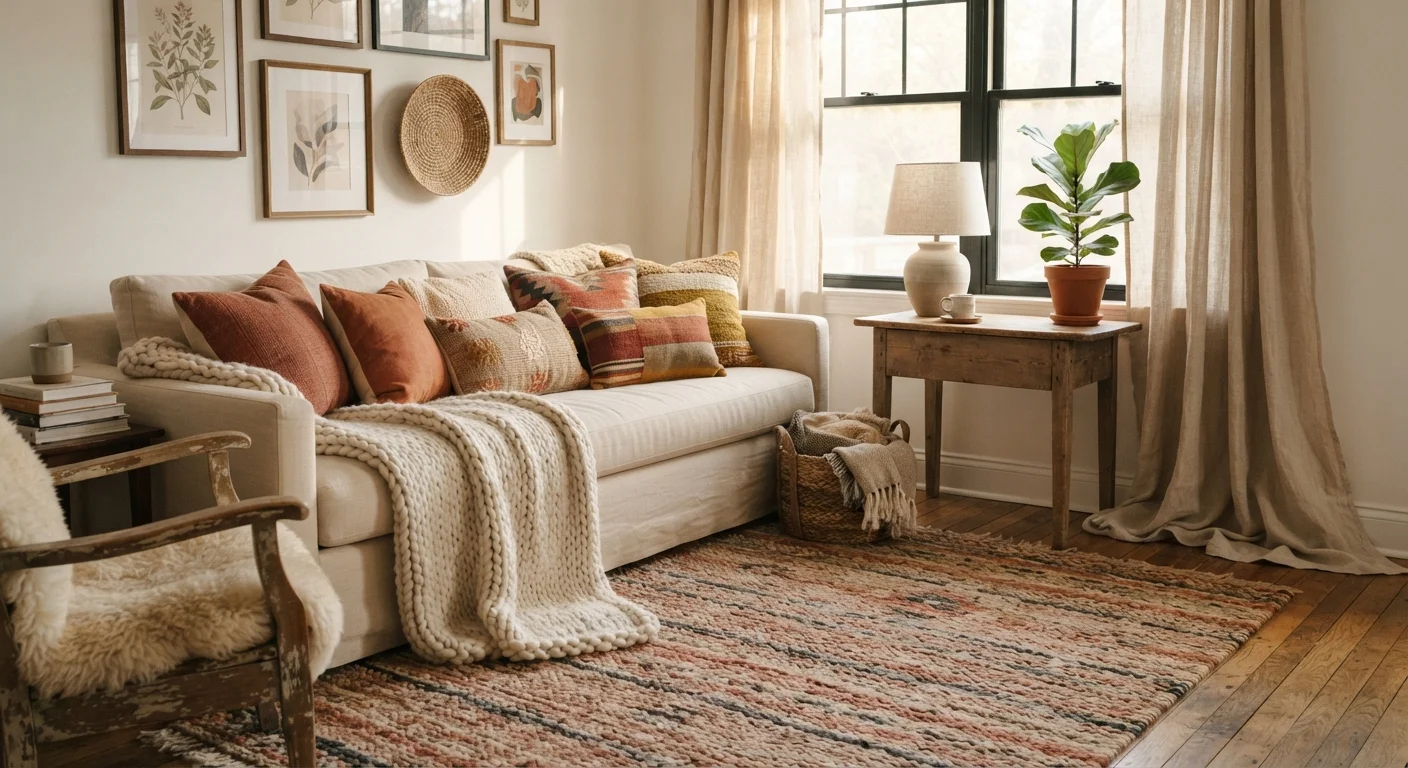
Why Textiles Shape a Room More Than You Might Expect
Most decorating conversations focus on paint colors, furniture layout, and lighting — all important, but none of them as immediately swappable as textiles. Rugs, curtains, throw pillows, and blankets work on multiple levels simultaneously: they affect how sound moves through a space, how warm or cool a room feels physically and visually, and how the eye travels across a composition.
Hard surfaces — bare hardwood, tile, concrete — reflect sound waves, creating an echo that makes a room feel cold and unsettled even when the temperature is comfortable. Soft surfaces absorb those waves. A single large area rug and fabric window panels can reduce reverberation noticeably in a typical living room. This acoustic effect is one reason rooms with ample textiles tend to feel more calming and livable — an effect that connects home environment to everyday wellbeing. See the Mental Wellness hub for more on how environment can support daily wellbeing.
Textiles also carry the practical advantage of being entirely non-permanent. You don't need permits, tools beyond a measuring tape, or professional help for most textile updates. That accessibility makes them the highest-leverage starting point for anyone looking to improve a room — regardless of budget or whether they rent or own.
What you will need
What You'll Need Before You Start
Before selecting any textile, gather basic information about the space. Know the room's floor dimensions and your window measurements, and have a sense of the existing color palette and how the room currently feels underfoot and acoustically. Armed with those specifics, the steps below will help you make textile choices that work together rather than competing.
Measuring tape
Accurately measure floor space and windows before selecting rugs or curtains.
Rug pad
Keeps rugs in place on hard floors and adds an extra layer of cushioning underfoot.
Curtain rod and hardware
Supports panels and determines hang height, which affects perceived ceiling height.
Fabric swatches or color samples
Allows you to test how a textile reads in your room's light before committing.
It's worth reading through Decorating Myths That Waste Money before you shop — several common assumptions about scale and matching can lead to purchases you'll regret.
Assess what your room is currently missing
Stand in the room and note how it feels rather than just how it looks. Does sound bounce sharply off hard surfaces? Does it feel cold and uninviting despite adequate furniture? Is there no visual anchor drawing the eye to a central point? Each of these is a textile problem with a textile solution. Hard floors echo; rugs absorb. Bare windows feel harsh; curtains soften. A sofa without throws or pillows feels utilitarian. Identifying the specific gap prevents you from over-buying.
If you're struggling to pinpoint what feels wrong, the article The Room Feels Off walks through common decorating errors that are easy to miss.
Choose and place your area rug
The area rug is typically the most impactful single textile in a room. It defines a zone, adds acoustic absorption, and anchors the furniture arrangement. For a living room, size up — the rug should be large enough that at minimum the front legs of the main seating pieces rest on it. For a bedroom, position the rug so it extends well past both sides and the foot of the bed.
Fiber matters for practical reasons: wool rugs are durable, naturally soil-resistant, and regulate temperature well; synthetic fibers like polypropylene tolerate moisture and heavy traffic; natural fibers like jute add texture but can be harder to clean in high-spill areas. Pair your rug choice with a quality non-slip pad. For context on how permanent flooring beneath affects your choices, see Flooring Options for Every Room.
Hang curtains at the right height and width
Curtain placement has an outsized effect on perceived ceiling height and window size. Hang the rod as close to the ceiling as practical — not directly above the window frame — and extend it 6 to 12 inches beyond the window on each side. This makes windows appear larger and ceilings taller without any structural change.
Fabric weight shapes the mood: light linen or sheer cotton lets in diffused light and feels airy; heavy velvet or blackout-lined panels feel substantial and reduce heat transfer. Length matters too — panels that just skim the floor read as tailored; those that pool slightly feel luxurious. Avoid panels that stop at the sill or mid-wall, which can make ceilings feel lower.
Layer throw pillows and blankets intentionally
Throw pillows and blankets are not afterthoughts — they are the final layer of texture that makes a seating area feel complete. A sofa typically reads well with an odd number of pillows (three or five), varying in size from larger backing pillows to a smaller accent. Avoid matching sets that came pre-packaged; mixing patterns and materials within a shared color story looks more considered.
[tip_callout]
A folded throw draped over an armrest or the back corner of a sofa adds warmth visually and physically. Choose materials that suit the season and climate — cotton gauze for warmer months, chunky knit or fleece for winter. Color temperature plays a role here too: warmer-toned textiles read as cozier, while cooler linens and light weaves feel breezy. For more on how color temperature shapes a room's atmosphere, see Warm vs. Cool Color Palettes.
Review the full room and adjust for balance
Once your key textiles are in place, step back and evaluate the room as a whole. Visual weight should be distributed — if the rug and curtains are both dark and heavy, lighter throws or pillows can balance the composition. If everything is soft and pale, a deeper-toned rug or patterned pillow adds grounding. Sound-wise, a room with a large rug, fabric curtains, and upholstered seating will already feel noticeably quieter and more intimate than the same room with bare floors and bare windows.
[important_callout]
Textiles work alongside other non-permanent elements. Houseplants contribute texture and organic scale that complements soft furnishings well. Adjust, swap, and rotate textiles seasonally — the ability to change the feel of a room without touching the walls is exactly what makes textile choices such a practical decorating tool.
Troubleshooting Common Textile Missteps
Even well-chosen textiles can underperform if placed incorrectly or combined carelessly. Here are the issues that come up most often:
- Rug too small: The furniture appears to float, and the room lacks a visual center. Measure before purchasing — always. See the callout above for sizing guidance.
- Curtains hung too low or too narrow: This compresses the room visually, making ceilings feel lower and windows feel smaller. Rehang the rod higher and wider.
- Too many competing patterns: If every textile has a bold print, the room reads as chaotic. A useful rule of thumb is one statement pattern, one subtle secondary pattern, and at least one solid.
- Textiles that ignore the season: Heavy wool and velvet in summer, or light gauze in a cold drafty room, creates a mismatch between visual warmth and physical comfort. Swap key pieces seasonally.
Rugs on Stairs Require Non-Slip Backing
If you place a runner rug on stairs or a loose rug near a high-traffic threshold, always use a non-slip rug pad underneath. Unsecured rugs on hard floors or stairs are a leading cause of household slips and falls. Check that your rug pad is sized correctly and replace it when it loses grip.
Addressing these missteps doesn't require starting over — often, repositioning or swapping a single piece resolves the imbalance.
The content on this site is for informational purposes only and is not a substitute for professional advice. Always consult a qualified professional for guidance specific to your situation.