

Why Decorating Myths Are So Persistent - and Costly
Decorating advice spreads quickly, especially when it sounds like common sense. Rules like "match your wood tones" or "keep small rooms light" get passed along so often that most people treat them as fact. The problem is that many of these rules are oversimplifications, and following them without question can lead you to spend more money, make timid choices, and end up with rooms that feel safe but lifeless.
Understanding why a supposed rule exists - and when it actually doesn't apply - is far more valuable than memorizing a list of dos and don'ts. This is especially true before you start spending. If you haven't already, working through a pre-decorating planning checklist can help you identify which constraints are real and which are just inherited assumptions.
Myth
All furniture in a room should match or come from the same collection.
Fact
Rooms with exclusively matched sets often look flat and showroom-generic. Intentional mixing of styles, materials, and eras creates depth and personality.
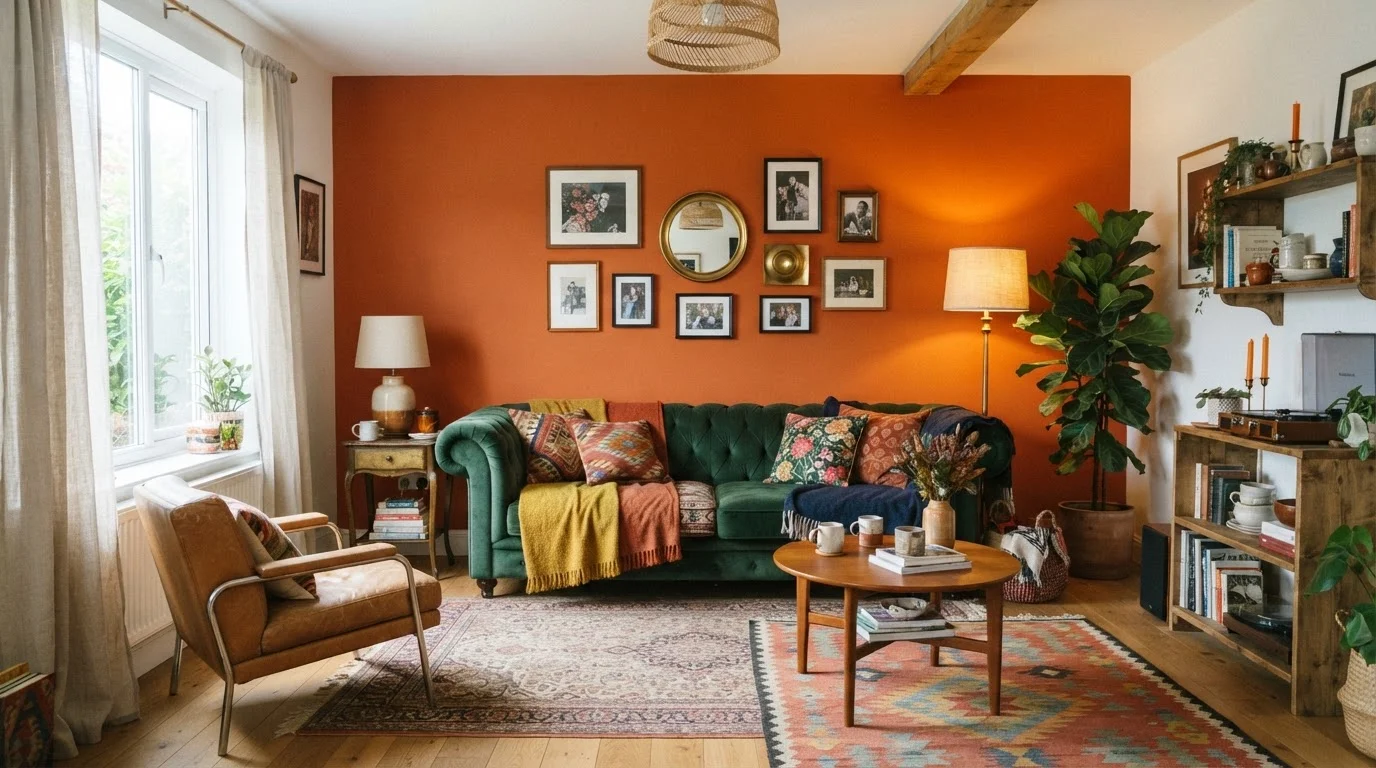
Furniture collections exist for convenience, not design excellence. When every piece shares the same finish, leg style, and proportion, the eye has nothing interesting to travel across. Interior designers routinely combine pieces from different periods and sources - the cohesion comes from a shared color palette or repeating material, not identical origins. The goal is harmony, not uniformity. A vintage side table next to a modern sofa works when the tones are complementary and the scale is considered. For a fuller framework on building a cohesive look deliberately, understanding interior design styles is a useful starting point.
Myth
Small rooms need small furniture to avoid feeling cramped.
Fact
Overcrowding a small room with too many small pieces can make it feel more cluttered than one or two well-scaled larger pieces would.
Scale is relative. A room filled with undersized furniture can feel chaotic and busy because the eye is drawn to too many competing elements. In many small rooms, a single sofa of the right depth - rather than two small loveseats - actually creates more usable space and visual calm. The key variables are clearance (the walkable space between pieces) and visual weight, not the absolute dimensions of individual items. Small-space decorating principles explains this trade-off in practical detail, including when going larger genuinely helps.
Myth
Neutral paint colors are always the safest, most versatile choice.
Fact
Neutrals can read as cold, dingy, or flat depending on a room's light conditions - and the 'wrong' neutral is just as much of a design problem as a strong color gone wrong.
Neutral is not a single category. Warm whites, cool grays, greige, and off-whites all behave differently under natural and artificial light. A gray that looks sophisticated in a north-facing showroom can appear bleak in a low-light apartment. More importantly, defaulting to neutral out of fear of color often produces rooms that lack atmosphere entirely. Color - used with intention - is one of the least expensive ways to give a room character. If you're considering an accent wall as a middle ground, when accent walls work and when they overwhelm covers the practical considerations thoroughly.
Myth
Expensive pieces automatically elevate a room's look.
Fact
Proportion, balance, and cohesion determine how polished a room looks - not the price tag of individual items.
A costly statement sofa placed against the wrong wall, under an undersized rug, in a room with no considered lighting, will not look expensive - it will look out of place. Conversely, thoughtfully arranged, well-proportioned pieces at modest price points can produce genuinely attractive rooms. The mistake is treating individual purchases as the lever for quality rather than attending to the room as a whole system. Budget allocation matters too: many designers suggest that lighting and rugs deserve a larger share of the budget than most consumers assign them, since both have an outsized effect on how the entire room reads.
Myth
You should decorate a room all at once for a cohesive look.
Fact
Rooms decorated gradually - adding pieces as the right ones are found - often have more personality and better cohesion than rooms filled in a single shopping trip.
The pressure to complete a room quickly leads to compromise purchases: pieces chosen because they're available rather than because they're right. These filler items rarely get replaced and end up defining the room by default. Decorating in stages, with a clear sense of the room's intended feeling and palette, allows each new addition to be evaluated against what's already working. This approach also spreads cost over time, which reduces the financial pressure that leads to poor decisions. Living with a room before finalizing it is not indecision - it is good practice.
Putting the Corrections Into Practice
Knowing that a rule is a myth is only useful if it changes how you approach a room. The most actionable shift is learning to evaluate each decision on its own terms: Does this piece serve the room's scale? Does this color work with the light in this specific space at this time of day? Does this furniture arrangement support how people actually use the room?
~66%
Homeowners who regret impulse décor purchases
A survey by Houzz found that roughly two-thirds of homeowners reported buying décor items impulsively that they later regretted, with cost and poor fit cited as the main reasons.
3x
Impact of lighting vs. paint on perceived room warmth
Lighting designers broadly note that bulb color temperature (measured in Kelvins) has a greater effect on how warm or cool a room feels than wall color alone - underscoring why lighting budget often matters more than paint choices.
Rooms that feel off often have one or two underlying issues rather than a long list of problems. If your space looks fine on paper but feels wrong in person, the common decorating missteps guide walks through the subtler culprits - things like rug size, lighting height, and furniture float that rarely get mentioned in style guides.
Textiles are another area where myths cost money. Many decorators over-purchase hard furnishings and under-invest in rugs, curtains, and throws - yet these are often what determine how a room actually feels to inhabit. For a grounded look at what fabric choices can do, the textile and soft furnishings guide covers how layering fabric affects acoustics, warmth, and visual scale.
Avoid Buying to 'Fill In' a Room Quickly
One of the most common decorating spending traps is purchasing items simply to fill empty-feeling spaces before a room feels complete. These compromise pieces rarely get replaced and can anchor a room's look in a direction you never actually wanted. If a space feels unfinished, living with it temporarily is a better outcome than filling it with pieces that don't serve your longer-term vision. Patience is a genuine design tool.
For a complete walkthrough that ties layout, color, lighting, and finishing layers together, see the full room decorating walkthrough. Approaching each room as a system - rather than a collection of individual purchases - is the single most effective way to avoid wasted spending.
The content on this site is for informational purposes only and is not a substitute for professional advice. Always consult a qualified professional for guidance specific to your situation.