

Start With a Style Direction, Not a Shopping Cart
The most common and costly decorating mistake is shopping before deciding. Rooms that feel disjointed usually contain individually appealing pieces that were never chosen with one another in mind. Before spending anything, spend time clarifying how you want the room to feel — calm and minimal, warm and layered, modern and graphic — and then build every decision around that feeling.
Gather reference images from any source — design websites, magazines, social media — and look for recurring patterns in what you save. Do you gravitate toward natural materials? Saturated color? Clean lines? Those patterns are your style signal. Narrowing to three or four words that describe your direction (for example, "warm, eclectic, earthy") gives you a filter for every purchase that follows.
If you're starting from a completely empty space, see our guide to decorating a blank-slate apartment for how to sequence those foundational decisions. And before you redecorate an existing room, it's worth working through this planning checklist before spending a dollar.
Build your reference collection for at least a week before making any purchases. Patterns in what you save consistently are more reliable than first impressions of a single piece.
Impulse purchases based on a single exciting item rarely cohere into a room; a curated reference set reveals genuine stylistic preferences and makes every subsequent decision faster.
When in doubt about furniture scale, err larger rather than smaller — a too-small sofa or rug is almost impossible to visually correct, while an oversized piece can sometimes be balanced with the rest of the room.
Scale errors are among the hardest decorating mistakes to fix without replacement; designers consistently note that under-scaled furniture is the more common and more damaging of the two errors.
Plan Your Layout Before Buying a Single Piece
Furniture that doesn't fit — or that fits physically but blocks traffic flow — is one of the most frustrating and avoidable decorating problems. Sketch your room to scale on graph paper or use a free digital floor-planning tool, then position furniture shapes within it before committing to any purchase.
Key layout principles to apply:
- Define zones first. In a living room, the conversation zone, reading nook, and media area each need their own spatial logic.
- Respect traffic paths. Allow at least 36 inches of clearance for main walkways, 18–24 inches between a sofa and coffee table.
- Float furniture away from walls. Pushing everything to the perimeter makes a room feel smaller, not larger — a common myth addressed in our article on decorating myths that waste money.
Note the room's fixed elements — windows, doors, outlets, and any architectural features — and treat them as non-negotiables your layout works around, not over.
36"
Minimum clearance for main walkways
Interior design standards and accessibility guidelines recommend at least 36 inches for primary traffic paths in residential spaces.
57–60"
Ideal art hanging height (floor to center)
This range, corresponding to average eye level, is the standard used by professional art installers and museum curators alike.
2700K–3000K
Warm bulb temperature range for living spaces
Lighting designers recommend this color temperature range for residential rooms where comfort and relaxation are the primary goals.
Choosing Color: Walls, Trim, and the 60-30-10 Rule
Color is the element with the biggest visual impact and, fortunately, one of the most reversible. The 60-30-10 rule is a practical framework borrowed from interior designers: 60% of a room's color comes from a dominant hue (often walls and large upholstery), 30% from a secondary tone (rugs, curtains, accent furniture), and 10% from an accent (pillows, art, small objects).
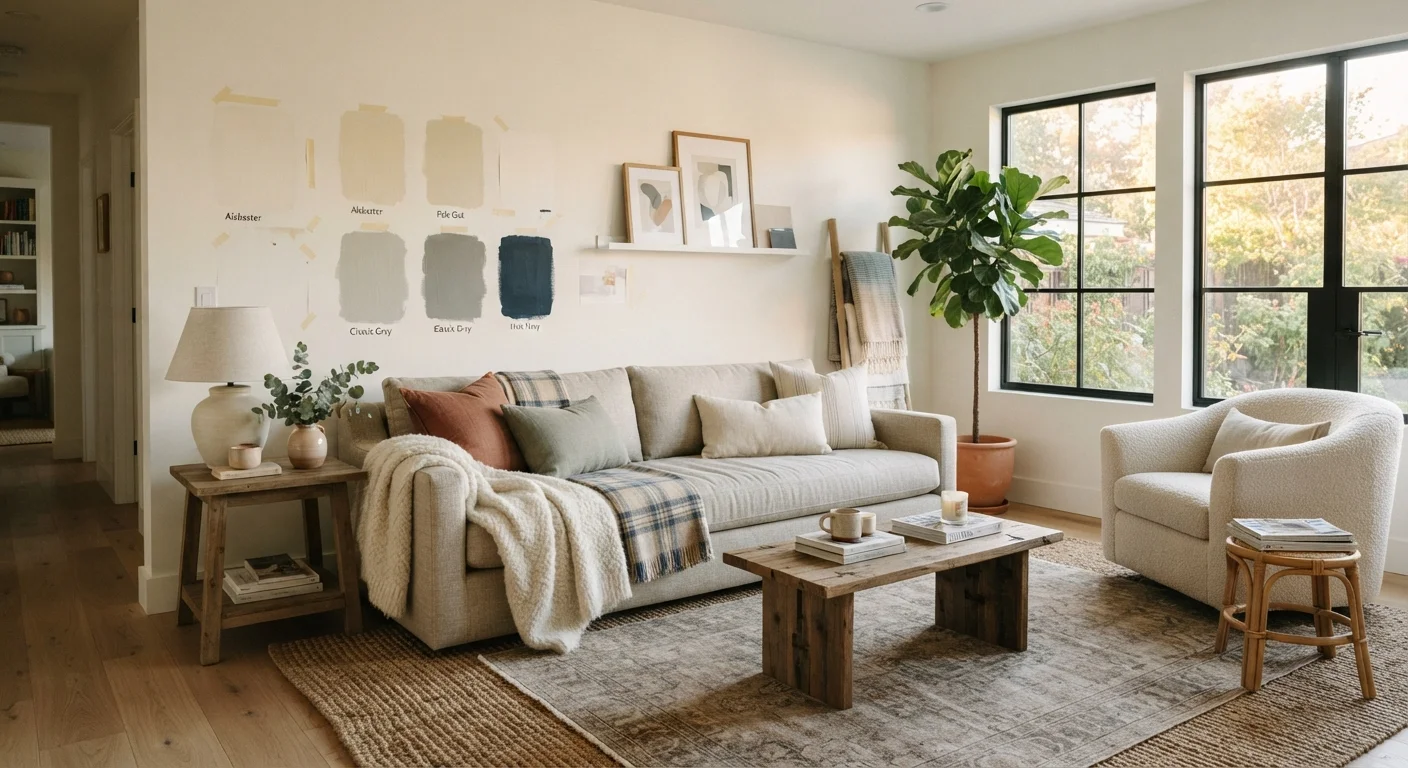
When choosing wall paint, always test samples on the actual wall in multiple light conditions — morning, afternoon, and artificial evening light. Colors shift dramatically depending on light source and surrounding surfaces. A paint chip in a store is nearly useless as a final decision tool.
Trim color matters more than many decorators realize. Crisp white trim adds contrast and architecture; matching trim to the wall color makes a room feel more enveloping and modern. Neither is wrong — the choice depends on your style direction.
Test Paint on the Actual Wall
Purchase sample pots and paint at least a 12-by-12-inch swatch directly on your wall — not on card or paper held up to it. Live with the swatch for two to three days, observing it at different times of day. Natural and artificial light will change the color significantly, and what looks perfect at noon may read entirely differently at 7 p.m.
Lighting Layers: The Element Most Rooms Get Wrong
Most rooms rely on a single overhead fixture and nothing else. This produces flat, unflattering light that undermines even well-chosen furniture and color. Effective lighting uses three layers working together:
- Ambient lighting — the general illumination that replaces daylight. Ceiling fixtures, recessed lighting, or flush mounts serve this role.
- Task lighting — focused light for specific activities. Reading lamps, under-cabinet kitchen lights, and vanity lights belong here.
- Accent lighting — decorative light that highlights art, architectural features, or shelving. Picture lights, wall sconces, and LED strips are common examples.
Dimmers are among the highest-value additions to any room's lighting plan. They allow a single fixture to serve multiple moods without additional hardware. Pair warmer bulb temperatures (2700K–3000K) with living and bedroom spaces for a comfortable, residential feel.
For a room-by-room perspective on practical home technology — including smart lighting — see our guide to home technology by room.
“Lighting is the single element that can make or break a room. Get it right and even modest furniture looks considered; get it wrong and even beautiful pieces look flat.”
— Nate Berkus, Interior designer and author
Furniture Selection and Placement
Furniture represents the largest share of most decorating budgets, so decisions here carry the most weight. A few durable principles guide good choices regardless of style or price point:
- Prioritize scale. Furniture that is proportionally right for the room — not too large, not too small — will always look better than expensive pieces at the wrong scale.
- Anchor with a rug. A rug defines a zone and ties furniture together. The most common mistake is a rug that's too small. In a living room, all front legs of seating should sit on the rug at minimum.
- Mix materials deliberately. A room that combines wood, metal, fabric, and glass in varied but complementary finishes reads as more sophisticated than one that matches everything to a single material family.
- Leave breathing room. Visual rest — empty surface space, an uncluttered wall — makes a room feel considered rather than cluttered.
If your project extends into a full kitchen overhaul, the furniture and layout logic overlaps with renovation planning — our kitchen renovation walkthrough covers that territory in depth.
The Finishing Layers: Textiles, Art, and Accessories
Textiles — curtains, throw pillows, blankets, and rugs — are the layer most responsible for a room feeling warm and lived-in. They also happen to be the most affordable and changeable element. Vary texture deliberately: smooth linen against a nubby boucle, woven cotton against polished wood. Contrast is what makes layering work.
Art placement follows a simple rule: hang pieces so the visual center sits at roughly eye level (approximately 57–60 inches from floor to center). Gallery walls benefit from laying the arrangement out on the floor first, then transferring it to the wall. Leaning larger pieces against a wall is a legitimate and flexible alternative to hanging.
Accessories are added last — and edited ruthlessly. Group objects in odd numbers, vary heights within each grouping, and ensure every shelf or surface has at least some negative space. If a room feels cluttered, the solution is usually removal, not addition. For a practical approach to clearing what doesn't belong, our room-by-room decluttering framework is a useful companion resource.
This article is for general informational and educational purposes only. Costs, results, and timelines for any home decorating project vary widely based on location, materials, and individual circumstances. For structural, electrical, or other regulated home modifications, consult a licensed professional and verify local permit requirements.
The content on this site is for informational purposes only and is not a substitute for professional advice. Always consult a qualified professional for guidance specific to your situation.