

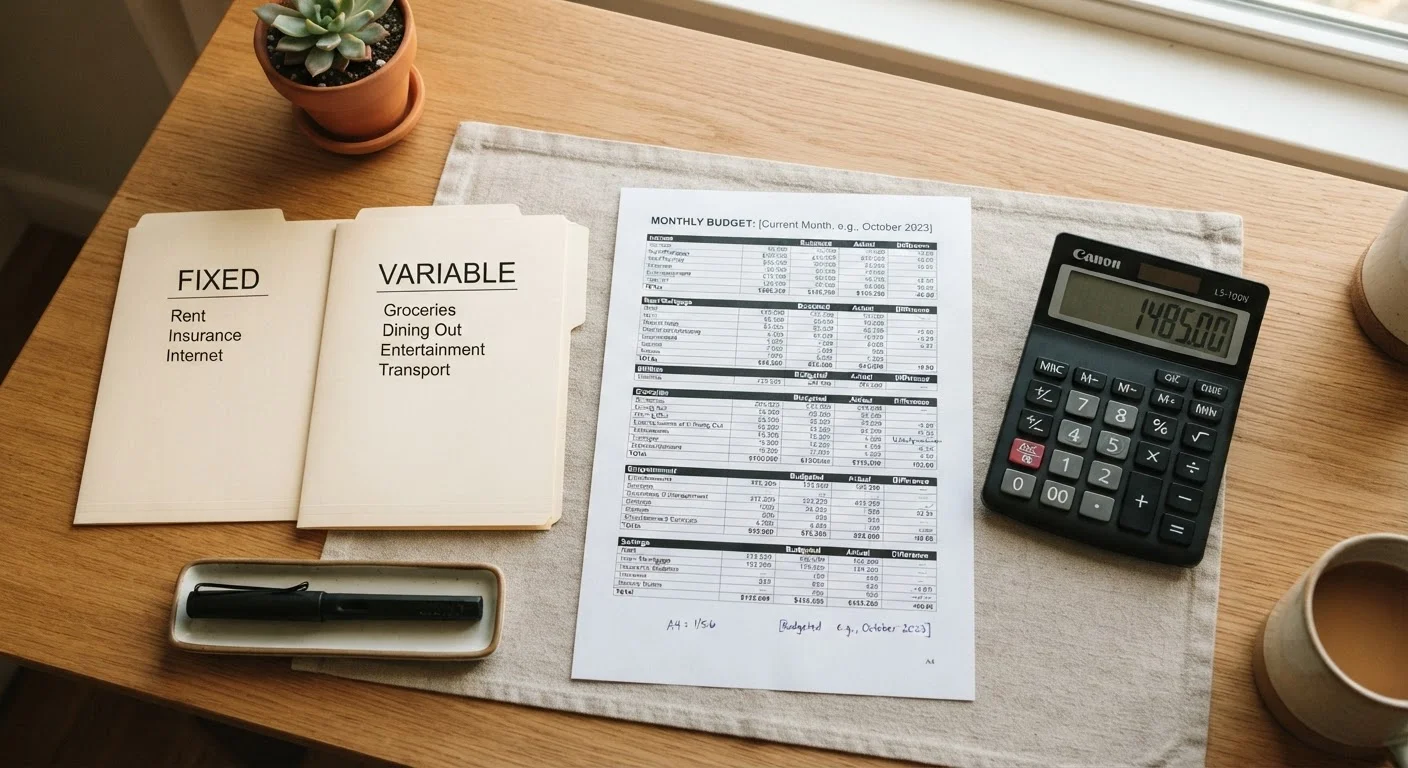
Option A
Fixed Expenses
The predictable, non-negotiable costs in your budget.
Best for: Understanding the baseline floor of what you must spend each month before anything else.
Option B
Variable Expenses
The flexible costs you can actively manage and adjust.
Best for: Identifying where spending flexibility lives and where day-to-day decisions have the most financial impact.
What Are Fixed Expenses?
Fixed expenses are costs that stay the same from month to month, regardless of how much you use a service or how your life changes week to week. You owe the same amount on the same date, which makes them predictable — but also largely outside your day-to-day control.
Common examples include:
- Rent or mortgage payments
- Car loan payments
- Student loan payments
- Insurance premiums (auto, health, renters, life)
- Subscription services billed at a flat monthly rate
Because these costs don't flex with your behavior, they define the financial floor of your budget — the non-negotiable baseline you must cover every single month. Changing a fixed expense usually requires a major decision: refinancing a loan, moving to a less expensive home, or canceling a service entirely. These aren't quick adjustments.
Understanding your total fixed expenses is a critical first step in any budget. See our plain-English budgeting guide for how to list and tally these costs as part of a complete budget setup.
What Are Variable Expenses?
Variable expenses are costs that change from month to month based on your choices, habits, or circumstances. Unlike fixed costs, these fluctuate — sometimes significantly — and represent the area where most of your day-to-day spending decisions live.
Common examples include:
- Groceries and household supplies
- Dining out and entertainment
- Gas and transportation costs
- Clothing and personal care
- Utility bills (electricity, water) that vary by usage
- Medical copays and out-of-pocket expenses
Variable expenses are not inherently bad — they're simply responsive to your behavior. That responsiveness is exactly what makes them the primary target when you need to tighten your budget. If your income drops or an unexpected bill arrives, variable expenses are where you have the most immediate ability to cut back.
Worth noting: some expenses look fixed but are actually variable. A cell phone plan has a set base rate (fixed), but data overage charges or add-ons make the total variable. Awareness of these hybrid costs matters. For a closer look at costs that often fall through the cracks, our article on spending categories that most budgets underestimate is a practical companion read.
| Criterion | Fixed Expenses | Variable Expenses |
|---|---|---|
| Monthly amount | Stays the same | Changes month to month |
| Examples | Rent, loan payments, insurance | Groceries, gas, dining, utilities |
| Control level | Low — requires major decision to change | High — responds to daily choices |
| Budget function | Sets your financial floor | Defines your spending flexibility |
| Best lever for saving | Refinancing or canceling long-term | Cutting back immediately when needed |
| Predictability | High — easy to forecast | Lower — requires tracking to manage |
Why the Distinction Matters for Your Budget
Separating fixed from variable expenses isn't just a bookkeeping exercise — it fundamentally changes how you approach financial decisions.
~60%
Share of spending that is often fixed or semi-fixed
Housing, transportation, and insurance alone can consume the majority of a household's take-home pay, according to U.S. Bureau of Labor Statistics Consumer Expenditure data.
1 in 3
Americans who track monthly spending
Surveys consistently show that most U.S. adults do not actively track their variable expenses, making it difficult to spot overspending patterns.
When you know exactly what is fixed, you can calculate your true monthly minimum: the amount you need to earn just to keep the lights on and the payments current. Everything above that amount is what you have to allocate across variable spending, savings, and financial goals.
This separation also helps during financial stress. If your income suddenly drops — due to a job change, medical situation, or irregular pay period — you immediately know which expenses can flex and which ones can't. That clarity reduces panic and speeds up decision-making. If you work with uneven income, our guide on budgeting with variable income applies these concepts directly to your situation.
Popular budgeting frameworks like the 50/30/20 rule and zero-based budgeting both rely on this fixed/variable distinction to allocate money across needs, wants, and savings. Learn more about how those methods compare in our zero-based budgeting vs. 50/30/20 rule article. For definitions of related terms, the budgeting terms glossary is a useful quick-reference.
Semi-Fixed Expenses: A Third Category
Some costs sit between fixed and variable — they recur regularly but the amount can vary. Insurance premiums you can shop annually, subscriptions you can downgrade, or a phone plan you can change all fit this middle category. Labeling these as 'semi-fixed' in your budget reminds you they aren't truly locked in forever, even if they feel that way month to month. Reviewing them once or twice a year is a reasonable habit.
The content on this site is for informational purposes only and is not a substitute for professional advice. Always consult a qualified professional for guidance specific to your situation.