

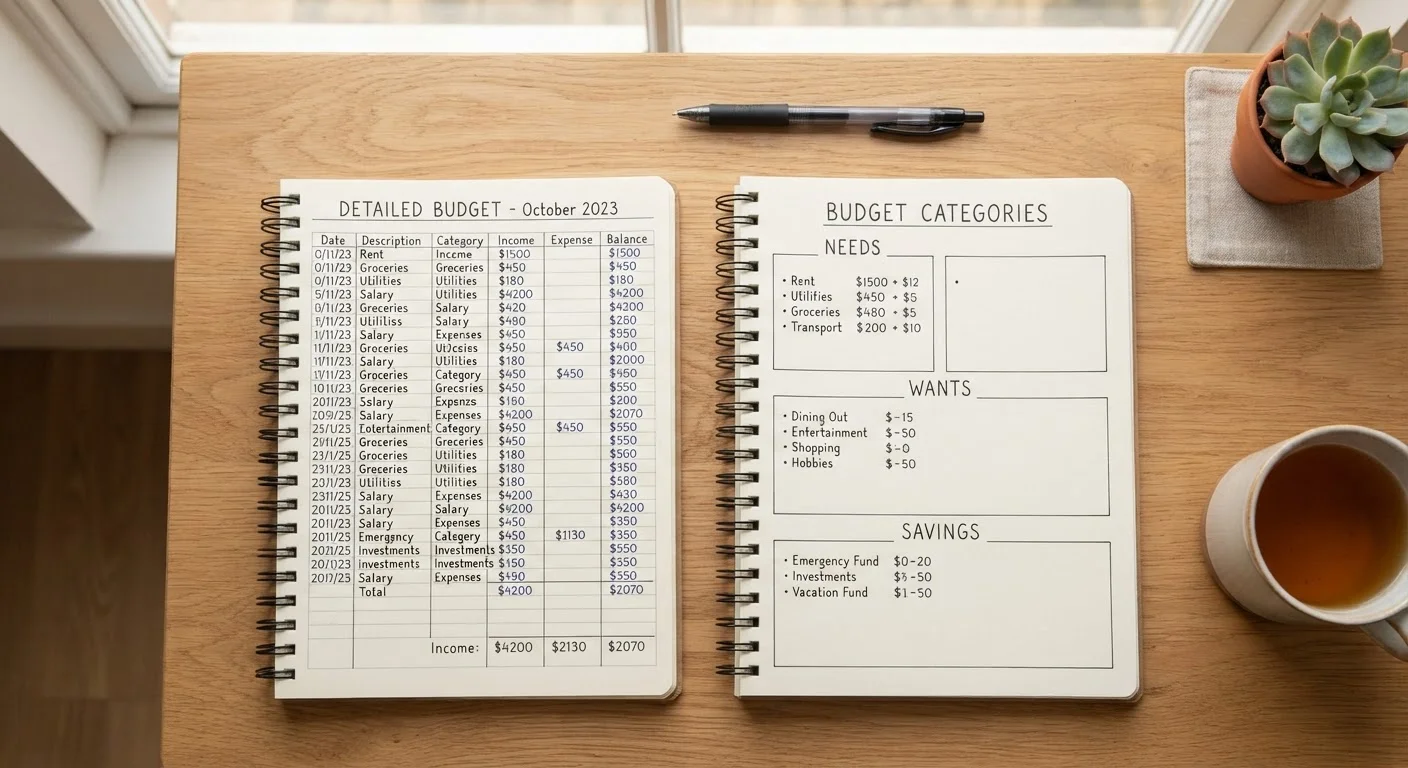
Option A
Zero-Based Budgeting
The detailed, every-dollar-accounted-for method.
Best for: People who want precise control over their spending and are willing to invest time each month tracking their finances.
Option B
The 50/30/20 Rule
The streamlined, percentage-driven framework.
Best for: People who want a simple, low-maintenance structure that still creates room for saving and spending on what matters.
How Each Method Works
Understanding the mechanics of each approach makes it much easier to decide which one fits your situation.
Zero-Based Budgeting
With zero-based budgeting (ZBB), you start each month — or pay period — with your total income and allocate every single dollar until you reach zero. That doesn't mean spending everything; it means every dollar is assigned a role, whether that's rent, groceries, savings, or an emergency fund contribution. The goal is that income minus all assigned expenses and savings equals zero. Nothing is left unaccounted for.
This method requires rebuilding your budget from the ground up each month, accounting for expenses that shift — irregular bills, seasonal costs, or income changes. For a deeper look at how irregular costs can trip up any budget, see spending categories that most budgets underestimate.
The 50/30/20 Rule
The 50/30/20 rule divides your after-tax take-home income into three broad buckets: 50% for needs (housing, utilities, groceries, minimum debt payments), 30% for wants (dining out, subscriptions, entertainment), and 20% for savings and extra debt repayment. Once you know your monthly take-home pay, the math is straightforward. For a full breakdown of how this framework operates, the 50/30/20 rule explained covers where it works well and where it has real-world limits.
| Criterion | Zero-Based Budgeting | 50/30/20 Rule |
|---|---|---|
| Setup time | High — rebuilt monthly | Low — set once, adjust occasionally |
| Ongoing effort | High — tracks every category | Low — three broad buckets |
| Best for income type | Variable or irregular income | Steady, predictable paycheck |
| Level of spending visibility | Very detailed — line by line | Broad — category-level only |
| Flexibility | High — adapts each month | Moderate — fixed ratios may not fit all |
| Beginner-friendly | No — steep learning curve | Yes — simple to start immediately |
| Debt paydown focus | Strong — allocate extra dollars directly | Partial — within the 20% bucket |
Practical Trade-Offs to Weigh
Both methods can work — but they come with real trade-offs worth thinking through honestly before you commit.
~33%
Americans with a detailed household budget
Gallup polling has consistently found that roughly one-third of U.S. adults report maintaining a detailed household budget.
20%
Income the 50/30/20 rule directs to savings and debt
Many financial educators suggest 20% as a reasonable starting savings and debt-repayment target, though individual circumstances vary widely.
Time and effort
Zero-based budgeting is genuinely time-intensive. You're building a detailed plan monthly, categorizing every dollar, and reconciling actuals against your plan throughout the month. Many people find this level of engagement helpful at first but hard to maintain long-term.
The 50/30/20 rule requires minimal ongoing effort once you've set the initial percentages. That simplicity is its biggest selling point — and also its limitation.
Flexibility vs. precision
The 50/30/20 rule's broad categories are forgiving. But that flexibility can also mask problems: a household spending 48% on needs and only 12% on savings technically fits a modified version of the rule, yet may be under-saving significantly. Zero-based budgeting, by contrast, exposes every category — which is uncomfortable but clarifying.
Suitability for variable income
For freelancers, gig workers, or anyone with income that changes month to month, zero-based budgeting adapts more naturally because you rebuild from your actual income each time. The 50/30/20 rule is harder to apply when the denominator changes unpredictably.
These methods aren't mutually exclusive
Some people use the 50/30/20 rule as a high-level guardrail while applying zero-based thinking within each category — for example, accounting for every dollar inside their 'needs' bucket. Mixing elements of both is a valid approach, especially if you want structure without full line-item complexity. What matters most is that your system reflects your actual income, expenses, and goals.
If you're entirely new to budgeting, our plain-English starting guide walks through the foundational steps before you choose a method.
Choosing and Maintaining Your Approach
No budgeting system is inherently superior — what matters is whether you can stick with it long enough to see results. A few practical considerations:
- Start simpler than you think you need to. Complexity is often what causes people to abandon budgeting entirely. The 50/30/20 rule builds the habit first; you can always add detail later.
- Test for one to three months before judging. Both methods require a short learning curve before your numbers feel accurate and realistic.
- Track actuals, not just plans. Whichever method you use, recording what you actually spent — not just what you planned — is where the real insight comes from. A monthly budget review is one practical way to build that habit.
- Consider your tools. Zero-based budgeting typically benefits from more structured tracking, whether that's a spreadsheet or an app. See how those options compare in spreadsheet budgeting vs. budgeting apps.
This article is for general informational purposes only and does not constitute personalized financial advice. Consider consulting a licensed financial professional for guidance tailored to your individual circumstances.
The content on this site is for informational purposes only and is not a substitute for professional advice. Always consult a qualified professional for guidance specific to your situation.