

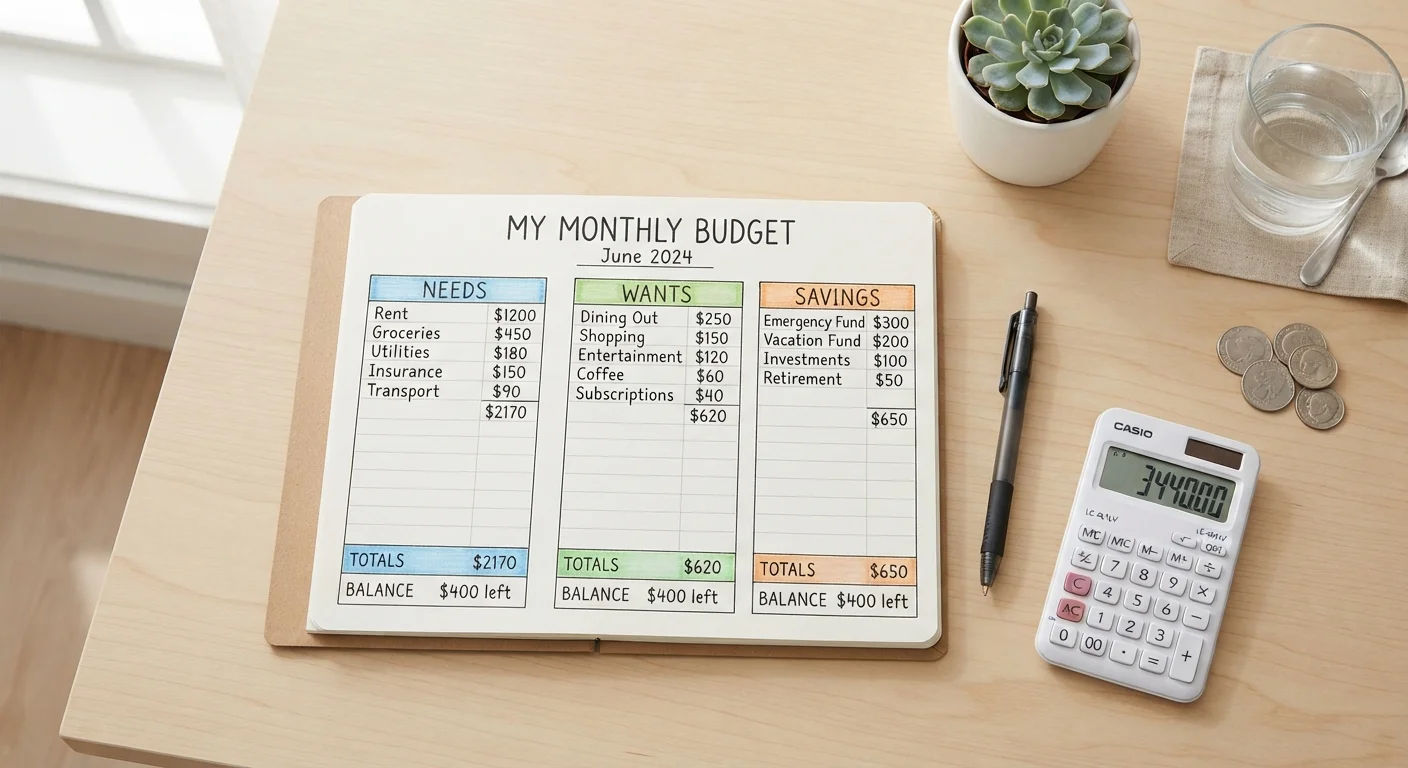
How the Three Categories Work
The 50/30/20 rule, popularized by Senator Elizabeth Warren and her daughter Amelia Warren Tyagi in their book All Your Worth, offers one of the most accessible entry points into personal budgeting. Rather than tracking each individual purchase, you monitor three broad categories against your monthly take-home pay.
50% — Needs
This half of your budget covers true essentials: housing costs (rent or mortgage), utilities, groceries, transportation, health insurance, and the minimum required payments on any debts. A straightforward test is to ask whether skipping the expense would put your housing, health, or employment at risk. If yes, it's a need.
30% — Wants
Wants are discretionary — things that improve your quality of life but aren't strictly required. Streaming services, restaurant meals, travel, hobbies, and clothing beyond the basics fall here. The 30% allocation acknowledges that healthy personal finances don't require eliminating all enjoyment.
20% — Savings and Debt Repayment
The final fifth is reserved for building financial security. This bucket can cover an emergency fund, retirement contributions, other investment accounts, and any debt payments above required minimums. If you're carrying high-interest debt, funneling extra payments here is generally a priority before focusing on long-term investments.
For a broader look at how saving fits into your financial picture, see our saving and goals hub.
50%
After-tax income allocated to essential needs
The 50/30/20 framework targets half of take-home pay for housing, food, utilities, and other non-negotiable expenses.
20%
Recommended share directed to savings and debt
Financial educators generally point to 20% of net income as a minimum savings rate for building meaningful financial security over time.
~57%
Americans living paycheck to paycheck
A recurring finding across multiple consumer surveys suggests that more than half of U.S. adults have little to no monthly financial buffer, underscoring the value of a structured budgeting approach.
Applying the Rule to a Real Paycheck
To put the framework into practice, start with your monthly net income — the amount that actually lands in your bank account. If your take-home pay is $4,000 per month, the targets look like this:
- Needs: $2,000 (50%)
- Wants: $1,200 (30%)
- Savings / debt repayment: $800 (20%)
Next, pull two to three months of bank and credit card statements and categorize past spending. Many people discover that what felt like a "need" — a premium cable package, a second car — actually belongs in the wants column. This honest audit is often the most revealing step.
Automate Before You Spend
Set up an automatic transfer to a savings account on payday — before you have a chance to spend the money. Treating savings as a fixed expense that leaves your checking account first makes the 20% target far easier to hit consistently. Even a modest automatic transfer builds the habit and the balance over time.
Once you know where you stand, small adjustments compound quickly. Shifting $100 a month from wants to savings adds $1,200 annually to your financial cushion without a dramatic lifestyle change.
When the Standard Ratios Don't Fit
The 50/30/20 rule is a starting framework, not a universal prescription. Several common situations may require adjusting the percentages.
High cost-of-living areas
In cities where median rent exceeds half of a typical paycheck, a rigid 50% ceiling on needs is unrealistic. Rather than abandoning the budget, many financial educators suggest temporarily compressing the wants bucket — dropping it to 15% or 20% — to protect the savings category.
Variable or irregular income
Freelancers, gig workers, and commission-based earners face income swings that make fixed percentages difficult to apply month to month. A practical workaround is to calculate your budget based on a conservative baseline income and treat any income above that as an additional savings contribution.
Aggressive debt payoff goals
If eliminating high-interest debt is your priority, you may want to temporarily redirect a portion of the wants allocation to the 20% bucket. Once the debt is cleared, those dollars can shift back toward discretionary spending or long-term investing.
The 50/30/20 method is one of several structured approaches. If you find it too broad, the zero-based budgeting comparison covers a more granular alternative worth considering.
Making the 20% Work Harder Over Time
The savings and debt category is where long-term financial progress lives. Initially, the priority for most households is an emergency fund covering three to six months of essential expenses — this provides a buffer that prevents a single setback from derailing everything else.
Once a foundational emergency reserve is in place, the 20% can shift toward longer-term objectives. Understanding the difference between short-term targets (a home down payment, a vehicle replacement) and long-term goals (retirement, financial independence) helps you decide which accounts and timelines make sense. The guide to short-term vs. long-term savings goals walks through that distinction in detail.
If you receive a windfall — a tax refund, a bonus, or an inheritance — your existing 50/30/20 structure provides a ready framework for allocating the extra funds intentionally. For guidance on that specific scenario, see making purposeful decisions with lump-sum windfalls.
“The most important thing about a budget isn't the system you use — it's whether the system is simple enough that you'll actually stick with it.”
— Amelia Warren Tyagi, Co-author of All Your Worth and personal finance researcher
This article is for general informational and educational purposes only and does not constitute personalized financial advice. Consider consulting a qualified financial professional for guidance tailored to your individual circumstances.
Frequently Asked Questions
Needs are expenses you cannot reasonably eliminate — rent or mortgage, basic groceries, utilities, transportation to work, health insurance, and minimum debt payments. If skipping a bill would cause serious harm or legal consequences, it likely qualifies as a need. Subscriptions, gym memberships, and dining out are wants, not needs, even if they feel essential.
Apply the rule to your net income — the amount deposited into your bank account after taxes, Social Security, and other payroll deductions are taken out. Using gross income inflates all three buckets and gives a misleading picture of what you can actually spend and save.
Many people in high-cost cities find that housing alone consumes more than 50% of take-home pay. In that case, temporarily reduce the wants percentage rather than cutting savings to zero. The framework is a starting target, not a fixed rule — adjusting the ratios to reflect your real situation is better than abandoning a budget entirely.
Yes. The 20% bucket is meant to cover savings, investing, and any debt payments above the required minimum. Paying down high-interest debt aggressively falls within this category and is generally considered a sound financial move before prioritizing investment contributions.
Neither is universally better — they suit different personalities and situations. The 50/30/20 rule is simpler and lower-maintenance, making it a strong starting point for budgeting beginners. Zero-based budgeting demands more detailed tracking but gives greater control over every dollar. See the <a href="/money-finance/budgeting-basics/zero-based-budgeting-vs-the-503020-rule">comparison of both methods</a> for a fuller breakdown.
Calculate your monthly after-tax income, then multiply it by 0.50, 0.30, and 0.20 to find your three spending targets. Review two to three months of bank and credit card statements to see how your current spending compares to each category. Adjust where you're over or under, and revisit the numbers whenever your income or major expenses change.
The content on this site is for informational purposes only and is not a substitute for professional advice. Always consult a qualified professional for guidance specific to your situation.