

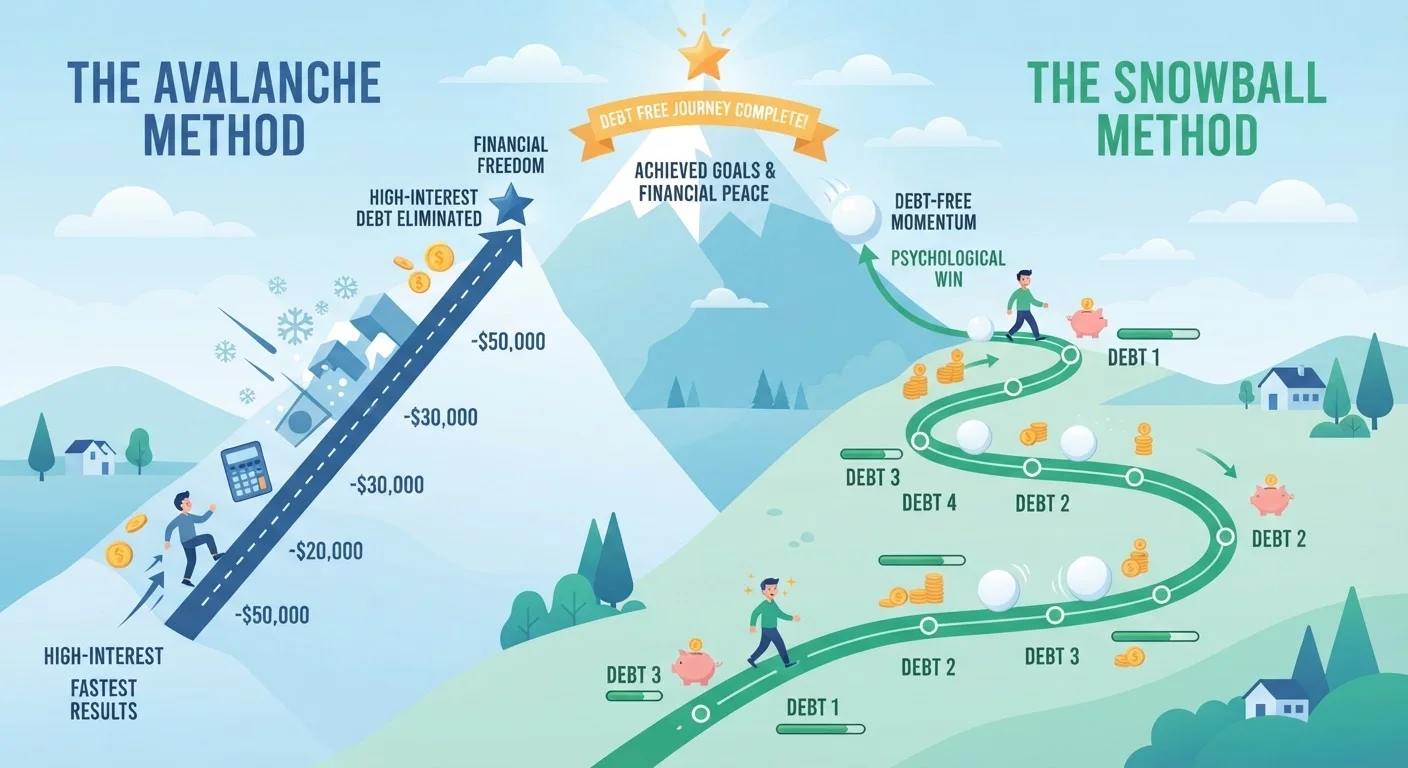
Option A
Debt Avalanche
The mathematically optimal, interest-minimizing approach.
Best for: Borrowers who want to pay the least total interest and are motivated by long-term financial efficiency.
Option B
Debt Snowball
The momentum-driven, psychologically rewarding approach.
Best for: Borrowers who need early wins to stay motivated and benefit from a sense of visible progress.
How Each Strategy Works
Both methods share the same core mechanic: you make minimum payments on every debt, then direct any extra money toward one priority debt. When that debt is paid off, you roll its payment into the next target. The difference is how you choose which debt to prioritize.
Debt Avalanche: You rank debts by interest rate — highest to lowest — and attack the top of the list first. Once the highest-rate balance is gone, you redirect that payment to the next highest rate, and so on. Because high-interest debt grows fastest, eliminating it early limits the total interest that accrues across your entire debt load.
Debt Snowball: You rank debts by outstanding balance — smallest to largest — regardless of interest rate. Paying off the smallest balance first creates a quick win. The payment you freed up "snowballs" into the next smallest balance, then the next. The psychological reward of eliminating an account can reinforce the habit and keep you going.
Before choosing, make sure you have a clear picture of each debt's balance, interest rate (APR), and minimum payment. If any of those terms are unfamiliar, the Debt & Credit Plain-Language Glossary offers quick definitions.
| Criterion | Debt Avalanche | Debt Snowball |
|---|---|---|
| Priority target | Highest interest rate first | Smallest balance first |
| Total interest paid | Lower (mathematically optimal) | Potentially higher |
| Time to first payoff | Longer if high-rate debt is large | Shorter — quick early wins |
| Motivational structure | Delayed gratification | Frequent milestones |
| Best suits | Disciplined, numbers-driven borrowers | Borrowers needing behavioral reinforcement |
| Complexity | Requires tracking APRs carefully | Simple balance ranking |
The Math vs. The Motivation Trade-Off
On paper, the avalanche wins every time when interest rates differ across your debts. By neutralizing high-rate balances early, you reduce the compound growth working against you. In practice, however, the earliest payoff milestone with the avalanche can take considerably longer — especially if your highest-rate debt also carries a large balance. That extended wait tests discipline.
The snowball sacrifices some mathematical efficiency in exchange for behavioral momentum. Behavioral finance research consistently shows that people are more likely to continue a plan when they experience concrete progress. For some borrowers, the motivational structure of the snowball is not just a psychological nicety — it is what makes the difference between completing a repayment plan and abandoning it.
~$1,000+
Potential interest savings with avalanche vs. snowball
The exact savings depend on balances, rates, and extra payment amounts, but the gap can be significant when high-APR debt is large.
77%
Americans carrying some form of debt
According to Experian's 2023 Consumer Credit Review, the vast majority of U.S. consumers carry at least one form of debt.
20%+
Typical credit card APR range
Federal Reserve data shows average credit card interest rates have exceeded 20% APR in recent reporting periods, underscoring the cost of carrying card balances.
Neither method requires a higher income. Both require the same ingredient: a consistent, dedicated extra payment each month. A solid foundation for finding that extra payment starts with your monthly budget — the Budgeting Basics hub offers practical frameworks for locating spending you can redirect toward debt.
If your debt load feels unmanageable regardless of method, it may also be worth reviewing managing debt when money is tight for strategies suited to tighter financial situations.
Choosing the Right Method for Your Situation
Consider these factors when making your decision:
- Interest rate spread: If your debts carry very similar interest rates, the avalanche's mathematical advantage shrinks and the snowball's motivational benefit becomes more compelling.
- Balance distribution: If your smallest debt is also one of your highest-rate debts, the two methods may converge — making the decision straightforward.
- Your track record: Honest self-assessment matters. If you have started and stopped repayment plans before, the snowball's built-in reward structure may be the more realistic choice.
- Number of accounts: Many open accounts add administrative complexity. The snowball reduces account count quickly, which can simplify your financial picture.
You might also consider whether debt consolidation is worth exploring alongside either method. A separate, balanced overview of how debt consolidation works and when it helps can help you weigh that option without confusing it with the repayment strategies covered here.
Once your debt is under control, the natural next step is redirecting those freed-up payments toward savings goals. The Saving & Goals hub and the article on short-term vs. long-term savings goals can help you plan that transition.
Hybrid Approaches Are Also Valid
Some borrowers blend both methods — starting with the snowball to eliminate one or two small accounts, then switching to the avalanche for the remainder. There is no rule requiring a single method for the life of your repayment plan. What matters most is that your chosen approach is consistent and sustainable over time.
This article is for general informational and educational purposes only and does not constitute personalized financial advice. Consult a qualified financial professional for guidance specific to your situation.
The content on this site is for informational purposes only and is not a substitute for professional advice. Always consult a qualified professional for guidance specific to your situation.