

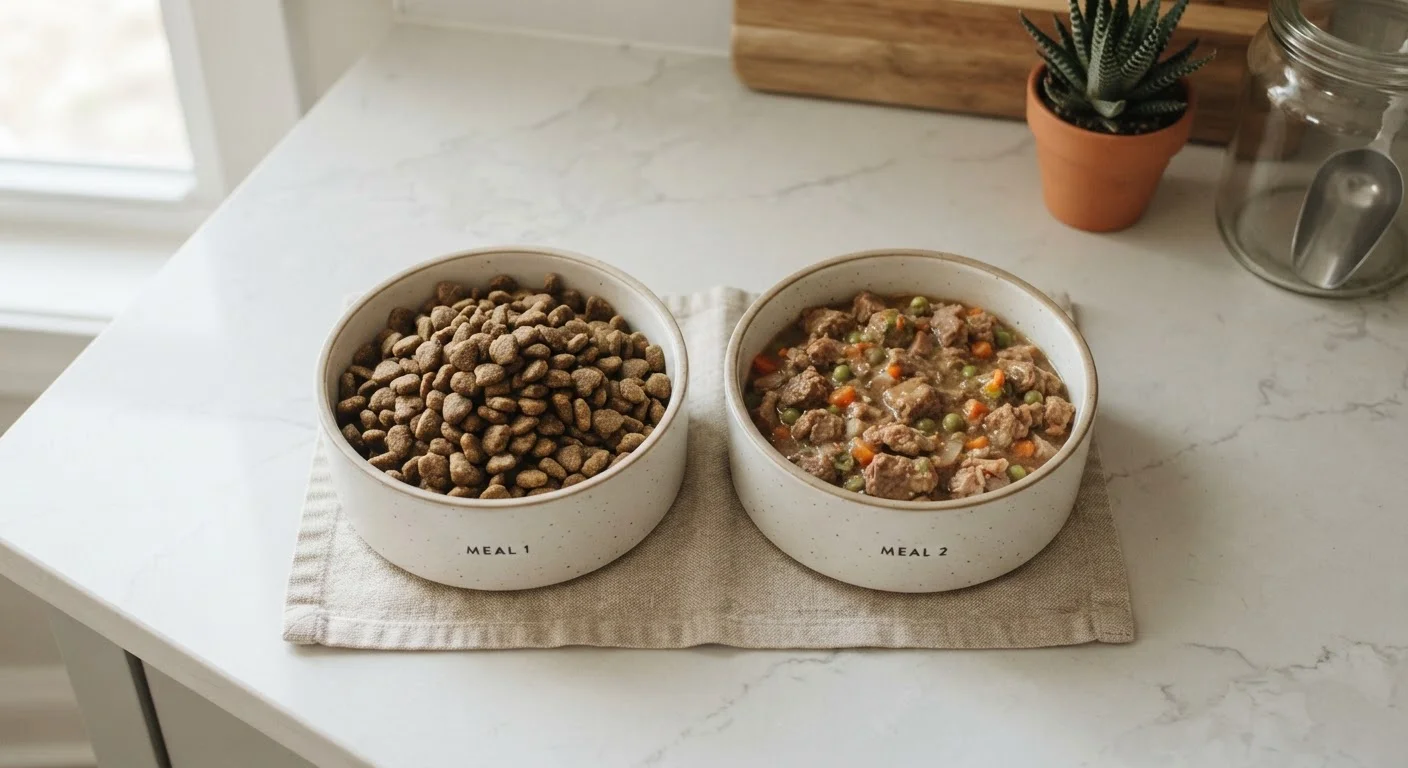
Option A
Dry Kibble
The convenient, shelf-stable staple.
Best for: Pet owners seeking a cost-effective, low-mess daily feeding option with a long shelf life.
Option B
Wet Food
The moisture-rich, palatable alternative.
Best for: Pets who need higher hydration, have dental or appetite challenges, or require more calorie-dense meals.
How Dry and Wet Food Are Made — and What That Means Nutritionally
Dry kibble is produced through a process called extrusion: ingredients are cooked under high heat and pressure, then formed into bite-sized pieces and dried to very low moisture levels. This manufacturing method yields a calorie-dense product with a long shelf life. Wet food, by contrast, is cooked at lower temperatures, sealed in cans or pouches with added water or broth, and retains far more moisture — typically between 70% and 80% by weight.
That moisture difference is the single most consequential nutritional distinction between the two formats. On a dry-matter basis (removing water from the equation), both high-quality kibble and well-formulated wet food can deliver comparable protein, fat, and micronutrient profiles. What changes is how those calories and nutrients are diluted by water content, which affects serving sizes and overall caloric density. A cup of kibble contains substantially more calories than the same volume of wet food.
For a broader look at how nutritional needs shift with your pet's age, see our guide on how dietary needs change across life stages.
| Criterion | Dry Kibble | Wet Food |
|---|---|---|
| Moisture content | 8–12% | 70–80% |
| Caloric density (per gram) | Higher | Lower |
| Cost per serving | Generally lower | Generally higher |
| Shelf life (unopened) | Weeks to months | Years (canned) |
| Shelf life (opened) | Days to weeks (sealed) | 24–48 hours (refrigerated) |
| Palatability | Moderate | High |
| Hydration support | Low | High |
| Dental benefit | Minimal (unless VOHC-certified) | Minimal |
| Suitable for automatic feeders | Yes | Generally no |
Hydration, Dental Health, and Palatability: Where Each Format Has an Edge
Hydration is perhaps the most important practical argument for wet food, especially in cats. Unlike dogs, cats have a low innate thirst drive — a trait inherited from desert-dwelling ancestors who obtained most of their water from prey. Cats fed exclusively dry kibble often consume less total fluid per day than those eating wet food, which may contribute to higher rates of urinary tract disease and chronic kidney issues over time. While adding water bowls and fountains can help, wet food remains one of the most reliable ways to increase a cat's daily water intake.
70–80%
Moisture content in wet pet food
Compared to just 8–12% in dry kibble, wet food's water content is its most clinically significant nutritional distinction.
~50%
Of cats develop kidney disease by age 15
Chronic kidney disease is among the most common conditions in older cats; adequate daily hydration is considered one supportive factor in urinary health.
2–4x
Cost difference per calorie (wet vs. dry)
Wet food typically costs two to four times more per calorie than dry kibble, a gap that becomes significant for larger or multiple-pet households.
On the dental health front, the evidence is more nuanced than marketing often suggests. Some dry kibbles carry a Veterinary Oral Health Council (VOHC) seal indicating they've been clinically tested for plaque or tartar reduction. However, most standard kibble does not confer meaningful dental benefit — the majority of pieces shatter rather than scrape against tooth surfaces. Wet food doesn't offer dental benefit either, but it also doesn't carry an inherent advantage on this metric unless your pet has painful chewing conditions. Regular professional dental cleanings remain the gold standard, regardless of food format.
Palatability generally favors wet food. Its stronger aroma and softer texture appeal to most dogs and cats, particularly older animals with reduced sensory acuity or post-surgical patients rebuilding appetite. This quality makes wet food a useful tool during illness recovery, even for pets that normally eat kibble.
Cost, Storage, and Practical Everyday Feeding
Cost is where dry kibble has a clear and consistent advantage. Per calorie delivered, dry food is typically a fraction of the price of equivalent wet food, and that gap widens for larger dogs with higher daily caloric needs. A large dog fed entirely on wet food would require a significant volume of cans daily, making it cost-prohibitive for many households.
Storage is similarly straightforward for dry food: a sealed bag stays fresh for weeks to months. Opened canned wet food must be refrigerated and used within 24–48 hours, which requires more planning. Pouches and pull-tab cans make portioning easier, but the logistics remain more involved than scooping kibble from a bag.
AAFCO Standards Apply to Both Formats
The Association of American Feed Control Officials (AAFCO) publishes nutrient profiles that define minimum standards for complete and balanced pet foods. Both dry and wet formulas can meet — and commonly do meet — these standards. When evaluating any food, look for an AAFCO nutritional adequacy statement on the label, which confirms the product is formulated for your pet's specific life stage. This statement is more informative than ingredient lists or marketing claims alone.
Many veterinary nutritionists recommend a mixed-feeding approach as a practical middle ground — dry kibble as the dietary base for cost and convenience, supplemented with wet food a few times per week for palatability and hydration support. There is no single correct ratio; the appropriate balance depends on your individual pet's health status, weight goals, and life stage. Before making significant changes to your pet's diet, a conversation with your veterinarian is always worthwhile — particularly if your animal has underlying health conditions.
For a broader comparison that includes raw diets alongside kibble and wet food, our editorial team has covered the trade-offs across all three major pet food formats. And if you're in the process of evaluating a specific product, our practical checklist for assessing a new pet food can help you look past label claims to what actually matters.
This article provides general pet nutrition information for educational purposes and does not constitute veterinary advice. Consult a licensed veterinarian for guidance specific to your pet's health needs.
The content on this site is for informational purposes only and is not a substitute for professional advice. Always consult a qualified professional for guidance specific to your situation.