

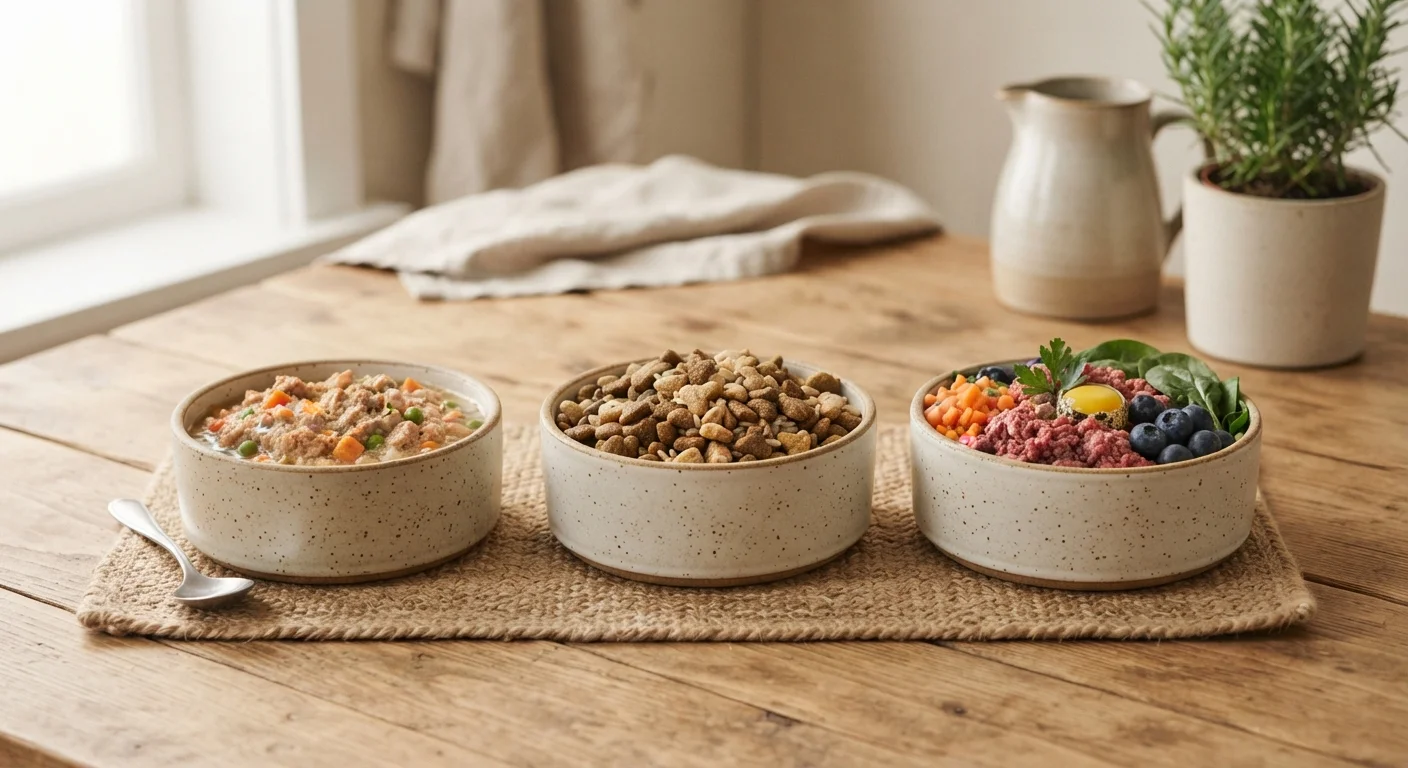
Our Verdict
Dry kibble remains the most practical choice for most households, offering convenience, affordability, and reliable nutritional standards when chosen carefully. Wet food earns its place for pets with hydration needs or palatability issues. Raw diets may suit some owners and pets, but only when approached with rigorous food safety practices and veterinary input.
| Best for | Recommended |
|---|---|
| Owners seeking convenience and cost efficiency | Dry Kibble |
| Cats, seniors, or pets needing extra hydration | Wet Food |
| Highly motivated owners with time and food safety knowledge | Raw Diet |
| Pets with digestive sensitivity or palatability issues | Wet Food |
Why the Format of Your Pet's Food Actually Matters
Pet food format affects far more than convenience. Moisture content, caloric density, ingredient processing methods, and microbial safety all vary significantly between wet food, dry kibble, and raw diets. These differences translate into real downstream effects on hydration, dental health, weight management, and digestion.
For most pets, any commercially prepared diet labeled as "complete and balanced" by AAFCO (the Association of American Feed Control Officials) can meet basic nutritional needs. But that baseline leaves a wide range of practical and health-related considerations that owners still have to navigate. Understanding those trade-offs is the goal here. For a broader framework on evaluating any food your pet eats, see our practical checklist for assessing new pet foods.
| Dry Kibble | Wet Food | Raw Diet | |
|---|---|---|---|
| Moisture Content | 8–12% | 70–82% | 60–75% (varies) |
| Cost Per Serving | Low | Moderate to high | High |
| Convenience | Very high | Moderate | Low |
| Shelf Life (opened) | Weeks to months | 24–48 hours refrigerated | 1–3 days refrigerated |
| Food Safety Risk | Low | Low to moderate | High |
| Palatability | Moderate | High | High |
| Nutritional Completeness | Reliable if AAFCO-certified | Reliable if AAFCO-certified | Variable; DIY formulas often incomplete |
| Hydration Support | Poor | Strong | Moderate to strong |
Dry Kibble: Practical, Affordable, and Widely Researched
Dry kibble is the dominant format in American pet feeding, and for good reason. It stores well, portion-controls easily, is generally less expensive per serving than alternatives, and thousands of formulations exist for different life stages, breed sizes, and health conditions.
The processing involved in making kibble — typically high-heat extrusion — does reduce some heat-sensitive nutrients, which manufacturers compensate for by adding vitamins and minerals post-processing. The result is a nutritionally consistent product when sourced from reputable manufacturers with rigorous quality controls.
The primary nutritional limitation of kibble is moisture content, typically 8–12%. Dogs and cats fed exclusively on dry food must compensate through water intake, and cats in particular — whose natural prey diet contains roughly 70% moisture — may chronically consume less water than is ideal. This can be a factor in urinary health over time, though individual variation is significant. Owners concerned about their pet's weight should also review how diet and body condition interact, since kibble's caloric density makes overfeeding easy without careful portioning.
Mixing Formats Is a Legitimate Strategy
Many veterinarians and pet owners use a combination of wet and dry food — kibble as the caloric base with wet food as a topper or separate meal. This can address palatability and hydration without dramatically increasing cost. If you try this approach, adjust total portions to avoid unintentional overfeeding, since wet food adds calories alongside moisture.
Wet Food: Hydration Benefits and Palatability — at a Cost
Canned and pouch wet foods typically contain 70–82% moisture, closely mirroring the water content of whole prey. This makes wet food a meaningful source of hydration, particularly valuable for cats, older pets with declining thirst drive, or animals prone to urinary tract issues.
Wet food is also often more palatable, which matters clinically: pets recovering from illness, those on appetite stimulants, or seniors with diminishing senses of smell may accept wet food when they refuse kibble. The texture variety — pâtés, stews, shredded formats — gives owners flexibility for picky eaters.
The trade-offs are real. Wet food costs significantly more per calorie than kibble. An opened can spoils within a few hours at room temperature and should be refrigerated and used within 24–48 hours. Wet food also provides less mechanical abrasion on teeth, though the evidence that dry kibble meaningfully reduces tartar is more limited than commonly believed. For a detailed side-by-side breakdown, our article on dry kibble vs. wet food goes deeper on the nutritional specifics.
Raw Diets: Genuine Appeal and Genuine Risk
Raw feeding — whether commercial frozen/freeze-dried raw or owner-prepared — has a passionate following. Proponents cite improved coat condition, smaller stool volume, and better energy. Some of these observations are plausible given the minimally processed, high-protein nature of raw diets. However, controlled research comparing raw to high-quality commercial diets remains limited, and most veterinary nutrition bodies — including the American Veterinary Medical Association (AVMA) — have expressed concern about raw diets due to documented food safety hazards.
The core risk is pathogen contamination. Raw meat can harbor Salmonella, Listeria, E. coli, and other organisms dangerous not just to pets but to humans in the household, including children, elderly individuals, and immunocompromised people. Studies have consistently found pathogen presence in commercial raw pet food products.
Nutritional imbalance is the second major concern. Home-prepared raw diets in particular are frequently deficient in calcium, phosphorus, or specific vitamins unless formulated by a board-certified veterinary nutritionist. If you're considering raw feeding, pairing it with professional guidance is not optional — it's essential. Our article on home-cooked meals for pets covers the nutritional fundamentals that apply equally to raw preparation.
Raw Diets Require Strict Food Safety Protocols
If you feed raw, treat all food surfaces, utensils, and bowls as you would raw meat in your own kitchen — because that's exactly what they are. Wash hands thoroughly after handling, sanitize feeding areas after every meal, and keep raw food away from immunocompromised family members. Never leave raw food in the bowl at room temperature for more than 30 minutes.
Making the Right Call for Your Pet
No format wins outright. A healthy adult dog thriving on quality kibble has no compelling reason to switch. A senior cat with chronic kidney disease may benefit meaningfully from the added moisture in wet food. An owner with the time, resources, and food-safety discipline to manage a commercial raw diet correctly may find it works well — but should do so with veterinary oversight.
Life stage matters too. Puppies and kittens have distinct caloric and nutrient demands; geriatric pets often need adjusted protein and phosphorus levels. The format you choose should support — not undermine — the nutritional profile your pet actually needs at this stage of life. For guidance on reading what's actually in any food you're considering, see what ingredient labels actually mean.
If you do decide to switch formats, transition gradually over seven to ten days to minimize digestive upset. Our guide on switching your pet's food without stomach upset walks through the process step by step.
This article is for general informational purposes only and does not constitute veterinary advice. Always consult a licensed veterinarian before making significant changes to your pet's diet, especially if your pet has an existing health condition.
The content on this site is for informational purposes only and is not a substitute for professional advice. Always consult a qualified professional for guidance specific to your situation.