

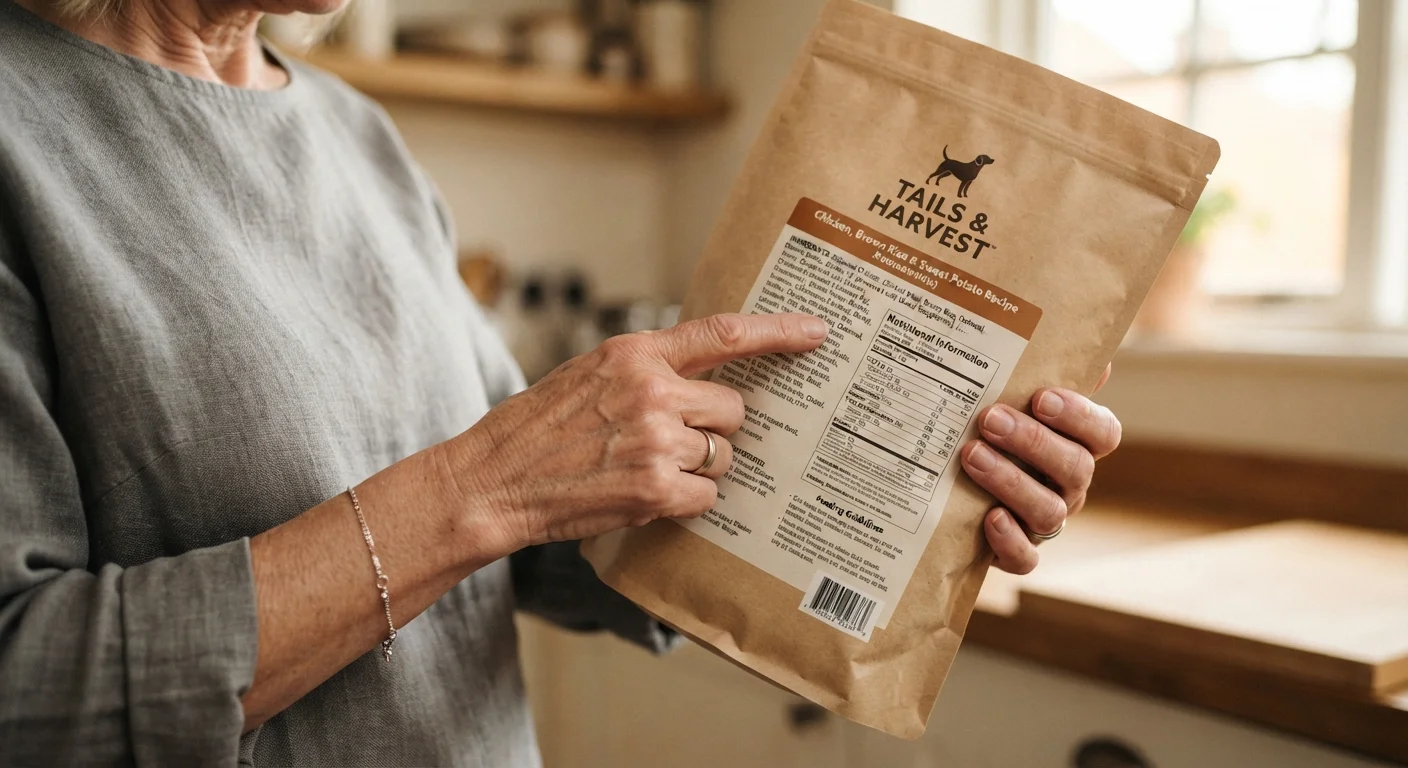
How the Ingredient List Is Structured — and What That Actually Means
Pet food ingredient lists follow a single organizing rule: ingredients are listed in descending order by weight before processing. This detail matters more than most pet owners realize. Whole chicken, for example, is roughly 70% water. Once cooked, its contribution to the final product shrinks considerably. An ingredient listed third or fourth after processing — such as chicken meal — may actually supply more protein to the finished food than the whole chicken listed first.
This is not a loophole or deception; it's a function of how raw weights are measured. Understanding it helps you read labels more accurately rather than reacting to ingredient position alone.
Every ingredient name on a U.S. pet food label corresponds to a standardized AAFCO definition. Terms are not chosen arbitrarily by manufacturers. 'Chicken' means skeletal muscle meat from chicken. 'Chicken by-products' means cleaned, non-rendered parts other than meat — including organs. 'Chicken meal' means rendered, dried chicken tissue. Each term is regulated. For a detailed breakdown of what these protein names mean nutritionally, see our guide on protein sources in pet food.
Ingredient Splitting: A Label Practice Worth Knowing
Some manufacturers list a single ingredient in multiple forms to push it lower on the list. For example, corn may appear as 'ground corn,' 'corn gluten meal,' and 'corn bran' separately. Individually, each appears lower in the list, but combined they may outweigh the named protein. Recognizing this pattern gives you a more honest read of the formula.
Named Proteins, By-Products, and Meals: Clearing Up the Confusion
Marketing has done significant damage to how pet owners perceive certain ingredient terms. 'By-products' in particular carries a stigma that its regulatory definition does not support. AAFCO defines poultry by-products as the non-rendered, clean parts of slaughtered poultry — including hearts, livers, lungs, and kidneys. These organs are, in many cases, more nutrient-dense than skeletal muscle meat.
The distinction that does carry practical weight is specificity. 'Chicken by-products' names a species; 'poultry by-products' or 'meat by-products' does not. Named sources allow for more traceability and consistency. Generic terms can mean the species or sourcing varies batch to batch — not inherently dangerous, but less transparent.
'Meal' ingredients — chicken meal, salmon meal, lamb meal — are rendered and dried proteins with most moisture removed. Because they are concentrated, they deliver a high protein density. A bag that lists 'deboned salmon' first and 'salmon meal' third may still derive the majority of its protein from the meal.
“The ingredient list tells you what's in the bag, but it doesn't tell you the quality of those ingredients, how digestible they are, or whether the diet is nutritionally balanced. You need the whole label — not just the ingredient panel.”
— Board-Certified Veterinary Nutritionist, American College of Veterinary Nutrition (ACVN) diplomate, paraphrased from widely published guidance on pet food label literacy
Carbohydrates, Fillers, and What They Actually Do
Ingredients like corn, wheat, rice, peas, and potatoes are frequently labeled 'fillers' in pet food discussions, implying they offer no value. The reality is more nuanced. Carbohydrate sources serve multiple functions in pet food manufacturing: they provide structure in kibble, contribute energy, and in some cases supply fiber that supports digestive health.
Corn and wheat, often dismissed as cheap fillers, are digestible carbohydrate sources and not known allergens for most pets — actual food allergies in dogs and cats are more commonly triggered by proteins like beef or chicken than by grains. Peas and legumes became popular as grain-free alternatives, but their long-term safety in dog diets is an ongoing area of veterinary investigation related to dilated cardiomyopathy (DCM), a type of heart disease. No definitive causal link has been established, but the topic warrants attention.
The presence of carbohydrates is not automatically a red flag. Their type, quality, and position in the ingredient list are more meaningful indicators. For a broader look at how macronutrients function, the guide on protein, carbs, and fat offers useful foundational context.
~70%
Water content in whole chicken before cooking
This is why whole meat listed first may contribute less protein to the finished product than a concentrated 'meal' ingredient listed lower on the label.
Top 2–3
Allergen-triggering ingredients in dogs
Veterinary dermatology research consistently identifies beef, dairy, and chicken as more common food allergen triggers in dogs than grains like corn or wheat.
Preservatives, Additives, and the Shelf-Stability Question
Preservatives in pet food are not optional — without them, fats go rancid and bacterial growth becomes a real safety risk. The question is not whether preservatives are present but which kind and at what levels.
Synthetic preservatives such as BHA (butylated hydroxyanisole), BHT (butylated hydroxytoluene), and ethoxyquin are approved for use in pet food at regulated concentrations. Natural alternatives — primarily mixed tocopherols (vitamin E) and ascorbic acid (vitamin C) — are effective but generally offer a shorter shelf life once the bag is opened.
Color additives, flavor enhancers, and texture agents round out the additive category. These are added for palatability or appearance, primarily for the owner's benefit rather than the pet's. Their presence does not indicate a low-quality food, but their absence is not a quality signal either.
For a fuller picture of what labeling rules actually require and what they don't, see how pet food regulations work in the United States.
Look Beyond the Ingredient List
After reading the ingredients, always check the AAFCO nutritional adequacy statement on the same package. This statement tells you whether the food was formulated to meet nutrient profiles for a specific life stage or validated through feeding trials — information the ingredient list alone cannot provide. Use both panels together for a complete picture.
What the Ingredient List Cannot Tell You
The ingredient list is one piece of a larger puzzle. It tells you what is in the food but not how digestible those ingredients are, how they were sourced, or whether the overall formula delivers balanced nutrition for your pet's life stage.
Nutritional completeness is conveyed through the AAFCO nutritional adequacy statement — a separate panel that indicates whether the food was formulated to meet AAFCO nutrient profiles or tested through feeding trials. This statement matters as much as the ingredient list itself. The complementary guide on decoding pet food labels explains how to read the guaranteed analysis panel alongside the ingredient list.
Marketing language — terms like 'natural,' 'holistic,' and 'human-grade' — has no standardized legal definition in most contexts and should be treated with appropriate skepticism. Our article on how marketing language shapes pet owner beliefs unpacks what these terms actually do and don't mean legally.
If you're evaluating a new food for your pet, our practical checklist for evaluating a new pet food offers a structured way to apply all of this information. When in doubt about your individual pet's dietary needs — especially for animals with health conditions, food sensitivities, or at specific life stages — consult your veterinarian rather than relying solely on label reading.
This article is for general informational purposes only and does not constitute veterinary or nutritional advice. Always consult a licensed veterinarian for guidance specific to your pet's health and dietary needs.
Frequently Asked Questions
The first ingredient listed is present by the greatest pre-cooking weight, which often signals the primary protein source. However, moisture content affects pre-cooked weight significantly — a whole chicken listed first may contribute less protein than a chicken meal listed third. Context matters more than position alone.
Not necessarily. AAFCO defines by-products as non-rendered, clean animal parts other than meat, including organs like liver and kidneys, which are often nutrient-dense. The quality and source of by-products vary, but the term itself does not indicate poor nutrition.
Chicken meal is rendered, dried chicken from which most moisture has been removed. Because it is concentrated, it can deliver more protein per pound than whole chicken. Our related guide on <a href="/pets-animals/pet-nutrition-diet/protein-sources-in-pet-food-what-the-names-on-the-label-actually-mean">protein label terminology</a> explains these distinctions in detail.
Look for the AAFCO nutritional adequacy statement on the packaging. It will indicate whether the food meets established nutrient profiles for a specific life stage (e.g., adult maintenance or growth). An ingredient list alone cannot confirm nutritional completeness.
Artificial preservatives like BHA, BHT, and ethoxyquin are approved for use at regulated levels in pet food. Some owners prefer foods preserved with tocopherols (vitamin E) or ascorbic acid (vitamin C), though these may have shorter shelf lives. Current evidence does not establish that approved synthetic preservatives cause harm at permitted levels.
Not necessarily. A longer list may reflect a wider range of vitamins, minerals, and added nutrients rather than poor-quality fillers. Evaluating the type and order of ingredients matters more than the total count.
The content on this site is for informational purposes only and is not a substitute for professional advice. Always consult a qualified professional for guidance specific to your situation.