

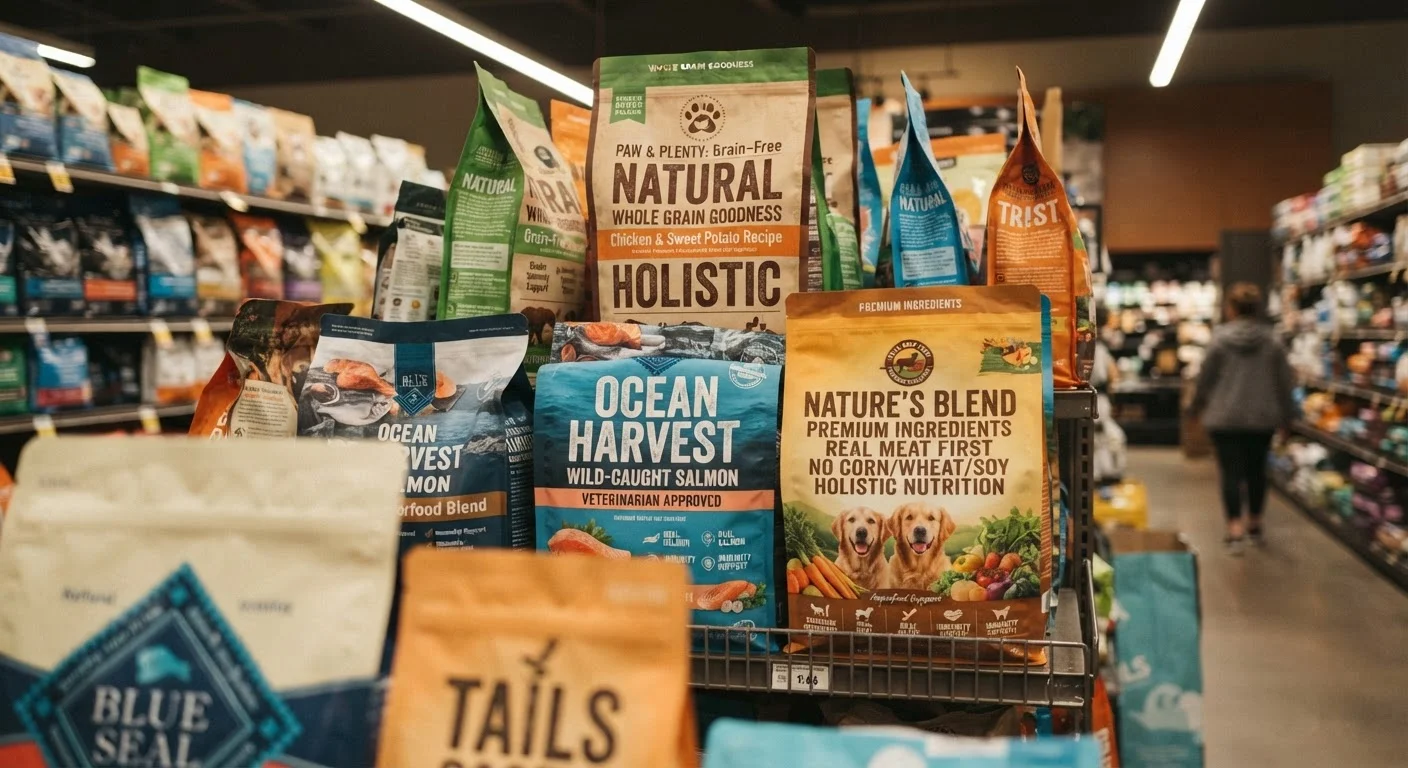
Why Label Language Matters
Walk through any pet store and you'll encounter a wall of promises: holistic, all-natural, ancestral recipe, super-premium. These words are selected by marketing teams, not nutritionists, and most carry no enforceable legal definition under U.S. pet food law. Yet research consistently shows they influence purchasing decisions significantly.
The regulatory gap matters. The AAFCO sets nutrient profiles and labeling standards, but it does not pre-approve pet foods before they reach shelves, and several common front-of-bag terms fall entirely outside its formal definitions. Understanding which words are regulated — and which are not — is the first step toward reading labels more critically.
For a deeper look at what the back of the bag actually communicates, see our guide to decoding pet food labels.
Myth
'Natural' on a pet food label means the product is minimally processed and free from artificial ingredients.
Fact
AAFCO defines 'natural' narrowly — it applies to ingredients derived solely from plant, animal, or mined sources — but the definition allows significant processing and does not govern the overall product formulation.
AAFCO's working definition of natural excludes chemically synthesized ingredients, but it permits heat treatment, rendering, purification, and other industrial processes. A highly processed kibble can still carry the 'natural' claim if its individual ingredients meet the source criteria. Additionally, many foods labeled natural contain added synthetic vitamins and minerals — permitted as long as the label notes that the product contains 'added vitamins and minerals.' The word signals nothing definitive about processing level, ingredient quality, or nutritional value.
Myth
'Holistic' pet food is held to a higher nutritional standard and represents a superior diet category.
Fact
'Holistic' has no legal or regulatory definition in U.S. pet food labeling. Any manufacturer can use the term without meeting any specific standard.
Neither AAFCO nor the FDA has defined holistic in the context of pet food. It is an entirely marketing-driven term with no enforceable meaning. A food labeled holistic is not subject to any additional testing, nutritional review, or ingredient requirement beyond what applies to any other pet food. When evaluating a product, ignore this word entirely and focus instead on the AAFCO nutritional adequacy statement and the ingredient list. You can find guidance on reading those elements in our article on what's actually in your pet's food.
Myth
Grain-free pet food is lower in carbohydrates and more aligned with what dogs and cats would eat naturally.
Fact
Grain-free diets frequently substitute grains with other high-carbohydrate ingredients like potatoes, peas, or lentils, and are not necessarily lower in total carbohydrate content.
Removing grains from a recipe does not eliminate carbohydrates — it simply changes the carbohydrate source. Many grain-free formulas rely heavily on legumes or root vegetables, which can contribute a similar or higher carbohydrate load compared to grain-containing equivalents. Beyond the nutrition question, the FDA has been investigating a potential association between certain grain-free diets high in legumes and a type of heart disease called dilated cardiomyopathy (DCM) in dogs. The science remains inconclusive, but the open questions are real. See our in-depth look at grain-free pet diets and the research behind them for a fuller picture.
Myth
'Premium' or 'super-premium' pet foods contain higher-quality ingredients than standard foods.
Fact
These terms have no regulatory definition and impose no additional ingredient or nutritional requirements on manufacturers.
Like 'holistic,' the terms premium and super-premium are marketing descriptors with no established meaning under AAFCO or FDA labeling rules. A manufacturer can place either word on the packaging of any product, regardless of ingredient sourcing, processing methods, or nutrient density. Price point is also not a reliable proxy for nutritional adequacy — some mid-priced foods carry strong AAFCO feeding trial credentials, while some expensive products do not. Focus on the nutritional adequacy statement and, when in doubt, discuss your pet's specific needs with your veterinarian.
What the Regulated Terms Actually Mean
A handful of label claims do carry specific regulatory meaning in the United States. Understanding this short list helps you separate signal from noise.
0
Regulated marketing terms like 'holistic' or 'premium'
Neither AAFCO nor the FDA has established an enforceable definition for 'holistic,' 'super-premium,' or similar front-of-bag descriptors used widely in the U.S. pet food market.
~$50B
Annual U.S. pet food and treat market size
The American Pet Products Association has reported the U.S. pet industry — including food — consistently exceeds tens of billions of dollars annually, making label literacy a meaningful consumer issue.
Human-grade is a term regulated by AAFCO when it appears on packaging. To legally use it, every ingredient must be edible under federal standards and the food must be manufactured, stored, and transported in a facility that also meets human food standards. Many foods use ingredients sourced from human food supply chains without meeting the full manufacturing requirement — meaning they cannot technically call the finished product human-grade, even if some brands imply otherwise.
Organic follows USDA National Organic Program rules when applied to pet food, the same framework used for human foods. If a product claims to be organic, the certification must be verifiable. By-products is another term with a formal AAFCO definition — it refers to secondary products of slaughter beyond muscle meat, and includes organs, which are nutrient-dense. The term is frequently used negatively in marketing, but its nutritional value depends on the specific ingredients, not the label category alone. Our article on pet food protein terminology breaks this down in full detail.
The most reliable quality signal on any pet food package remains the AAFCO nutritional adequacy statement — a sentence on the back panel stating whether the food has been formulated to meet established nutrient profiles or has passed feeding trials for a specific life stage.
For broader context on how oversight works, see how pet food regulations work in the United States. And if you're weighing different food formats, our comparison of wet food, dry kibble, and raw diets offers an objective overview.
This article is for general informational purposes only and does not constitute veterinary or dietary advice. Consult a licensed veterinarian before making significant changes to your pet's diet.
The content on this site is for informational purposes only and is not a substitute for professional advice. Always consult a qualified professional for guidance specific to your situation.