

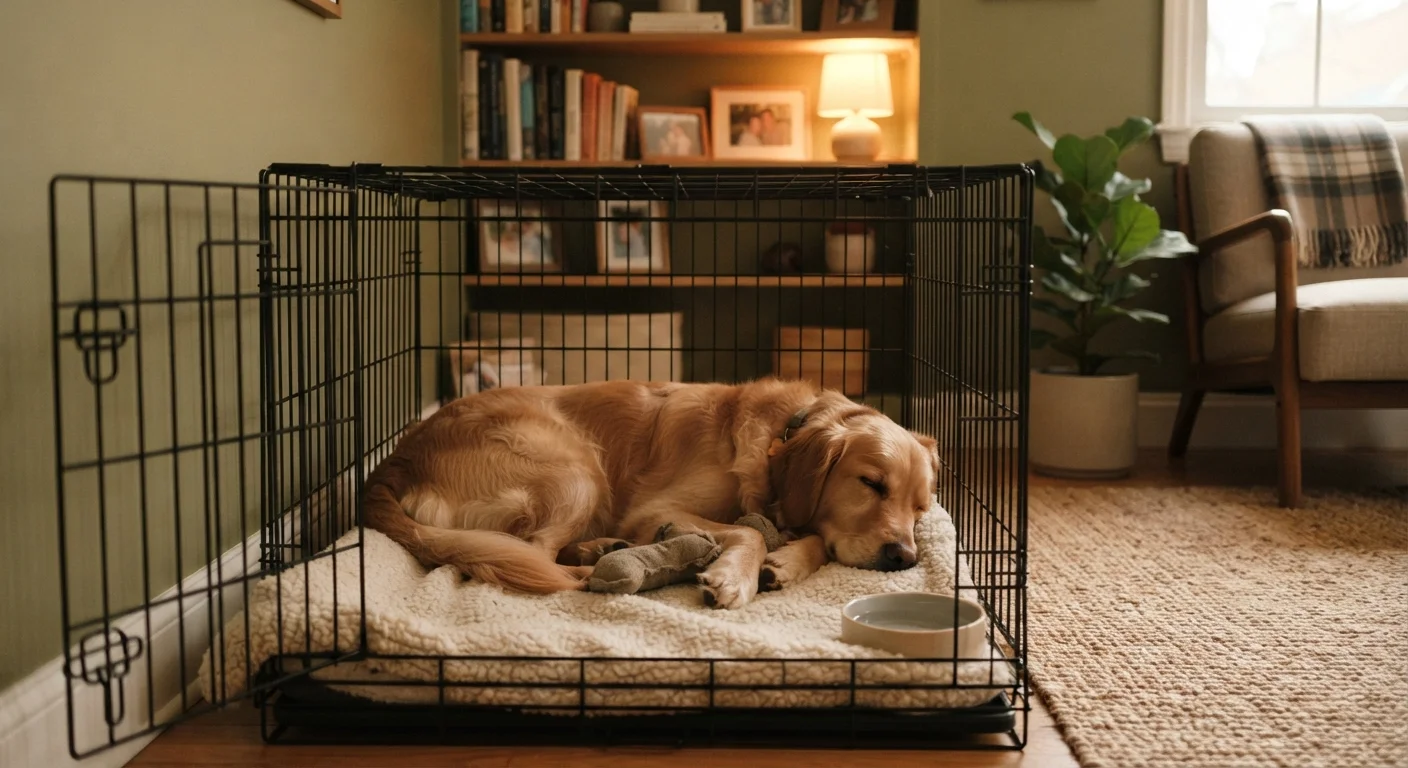
Why Crates Work With Canine Instinct
Dogs are not descended from animals that slept in wide-open spaces. In the wild, canids rest in small, sheltered locations — dens — that offer safety and sensory containment. Domestic dogs retain this preference, and a well-introduced crate taps directly into it. The crate is not a cage in the punitive sense; it's a defined territory the dog can claim as its own.
This matters because training that aligns with natural behavior tends to succeed faster and hold up longer than training that works against it. When an owner introduces a crate correctly, most dogs begin voluntarily retreating to it even when the door is open — particularly during loud events, household visitors, or when they simply want to rest undisturbed. If you are still building foundational trust with a new dog, see our guide to the first 30 days with a new dog for context on what to prioritize before formal training begins.
It's also worth noting that crate training is relevant at every stage of a dog's life — not just puppyhood. Our overview of how behavioral needs shift with age covers how training goals evolve over time.
What you will need
What You'll Need Before Starting
Effective crate training requires very little equipment, but what you use matters. Crate sizing is one of the most commonly misunderstood variables — too large and the crate loses its den-like quality; a puppy may also use the extra space as a bathroom. For puppies expected to grow considerably, a crate with a divider panel lets you adjust the interior size as the dog grows without buying multiple crates.
Wire or plastic dog crate
Provides the enclosed den-like space central to the entire training process.
High-value food treats
Used to build positive associations with entering and remaining in the crate.
Soft crate mat or blanket
Makes the crate interior comfortable and familiar-smelling to the dog.
Puzzle toy or chew
Provides mental engagement inside the crate to help the dog settle during longer durations.
Timing Meals Near the Crate Builds Positive Association
Feed your dog their regular meals just outside the crate door, then gradually move the bowl further inside over several sessions. This pairs something inherently rewarding — food — with the crate environment. It's one of the fastest ways to shift emotional tone from neutral to genuinely positive.
The Step-by-Step Acclimation Process
The steps below represent a graduated approach grounded in classical conditioning — systematically pairing the crate with positive experiences until the dog's emotional response to the space shifts from uncertainty to comfort. The timeline is intentionally flexible because individual dogs vary considerably in their temperament and prior experiences. Rushing this process is the most common mistake owners make.
Never Use the Crate as Punishment
Sending a dog to the crate after undesirable behavior teaches the dog to associate the space with negative emotion — the opposite of what you're building. The crate must always be a positive, neutral space. If you use it as a timeout, you will likely see increased resistance, anxiety, and difficulty with the training process overall.
Introduce the crate as furniture, nothing more
Place the crate in a room where your family spends time — a living room or bedroom works well. Leave the door open and let your dog investigate at their own pace. Do not push, lure, or force your dog inside during this phase. Simply allow curiosity to do the work. Some dogs walk straight in; others may take a day or two before approaching without hesitation. Both are normal.
Toss treats inside and let the dog enter voluntarily
Once your dog is comfortable approaching the crate, begin tossing treats toward the back of the crate interior while the door stays open. The dog enters, takes the treat, and is free to exit immediately. Repeat this five to ten times per session. The goal is to make every trip into the crate a small, rewarding event — not a commitment to stay.
Begin feeding meals inside the crate
Place your dog's regular meal bowl just inside the crate threshold. Over the next several meals, move the bowl progressively further inside — eventually placing it at the far back wall. Once your dog is eating comfortably with their body fully inside, you can gently close the door while they finish the meal. Open it immediately when they're done. Gradually extend the time the door remains closed by a minute or two at each subsequent meal.
Build duration in short, structured sessions
Outside of mealtimes, practice having your dog enter the crate, settle, and remain for progressively longer periods. Use a cue word consistently — many owners use 'crate' or 'place.' Reward calm behavior inside with quiet praise or a treat dropped through the door. Start with two-minute intervals and work up over several days. Stay in the room initially; your presence reduces stress during this critical phase.
Practice short absences from the room
Once your dog settles calmly for ten to fifteen minutes with you present, begin leaving the room briefly — first for one or two minutes, then building to longer stretches over the following days. Return calmly and without fanfare. Avoid making arrivals or departures dramatic, as this can inadvertently heighten anticipation and anxiety around your comings and goings.
Establish a consistent nighttime routine
Place the crate in or near the bedroom during the initial weeks — especially for puppies. Proximity to you reduces nighttime distress significantly. As your dog grows more confident in the space, you can gradually move the crate to your preferred long-term location. Consistency in timing — crating at roughly the same hour each night — helps the dog anticipate the routine without resistance.
Watch for Signs of Distress, Not Just Noise
Some dogs vocalize briefly out of mild frustration and settle quickly. However, prolonged panic — excessive drooling, self-injury from trying to escape, or complete inability to settle — signals that the current training pace is too fast. Slow down the acclimation process. If separation-related distress is severe, consult a certified professional trainer or veterinary behaviorist before continuing.
This article is for general informational purposes. For dogs with severe anxiety or behavioral concerns, consult a certified professional trainer or a veterinary behaviorist rather than attempting to work through the process alone.
Once your dog reliably settles in the crate, you may find it easier to work on other cues that require impulse control. Our article on teaching a reliable 'stay' builds on many of the same foundations covered here.
The content on this site is for informational purposes only and is not a substitute for professional advice. Always consult a qualified professional for guidance specific to your situation.