

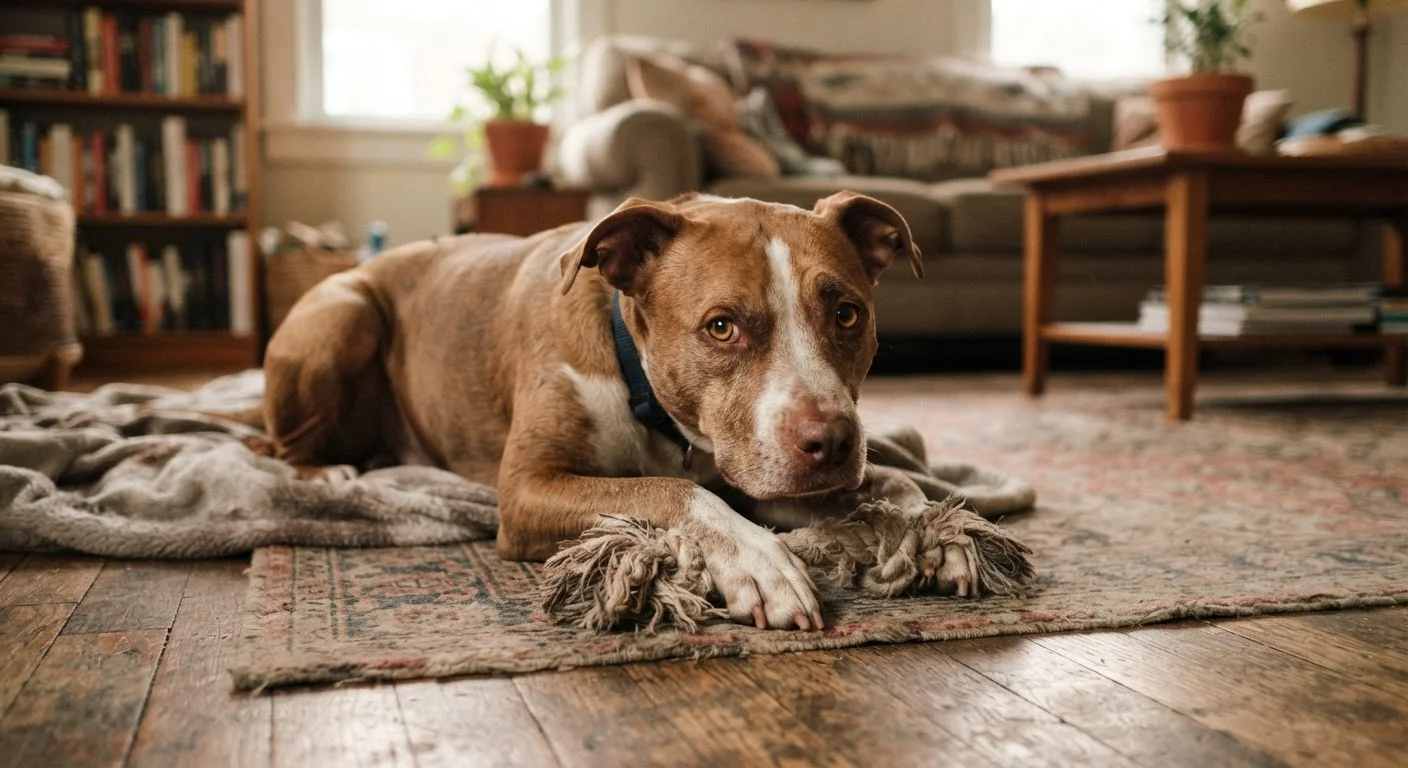
What Resource Guarding Actually Looks Like
Resource guarding exists on a spectrum, and owners often miss the early, subtle signals. The sequence typically follows a predictable escalation path when warnings go unheeded.
- Freezing or stiffening: The dog goes rigid over the item, a quiet but clear signal of discomfort.
- Hard stare: Prolonged, unblinking eye contact directed at the approaching person or animal.
- Lip curl or low growl: Vocalized warnings that communicate "back off" without physical contact.
- Snapping or lunging: Escalated responses when earlier warnings were ignored or punished.
- Biting: The most serious end of the spectrum, typically reached when all other signals have failed.
The items dogs guard most commonly include food bowls, high-value chews, toys, sleeping spots, and occasionally people. Understanding that the behavior is communicative — not malicious — changes how owners should respond. Just as leash pulling reflects instinct rather than stubbornness, resource guarding reflects a dog's internal calculus about survival and competition.
Guarding Is Not the Same as Aggression
It can be alarming when a dog growls at a family member, but it is important not to leap to the label of "aggressive dog." Resource guarding is a specific, context-bound behavior that can coexist with an otherwise friendly, stable temperament. Mislabeling the behavior often leads to inappropriate responses — including punishment — that make the situation worse rather than better.
Why Dogs Develop Guarding Behavior
Resource guarding has deep evolutionary roots. Wild canids that successfully defended food and shelter had a survival advantage — that trait persisted. Domestic dogs retain this instinct to varying degrees, regardless of how comfortable and resource-rich their home environment actually is.
Several factors can intensify guarding in individual dogs:
- Early competition: Dogs from large litters or chaotic shelter environments may have learned early that resources disappear if not defended.
- Learned reinforcement: If guarding behavior has previously caused people or other animals to retreat, the dog learns it works.
- Inconsistent handling: Unpredictable access to food or toys can heighten anxiety around valued items.
- Underlying anxiety: Dogs with broader anxiety profiles — including separation anxiety — may guard more intensely as a general expression of insecurity.
It is worth noting that guarding is not caused by a dog believing it is the "pack leader." Dominance-based explanations for guarding have been substantially revised by behavioral science, and management strategies built on that premise can backfire.
“The goal of behavior modification for resource guarding is not to convince the dog it has no right to its resources — it is to change the emotional association so that an approaching human predicts good things rather than loss.”
— Dr. Karen Overall, Veterinary behaviorist and author of clinical behavioral medicine texts for small animals
Safe and Effective Approaches for Owners
The most effective long-term strategy is counter-conditioning — changing the dog's emotional response to an approaching person from anxiety to positive anticipation. Here is how that works in practice:
- Approach and add, don't take: Walk near the dog during mealtime and drop a high-value treat near the bowl, then walk away. Over time the dog learns that your approach predicts good things.
- Trade up, don't grab: If you need to retrieve an item, offer something equally or more appealing in exchange. "Drop it" trained on lower-stakes items builds trust for higher-stakes situations.
- Avoid punishment for growling: Suppressing the growl removes a warning signal but does not address the discomfort driving it. A dog that stops growling has not stopped feeling threatened — it has simply lost its early warning system.
- Manage the environment: In multi-pet households, feed dogs separately and pick up high-value chews before gatherings. Preventing the situation is valid management. See our guidance on managing territorial conflict in multi-pet homes for more on household dynamics.
Start Training in Low-Stakes Situations
Begin counter-conditioning with items your dog guards least intensely — a low-value toy rather than a prized chew. Building positive associations around less charged items first gives the dog a foundation of trust that transfers gradually to higher-value resources. Small, frequent practice sessions are more effective than infrequent marathon training attempts.
Progress with guarding behavior is gradual. Consistency and patience across weeks — not days — are what produce durable change. Be cautious about dramatic training claims encountered online; viral training advice does not always reflect behavioral science.
When to Bring in a Professional
Not all resource guarding can or should be addressed through owner-led training alone. Seek professional help if:
- The dog has made contact — a snap or bite — in a guarding context.
- Guarding is escalating in frequency or intensity over time.
- Children under 12 regularly interact with the dog.
- Multiple animals in the home are involved in guarding conflicts.
- The owner feels unsafe or unable to manage the environment.
A certified applied animal behaviorist (CAAB) or a board-certified veterinary behaviorist (Dip ACVB) has the training to conduct a full behavioral assessment and build a structured modification plan. In some cases, a veterinary evaluation is also appropriate to rule out pain-related irritability — a dog guarding more than usual after an injury or illness may be reacting to discomfort rather than behavioral motivation alone. Always consult a qualified professional for personalized guidance about your specific dog's behavior.
This article is for general informational and educational purposes only and does not constitute professional veterinary or behavioral advice. Consult a licensed veterinarian or certified animal behaviorist for guidance specific to your dog's situation.
Frequently Asked Questions
Resource guarding is a specific, context-driven behavior — not a global personality trait. A dog that guards its food bowl is not necessarily aggressive in all situations. However, guarding that regularly escalates to snapping or biting does carry injury risk and warrants professional evaluation.
Growling near food is the dog communicating discomfort about a perceived threat to a valued resource. It is often learned from early experiences of competition or resource scarcity. The growl is a warning signal, not an unprovoked attack, and should not be punished away.
Many dogs show significant improvement with consistent counter-conditioning, but the underlying predisposition may not disappear entirely. The realistic goal is managing and reducing guarding to a safe, non-disruptive level — not necessarily eliminating the instinct.
Forcibly taking items to assert dominance is not supported by current behavioral science and can escalate guarding or trigger defensive biting. Trade-based approaches — offering something of equal or higher value — are safer and more effective.
If your dog has snapped, lunged, or bitten in relation to a resource, or if the behavior is escalating, consult a certified professional canine behaviorist or a veterinary behaviorist promptly. Situations involving children or multiple pets in the household also warrant early professional input.
Guarding can appear in any breed, though some dogs bred for independent work or property guarding may show stronger tendencies. Breed alone is not a reliable predictor — individual temperament, early socialization, and learned experience all play significant roles.
The content on this site is for informational purposes only and is not a substitute for professional advice. Always consult a qualified professional for guidance specific to your situation.