

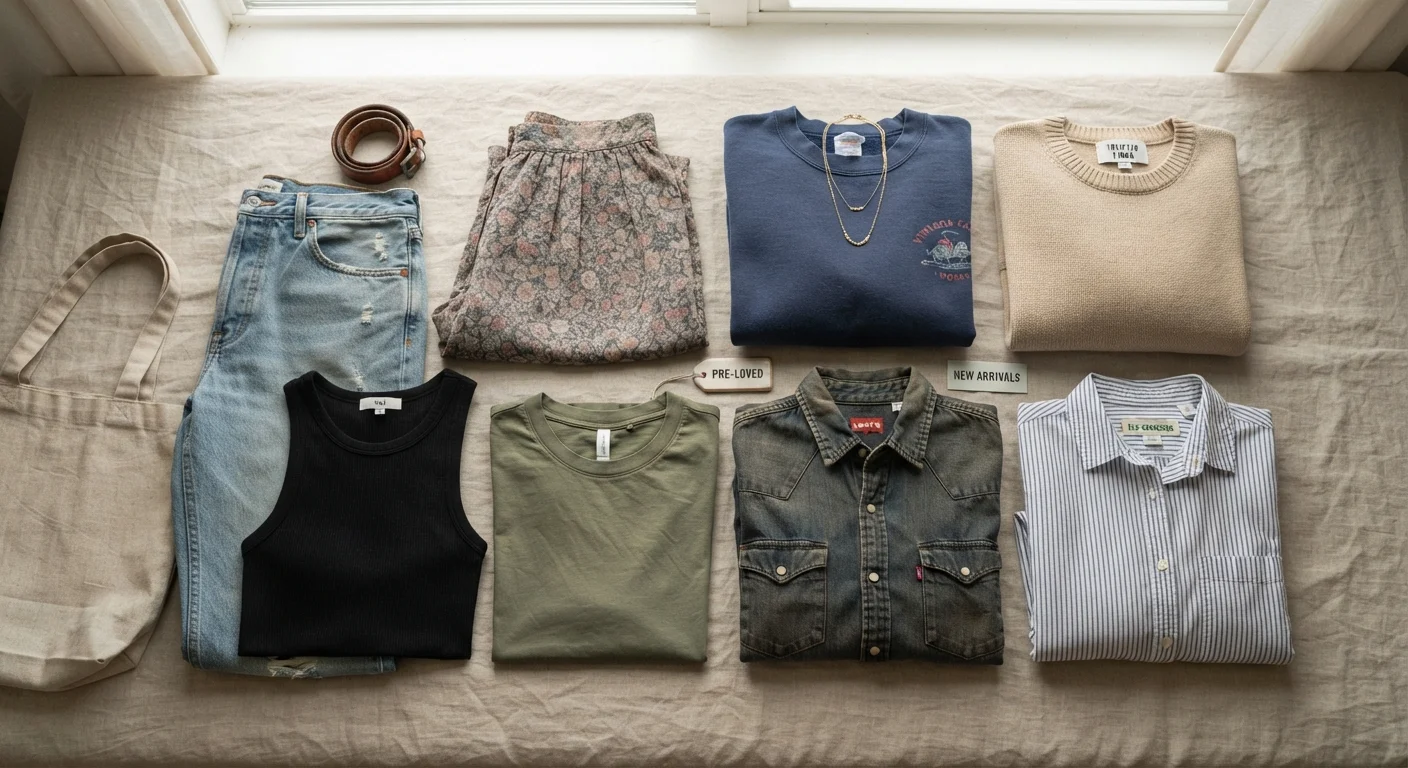
Our Verdict
Secondhand shopping tends to offer stronger value per dollar and a smaller immediate environmental footprint, but it demands time and flexibility. Fast fashion delivers speed and predictability at the cost of durability and resource use. For most everyday Americans, the most practical wardrobe strategy combines both — thrifting where possible and buying new only when secondhand options fall short.
| Best for | Recommended |
|---|---|
| Budget-focused shoppers with flexible schedules | Secondhand / Thrifted |
| Those needing specific sizes, fits, or items quickly | Fast Fashion |
| Shoppers building a long-term, versatile wardrobe | A blended approach |
| Anyone prioritising environmental considerations | Secondhand / Thrifted |
Cost: Where Does Your Dollar Actually Go?
On a pure sticker-price basis, secondhand wins most of the time. Thrift stores, resale apps, and consignment shops typically price garments well below their original retail value — sometimes dramatically so. A blazer that retailed for $80 might turn up for $12 at a well-stocked thrift shop.
Fast fashion competes by offering low entry prices on new items, but the math shifts when you factor in durability. A $15 top that pills or loses its shape after five washes costs more per wear than a $10 secondhand blouse that holds up for years. That said, fast-fashion basics — plain tees, casual leggings, simple layering pieces — can still deliver reasonable cost-per-wear when chosen deliberately and cared for well.
For practical guidance on stretching what you already own, see getting more mileage out of your current wardrobe before spending anything new.
Calculate Cost Per Wear
Divide an item's price by the number of times you realistically expect to wear it. A $40 secondhand jacket worn 80 times costs $0.50 per wear; a $10 fast-fashion top worn five times costs $2.00. This simple frame shifts focus from sticker price to actual value — and works for any wardrobe decision regardless of where you shop.
Quality and Durability: What You're Actually Getting
Secondhand clothing spans the full quality spectrum — you might find a barely-worn wool coat or a synthetic blouse on its last thread. The key variable is construction: natural fibers, reinforced seams, and quality hardware tend to survive multiple owners. Learning to check garment labels and inspect seams before buying pays off quickly.
Fast fashion, by design, prioritises speed and price over longevity. Fabric weights have trended lighter over the past two decades, and construction shortcuts are common. That doesn't mean every fast-fashion piece is disposable, but it does mean scrutinising a garment's stitching and fabric content before buying is especially important in that category.
Dressing well at any price point comes down to fit and fabric more than the tag — a principle that applies equally whether you're thrifting or shopping new.
| Secondhand / Thrifted | Fast Fashion | |
|---|---|---|
| Typical price per item | Generally lower | Low to moderate |
| Item availability | Unpredictable, hunt required | Consistent, on-demand |
| Size consistency | Variable across eras and brands | Standardised by retailer |
| Garment durability | Varies widely; inspect carefully | Often lower; construction shortcuts common |
| Environmental footprint | Lower if replacing new purchases | Higher per item manufactured |
| Time investment | Higher — browsing required | Lower — quick and convenient |
| Return / exchange ease | Limited or none | Generally easier |
Environmental Impact: Honest Accounting
The environmental case for secondhand shopping is real but nuanced. Buying a used garment does avoid the energy, water, and raw materials required to manufacture a new one. Research on textile production consistently identifies it as a resource-intensive industry, and extending a garment's lifespan has a measurable positive effect.
However, the full picture is more complicated. If secondhand shopping simply adds to an already-large wardrobe rather than replacing new purchases, the net benefit shrinks. And fast-fashion items aren't automatically worse if they're worn hundreds of times and properly maintained. How long you wear something — regardless of where it came from — is among the strongest predictors of its overall environmental cost per use.
For a fuller exploration of what sustainability claims in fashion actually mean, Style and Sustainability: What Everyday Shoppers Should Actually Know offers an honest, evidence-grounded breakdown.
~10%
Global carbon emissions from apparel and footwear
The United Nations Environment Programme has estimated the fashion industry accounts for around 8–10% of global carbon emissions, though precise figures vary by methodology.
700+ gallons
Water to produce one cotton T-shirt
The World Resources Institute has cited estimates suggesting it takes roughly 700 gallons of water to grow enough cotton for a single T-shirt.
3x longer
Impact of doubling garment lifespan
The Ellen MacArthur Foundation has noted that extending clothing use even modestly — such as wearing garments twice as long — can significantly reduce overall environmental impact.
Practicality: Time, Access, and Real-Life Constraints
Thrifting rewards patience. Finding the right size, fit, and condition in a secondhand setting takes browsing time that not everyone has. Access also varies — urban thrift markets tend to be better stocked than rural ones, and online resale platforms have expanded options but add shipping time and return friction.
Fast fashion's core advantage is convenience: consistent sizing, easy returns, and items available on demand. For specific wardrobe needs — a particular color for a wedding, a specific uniform requirement, or a hard-to-find size — new retail often remains the practical default.
If you're navigating seasonal wardrobe shifts, seasonal wardrobe transitions without constant new purchases offers strategies that work alongside either shopping approach. And for higher-stakes purchases like formalwear, the calculus changes again — renting vs. owning formalwear is worth reading before committing to either buying new or hunting secondhand.
Buying More Isn't Automatically Better
A common pitfall with both thrifting and fast fashion is treating low prices as a reason to buy more than you'll actually wear. An unused $6 thrift-store find delivers no value and still contributes to clutter. Before purchasing, ask whether the item fills a real gap in your wardrobe — not just whether the price feels like a deal.
The content on this site is for informational purposes only and is not a substitute for professional advice. Always consult a qualified professional for guidance specific to your situation.