

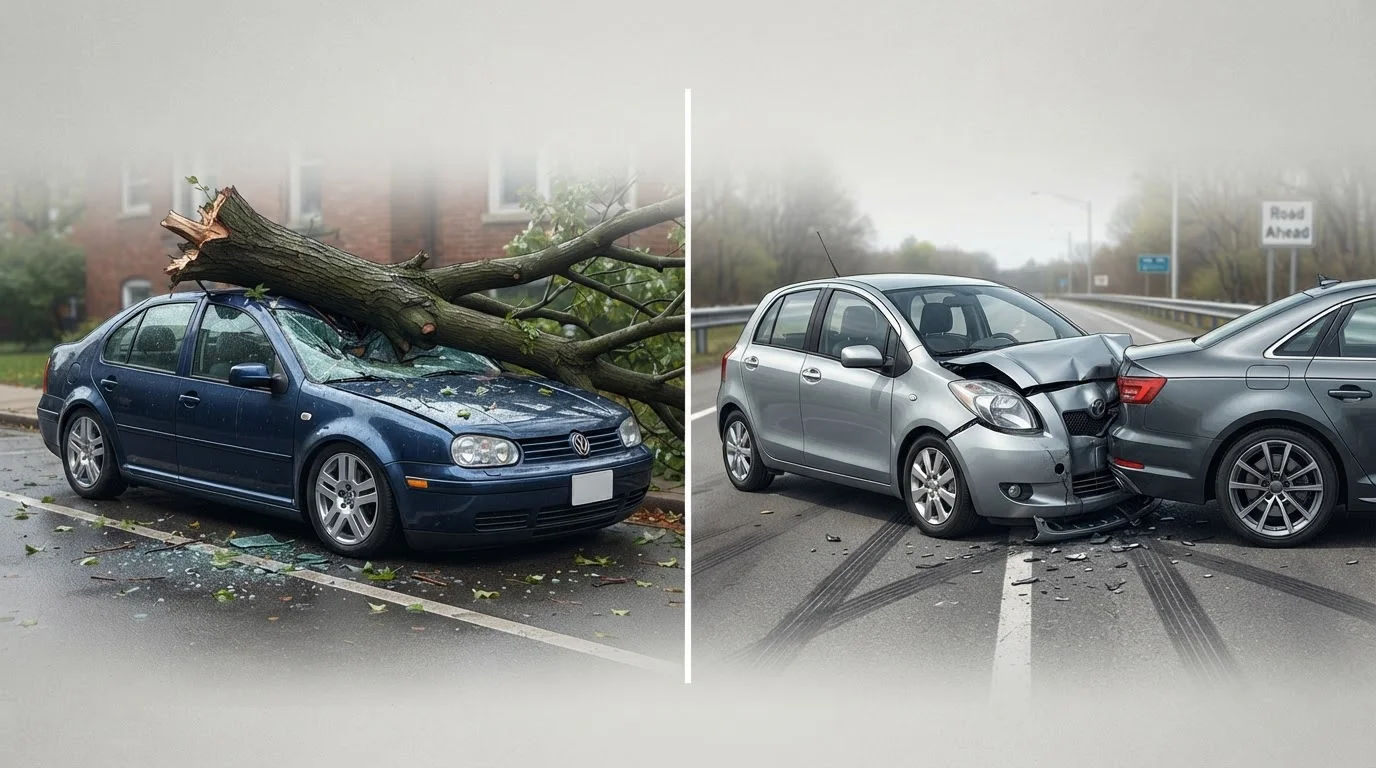
Option A
Comprehensive Coverage
Protection against events outside your control.
Best for: Drivers who want financial protection from weather damage, theft, animal strikes, and other non-collision incidents.
Option B
Collision Coverage
Protection when your car makes unwanted contact.
Best for: Drivers who want protection when their vehicle is damaged by contact with another car, object, or the road itself.
What Each Coverage Actually Does
Comprehensive and collision are both optional coverages - optional in the sense that no state mandates them - but they address fundamentally different types of loss. Understanding the distinction matters when you're evaluating your policy or deciding what to keep.
Comprehensive coverage pays to repair or replace your vehicle when it's damaged by something other than a collision. Common triggers include theft, vandalism, fire, flooding, hail, falling objects (like a tree limb), and striking an animal. The defining characteristic: the event is largely outside the driver's control.
Collision coverage pays when your vehicle makes physical contact with another vehicle or object - another car, a guardrail, a utility pole, or even the ground after a rollover. It responds regardless of who is at fault. If you rear-end another driver or slide on ice into a curb, collision coverage handles your vehicle's damage.
For a broader look at how these fit into an overall policy structure, see our guide to liability vs. full coverage. And if any of the terminology feels unfamiliar, our auto insurance terms reference is a useful starting point.
| Criterion | Comprehensive Coverage | Collision Coverage |
|---|---|---|
| What triggers a claim | Non-collision events (theft, weather, animals, fire) | Impact with another vehicle or object |
| At-fault requirement | Not applicable - event-based | Covers regardless of fault |
| Typical deductible range | $250-$1,500 | $250-$1,500 |
| Payout basis | Actual cash value minus deductible | Actual cash value minus deductible |
| State-mandated | No | No |
| Lender/lessor required | Typically yes | Typically yes |
| Covers theft | Yes | No |
| Covers hitting a deer | Yes | No |
| Covers single-vehicle rollover | No | Yes |
| Covers damage to other vehicle | No | No |
Deductibles, Payouts, and What Insurers Actually Cover
Both coverages pay your vehicle's actual cash value (ACV) - what the car is worth at the time of the loss, accounting for depreciation - minus your chosen deductible. The deductible is the amount you pay out of pocket before the insurer covers the rest.
Deductibles for both types typically range from $250 to $1,500. Choosing a higher deductible lowers your premium but increases your exposure when you file a claim. There is no single right answer; the optimal level depends on your vehicle's value, your savings buffer, and how frequently you anticipate needing to file.
~$167/yr
Average comprehensive premium (U.S.)
According to the National Association of Insurance Commissioners (NAIC), the average U.S. expenditure for comprehensive coverage was approximately $167 annually in recent reported data.
~$363/yr
Average collision premium (U.S.)
NAIC data shows collision coverage consistently costs more than comprehensive, reflecting the higher frequency of impact-related claims nationwide.
1 in 88
Odds of a vehicle theft claim
The Insurance Information Institute estimates roughly one in 88 insured vehicles is subject to a theft-related claim in a given year, underscoring comprehensive coverage's relevance.
One important distinction: comprehensive deductibles and collision deductibles are set separately. You might carry a $500 comprehensive deductible and a $1,000 collision deductible, or any other combination your insurer allows. Review both when comparing quotes.
Be aware that neither coverage pays for damage to the other driver's vehicle or property - that's the role of liability coverage. For a full picture of what standard policies may leave unaddressed, see our article on gaps in auto coverage that catch drivers off guard.
When It Makes Sense to Carry One, Both, or Neither
If you have an outstanding auto loan or are leasing your vehicle, carrying both comprehensive and collision is almost certainly required by your lender or lessor - not optional. Dropping either coverage while the loan is active violates most financing agreements.
If you own your vehicle outright, the decision becomes a financial calculation. A general rule of thumb: if the combined annual cost of both premiums plus your deductible approaches or exceeds your vehicle's current market value, the coverages may return less than they cost over time. However, this is a general heuristic, not a guarantee - a single total-loss event could shift the math significantly.
Geography also plays a role. Drivers in regions with frequent hail, flooding, or high vehicle theft rates tend to derive more value from comprehensive coverage. Those with long highway commutes or urban driving patterns face statistically higher collision exposure. Consider your actual risk profile, not just the sticker price of the premium.
This article provides general insurance education and is not personalized advice. Coverage needs vary by individual, vehicle, and insurer. Always read your actual policy documents and speak with a licensed insurance agent before making changes to your coverage.
This article is for informational purposes only and does not constitute personalized insurance, financial, or legal advice. Terms, coverage, exclusions, and premiums vary by provider and state. Consult a licensed insurance professional before making decisions about your specific policy.
What 'Full Coverage' Actually Means
The term 'full coverage' is informal - it has no standard legal or regulatory definition. In practice, most insurers and consumers use it to describe a policy that includes liability, comprehensive, and collision coverage together. It does not mean every possible loss is covered. Always review your specific policy declarations page to know exactly what is and isn't included.
The content on this site is for informational purposes only and is not a substitute for professional advice. Always consult a qualified professional for guidance specific to your situation.