

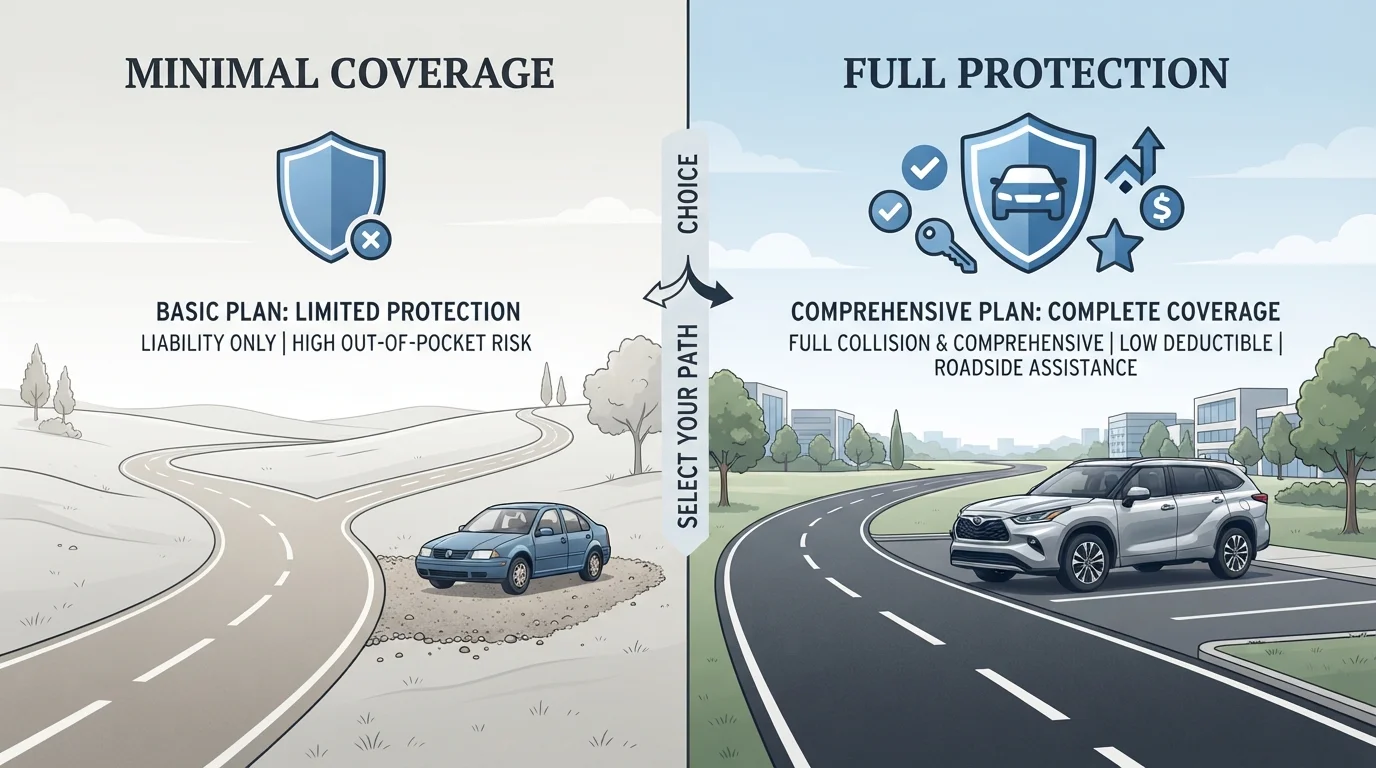
Option A
Liability-Only Coverage
The legally required minimum that protects others, not your vehicle.
Best for: Drivers of older, lower-value vehicles who carry no loan or lease obligation and can absorb the financial loss of a totaled car.
Option B
Full Coverage
The broader protection package that includes your own vehicle's repair costs.
Best for: Drivers with newer or financed vehicles who need financial protection against damage to their own car, regardless of fault.
What Each Coverage Type Actually Covers
Auto insurance policies are built from distinct coverage types, each addressing a different financial risk. Understanding what you're actually buying - and what you're not - is the foundation of any smart coverage decision.
Liability coverage is the baseline required in nearly every U.S. state. It pays for bodily injury and property damage that you cause to other people in an at-fault accident. If you rear-end another car, your liability coverage pays to repair that vehicle and covers medical expenses for anyone injured - up to your policy limits. Critically, it does not pay for damage to your own vehicle or your own medical bills.
Full coverage is not a single policy type but rather an industry shorthand for a bundle that combines liability coverage with two additional components: comprehensive and collision. Collision coverage pays to repair or replace your vehicle after a crash, regardless of fault. Comprehensive coverage pays for losses caused by non-collision events - theft, vandalism, hail, flooding, or hitting an animal. Together, these three elements form what consumers and insurers commonly call full coverage. To understand the distinction between those two add-ons, see our breakdown of comprehensive vs. collision coverage.
| Criterion | Liability-Only | Full Coverage |
|---|---|---|
| Covers damage to others | Yes | Yes |
| Covers your own vehicle damage | No | Yes (collision + comprehensive) |
| Covers theft or weather damage | No | Yes (comprehensive) |
| Required by lenders/lessors | No | Typically yes |
| Monthly premium | Lower | Higher |
| Deductible applies | No (for third-party claims) | Yes (for your own vehicle claims) |
| Suitable for older, low-value cars | Often yes | Less cost-effective |
The Financial Trade-Off: Premiums vs. Exposure
The core trade-off is straightforward: liability-only costs less each month, but leaves you personally responsible for any damage to your own vehicle. Full coverage carries a higher premium, but transfers that risk to the insurer.
~75%
U.S. drivers carrying more than liability-only
According to the Insurance Research Council, roughly three-quarters of insured drivers in the U.S. carry collision coverage, reflecting widespread recognition of out-of-pocket repair risks.
$1,000+
Typical average annual collision coverage cost
The National Association of Insurance Commissioners reports that collision coverage is consistently the most expensive optional add-on in a standard auto policy.
Whether that trade-off makes financial sense depends largely on your vehicle's current market value. A general rule of thumb used by many financial educators is to compare the annual cost of adding comprehensive and collision coverage against the vehicle's actual cash value, minus your deductible. If the premiums approach or exceed a meaningful percentage of what you'd actually collect from a claim, the added protection may offer diminishing returns.
It's equally important to consider your personal financial resilience. If your car was totaled tomorrow with no collision coverage, could you replace it or manage without it? If the answer is no, the math shifts in favor of carrying full coverage regardless of the vehicle's age. For a closer look at where standard policies fall short, our article on common gaps in auto coverage is worth reviewing.
When the Decision Is Made for You
For many drivers, the liability-versus-full-coverage decision isn't entirely theirs to make. If you financed your vehicle through a lender or are leasing it, your contract almost certainly requires you to carry both comprehensive and collision coverage for the life of the loan or lease. This protects the lender's financial interest in an asset they technically still have a stake in.
Dropping to liability-only while carrying an auto loan is a contractual violation and can result in the lender purchasing force-placed insurance on your behalf - typically at a significantly higher cost than a standard policy, and with coverage that benefits the lender rather than you.
Force-Placed Insurance: An Important Caution
If a borrower drops required coverage on a financed vehicle, the lender can purchase insurance on the car and bill the borrower for it. Force-placed policies typically cover only the lender's interest - not the driver's personal liability or vehicle repair costs from the driver's perspective. The premiums are often higher than standard market rates. Maintaining the coverage required by your loan agreement is the straightforward way to avoid this outcome.
Once a loan is paid off or a lease ends, the requirement lifts and the decision reverts to you. At that point, re-evaluating your coverage based on the vehicle's current value and your financial situation is a reasonable step. For context on how state minimums factor into this calculation, see our article on state minimum requirements vs. adequate coverage.
This article is for general informational purposes only and does not constitute personalized insurance, financial, or legal advice. Coverage terms, requirements, and costs vary by provider, state, and individual circumstances. Consult a licensed insurance professional before making coverage decisions.
The content on this site is for informational purposes only and is not a substitute for professional advice. Always consult a qualified professional for guidance specific to your situation.