

Our Verdict
No single insulation material wins across every scenario. Fiberglass suits straightforward new construction or open-stud retrofits on a tighter budget. Spray foam is the standout performer for air sealing and unusual geometries. Cellulose strikes a practical middle ground for retrofit projects in enclosed, hard-to-reach spaces and carries strong environmental credentials.
| Best for | Recommended |
|---|---|
| Budget-conscious new construction or open stud walls | Fiberglass Batts |
| Maximum thermal performance and air sealing in one step | Spray Foam |
| Retrofitting enclosed walls or attics with irregular framing | Cellulose |
| Eco-minded homeowners prioritizing recycled content | Cellulose |
Why Insulation Type Matters More Than Most Homeowners Realize
Insulation is one of those home systems that works invisibly — until it doesn't. Picking the wrong material for a given application can result in moisture problems, persistent drafts, and energy bills that never seem to drop no matter how well you seal windows and doors. Understanding the three most common residential insulation materials — fiberglass batts, spray foam, and cellulose — gives you the context to make smarter decisions whether you're finishing a basement, insulating an attic, or retrofitting an older home.
All three materials are measured partly by R-value, a rating that describes resistance to heat flow. The higher the R-value per inch, the more thermal resistance a given thickness provides. But R-value alone doesn't tell the whole story: air sealing ability, moisture tolerance, installation method, and cost all factor into which material earns its place in a specific location.
Installation Quality Matters as Much as Material
Even the highest R-value insulation underperforms when it's cut too short, compressed into a cavity, or leaves gaps around electrical boxes and pipes. If you're doing a DIY fiberglass install, take the time to cut each batt precisely and fill every void — especially around framing irregularities. For enclosed walls or complex geometries, professional dense-pack or spray foam application typically yields more consistent results than a DIY attempt.
Fiberglass Batts: The Familiar Workhorse
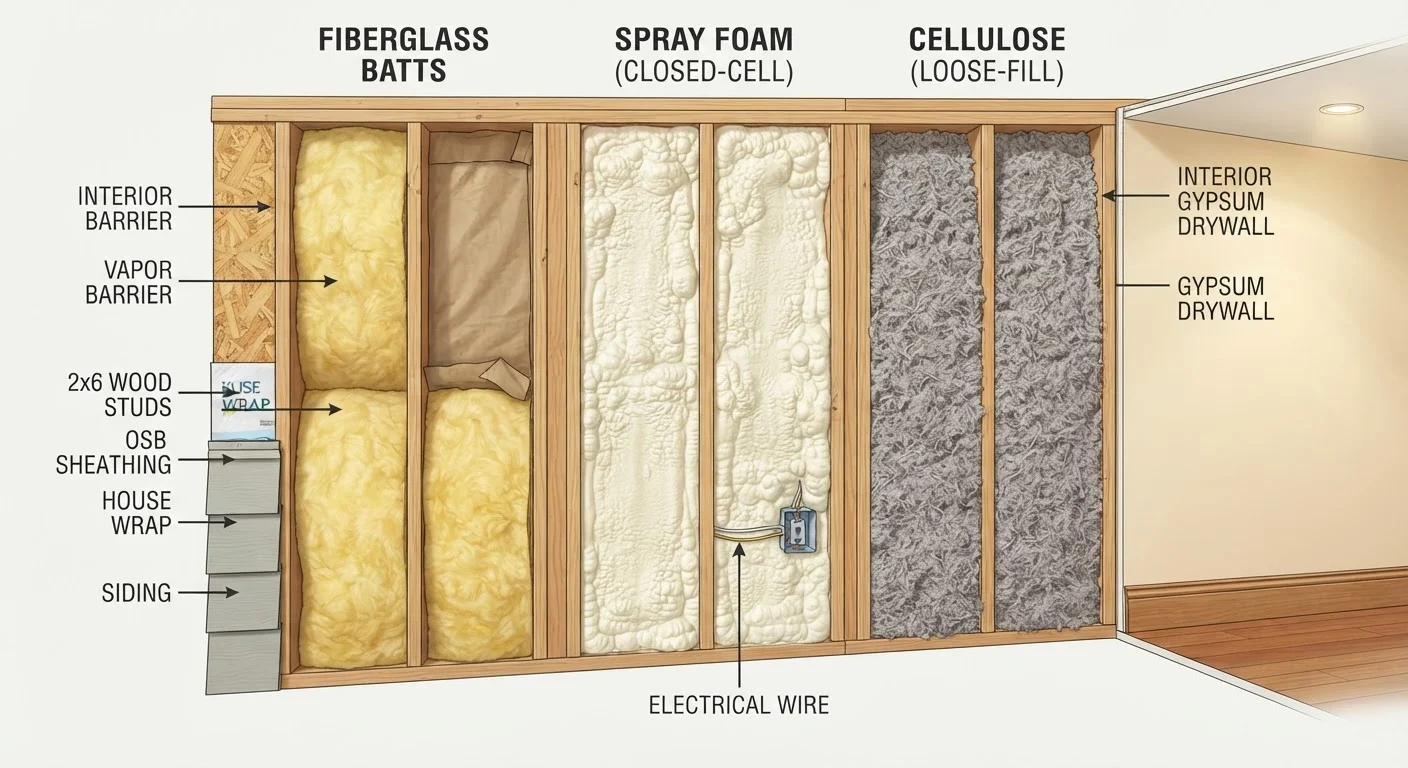
Fiberglass batts are the pink or yellow rolls and pre-cut panels most people picture when they think of insulation. They're manufactured from spun glass fibers and sized to fit standard 16-inch and 24-inch stud and joist spacing. R-values typically range from about R-11 for a 3.5-inch batt (standard 2×4 wall) to R-38 or higher for thicker attic batts.
Where fiberglass excels: open-stud walls during new construction, floor joists above unconditioned crawl spaces, and attic floors where there's room to lay multiple layers. Installation is accessible enough for a careful DIYer, though proper fitting is critical — gaps, compression, or voids can significantly reduce real-world performance.
Limitations: fiberglass does not stop air movement on its own. It insulates, but air can still infiltrate around and through it unless a separate air barrier (house wrap, rigid foam sheathing, or careful taping) is also in place. It also performs poorly in irregularly shaped cavities where cutting and fitting becomes time-consuming and imprecise.
Spray Foam: High Performance, Higher Investment
Spray polyurethane foam (SPF) comes in two main forms: open-cell and closed-cell. Open-cell foam is softer, expands dramatically to fill cavities, and achieves roughly R-3.5 to R-4 per inch. Closed-cell foam is denser, more rigid, and delivers R-6 to R-7 per inch — among the highest available for a spray-applied material. Critically, closed-cell foam also acts as a vapor retarder and a strong air barrier simultaneously, reducing the need for additional layers.
Spray foam shines in areas where irregular geometry makes batts impractical: rim joists, cathedral ceilings, around pipes and wiring penetrations, and in older homes with non-standard framing. It bonds to surfaces and expands into gaps that other materials simply can't reach.
The tradeoffs are cost and installation complexity. Professional installation is standard for most spray foam applications because the two-component chemical system requires proper mixing ratios, protective equipment, and ventilation during curing. Improper application can lead to off-ratio foam that doesn't cure correctly, creating indoor air quality concerns. Some formulations also have environmental considerations related to the blowing agents used.
Spray Foam Requires Proper Ventilation During Curing
Freshly applied spray polyurethane foam releases fumes during the curing process that can irritate the respiratory system and eyes. Occupants and pets should vacate the area for the period recommended by the installer — typically 24 to 72 hours depending on the product and ventilation. Always ask the contractor for the specific re-entry timeframe and ensure adequate ventilation before returning.
Cellulose: The Retrofit Specialist
Cellulose insulation is made primarily from recycled newspaper and cardboard treated with fire-retardant chemicals, typically borate compounds. It achieves R-values of approximately R-3.2 to R-3.8 per inch, comparable to fiberglass but with a notably different installation method.
Cellulose is blown in using specialized equipment — either dry-blown into open attic spaces or dense-packed into enclosed wall cavities through small drilled holes. That dense-pack method is what makes cellulose particularly valuable for retrofitting existing walls without opening them up entirely. Contractors drill a series of small holes, pack the cellulose in under pressure, then patch and paint. The result is a tightly filled cavity that also reduces air movement better than loose-fill fiberglass.
Environmental note: cellulose typically contains 75–85% post-consumer recycled content, making it one of the more sustainable insulation choices available. It also has a relatively low embodied energy compared to foam products.
Moisture management is worth monitoring: cellulose can absorb water if a leak goes undetected, and sustained moisture exposure can reduce performance and lead to mold. Proper vapor management in the wall assembly is important. Just as thoughtful material selection improves thermal comfort, pairing your insulation strategy with interior choices — like the acoustic buffering that textiles provide in a room — creates a more comprehensively comfortable home environment.
Side-by-Side: How the Three Materials Compare
The table below summarizes how fiberglass batts, spray foam, and cellulose stack up across the criteria most relevant to common residential applications. Use it as a starting reference alongside input from a qualified insulation contractor for your specific project.
| Fiberglass Batts | Spray Foam (Closed-Cell) | Cellulose | |
|---|---|---|---|
| R-value per inch | ~R-3.1 to R-3.7 | ~R-6 to R-7 | ~R-3.2 to R-3.8 |
| Air sealing ability | Poor (needs separate barrier) | Excellent (integral barrier) | Good (dense-pack method) |
| Best application | Open stud bays, attic floors | Rim joists, cathedral ceilings | Retrofit enclosed walls, attics |
| DIY-friendly | Yes, with care | No, professional required | Partial (blower rental possible) |
| Relative material cost | Lower | Higher | Moderate |
| Moisture tolerance | Low (does not absorb, but can hold moisture) | High (vapor barrier) | Moderate (can absorb if wet) |
| Recycled content | Some (20–30%) | Minimal | High (75–85%) |
Keep in mind that local building codes specify minimum R-values by climate zone and application type. Check your local requirements — or have a contractor verify them — before committing to a material or thickness. Insulation work in certain areas, including attic hatches, crawl spaces, and any area involving structural modifications, may require a permit. Just as flooring decisions hinge on room-by-room trade-offs (as explored in our flooring guide), insulation choices are rarely one-size-fits-all.
This article is for general informational and educational purposes. Always verify local building codes and consult a licensed insulation contractor before undertaking insulation work, particularly in enclosed, electrical, or structurally sensitive areas.
The content on this site is for informational purposes only and is not a substitute for professional advice. Always consult a qualified professional for guidance specific to your situation.