

Why Small Spaces Demand Different Strategies
Managing a home efficiently is challenging at any size, but compact apartments and smaller houses present a specific set of problems: clutter accumulates visibly and quickly, cleaning paths are short but awkward, and storage is almost always inadequate by default. The principles that work in a sprawling four-bedroom home often fall apart in 600 square feet.
The good news is that small-space household management is a learnable skill set — one built on intentional systems rather than sheer storage volume. The strategies below address the most common friction points: too much stuff, too little room to clean around it, and organizational systems that collapse under daily use. Whether you're in a studio apartment, a one-bedroom rental, or a compact owned home, these approaches are designed to scale to your actual square footage.
For a complementary look at how decorating choices interact with organization, see small-space decorating principles that hold up in tight rooms.
Declutter before you organize
In a small space, organizing clutter is counterproductive — you're just rearranging the problem. Before investing in any storage solution, go through every category of belongings and reduce volume. A useful rule of thumb: if an item hasn't been used in 12 months and holds no genuine sentimental value, it's a candidate for donation or disposal.
A room-by-room decluttering framework prevents you from feeling overwhelmed by treating each space as a contained project. Focus on one room — or even one zone within a room — before moving on. Repeat this process every season, not just once a year.
Organizing clutter just rearranges the problem — reduce volume first, then find a home for what remains.
Use vertical space as primary storage
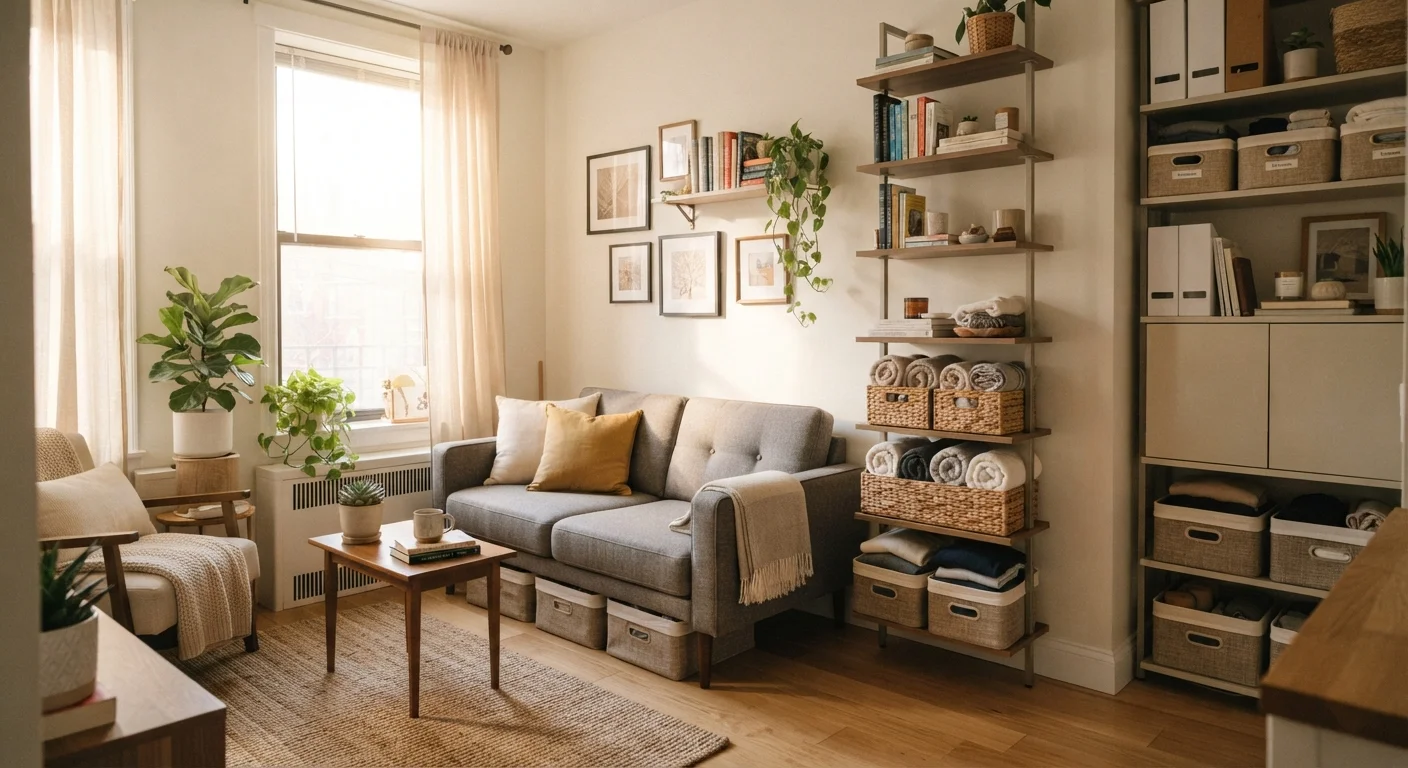
Floor space is the scarcest resource in a small home; wall space is usually underdeveloped. Tall shelving units, wall-mounted hooks, over-door organizers, and cabinet-top storage can dramatically increase usable storage without touching the floor plan. Shelf risers within cabinets double the effective storage layers without adding square footage.
When evaluating open shelving versus closed cabinets, consider that open shelving in small spaces works best for items you use daily — things that look orderly and don't accumulate dust quickly. Closed storage keeps visual clutter low, which is especially important when your living, working, and storage areas overlap.
Wall space is the most underused asset in small homes — treat it as your primary storage real estate.
Choose multi-purpose furniture over single-use pieces
Every piece of furniture in a compact home should justify its footprint. Ottomans with interior storage, beds with under-frame drawers, dining tables that fold against the wall, and benches with interior compartments all serve double duty without requiring additional square footage. When replacing or adding furniture, evaluate storage capacity alongside function and aesthetics.
This principle extends beyond furniture. Kitchen tools, linens, and even cleaning supplies should have multipurpose applications wherever possible. Fewer, more capable items reduce the total volume your space must absorb.
In a compact home, every piece of furniture should justify its footprint with more than one function.
Build daily micro-routines instead of weekly overhauls
In a small space, disorder compounds quickly — a few misplaced items can make an entire room feel chaotic within hours. Weekly cleaning sessions matter, but they work far better when supported by short daily routines that prevent accumulation. A 10-minute reset each evening — putting items back in their designated spots, clearing flat surfaces, and running a quick wipe-down of high-touch areas — reduces the effort required for deeper cleaning significantly.
The concept is sometimes called "cleaning as you go," and it's particularly effective in studio and one-bedroom apartments where a single room serves multiple functions throughout the day. Anchoring the reset habit to an existing routine (after dinner, before bed) makes it easier to maintain consistently.
[note_callout]A 10-minute daily reset prevents the kind of accumulation that makes weekly cleaning feel overwhelming.
Clean in zones, not whole-home sweeps
Standard cleaning advice — vacuum everything, then mop, then dust — assumes enough room to move through a home in logical sequences. In compact spaces, this approach often means moving the same obstacles repeatedly. Instead, divide your home into cleaning zones and complete each zone fully before moving to the next: surfaces, then floor, then appliances within a defined area.
Keeping a small, portable cleaning caddy (a handled tote with your core supplies) eliminates back-and-forth trips to a storage closet that may not be conveniently located. In homes where storage is tight, a caddy that lives under the sink or in a closet corner keeps supplies accessible without consuming prime storage real estate.
Zone-based cleaning eliminates wasted movement and makes maintenance feel more contained in tight spaces.
Apply a dedicated system to high-turnover areas
Entryways, kitchen counters, and bathroom surfaces are the areas most prone to clutter in small homes because they serve as landing zones for items in transition — keys, mail, groceries, toiletries. Each of these areas benefits from a specific, simple system rather than a general tidying approach.
For pantry and kitchen organization in particular, the method you choose matters significantly. Zone-based, category-based, and frequency-based pantry systems each have real advantages depending on how your household shops and cooks. In small kitchens, a frequency-based approach — placing most-used items at eye level and front-of-shelf — often reduces daily friction most effectively.
High-turnover surfaces like counters and entryways need their own dedicated system, not just general tidiness.
Putting It All Together
None of these strategies require expensive renovation or a complete lifestyle overhaul. The most effective small-space households tend to share one trait: they treat organization as an ongoing practice rather than a one-time project. That means revisiting systems every few months, re-evaluating what's earning its space, and adjusting routines as your household changes.
Schedule a quarterly reset
Every three months, spend 30–60 minutes evaluating whether your current systems are still working. Household needs shift with seasons, habits, and life changes. A quarterly check-in lets you catch failing systems early — before they produce the kind of clutter buildup that requires a full weekend to address. Mark it on your calendar like any other recurring task.
If your household involves multiple people, distributing cleaning and organizing responsibilities fairly is just as important as having the right system. Sharing household responsibilities fairly helps prevent resentment and keeps any system functioning long-term. And if your home management extends to paperwork and scheduling, consider whether paper or digital organization tools better suit how your household actually operates — in small spaces, even your organizational system should take up as little room as possible.
The content on this site is for informational purposes only and is not a substitute for professional advice. Always consult a qualified professional for guidance specific to your situation.