

Our Verdict
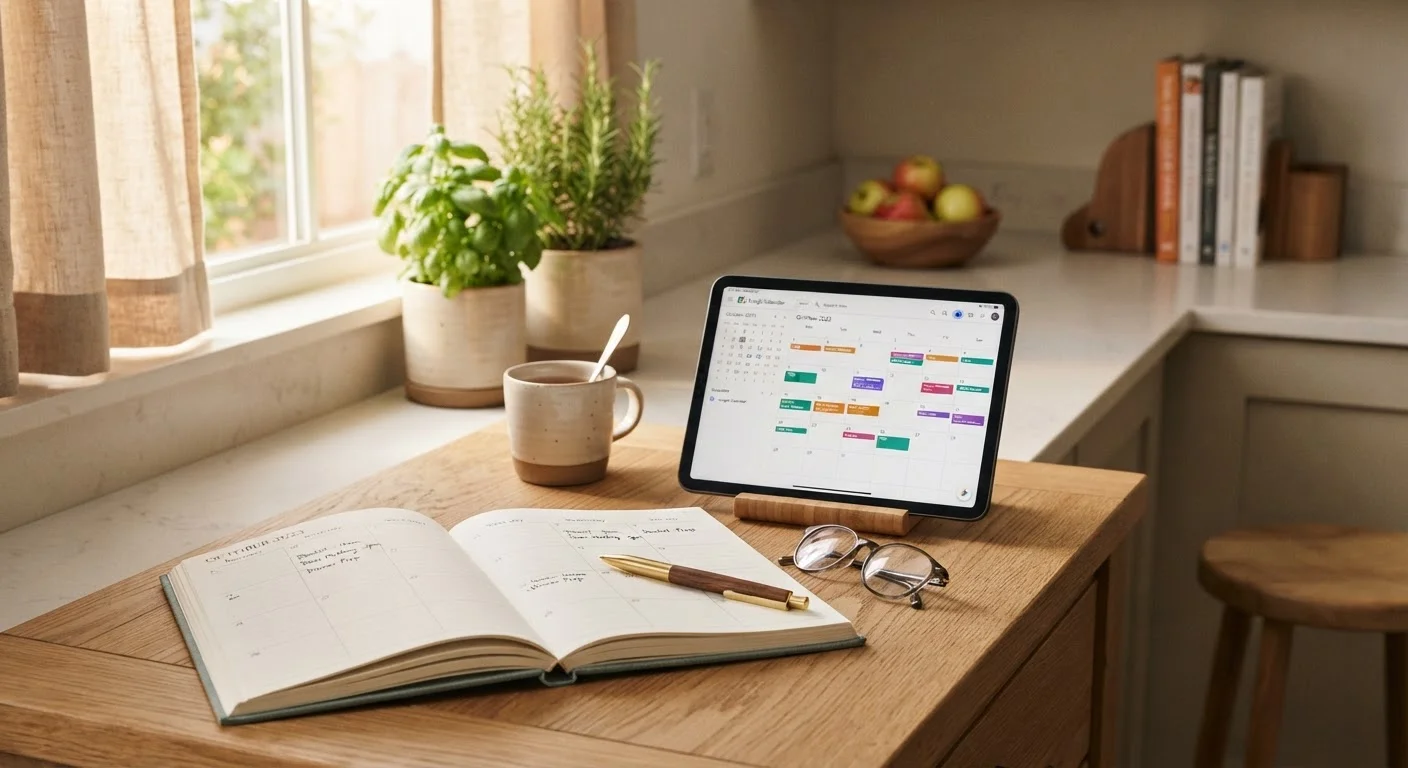
Neither paper nor digital household organization is universally better — each has genuine strengths that suit different households, habits, and life stages. Paper excels for visual thinkers, younger children, and anyone who values simplicity and distraction-free planning. Digital tools shine in larger households with complex, overlapping schedules that need real-time coordination. Many families find that a deliberate hybrid — paper for daily routines, digital for shared calendars — outperforms either option alone.
Paper systems are ideal for individuals or small families who prefer tactile, low-tech routines; digital tools are best for busy multi-person households with smartphones already integrated into daily life.
Why Your Organization System Matters More Than You Think
The difference between a household that feels managed and one that feels chaotic often comes down to one thing: a consistent system for tracking tasks, schedules, and responsibilities. Whether that system lives in a spiral-bound planner on the refrigerator or inside a shared app on everyone's phone is secondary — but it's not trivial.
The format you choose affects how often family members actually engage with it, how much cognitive load it carries, and whether it survives contact with the unpredictable rhythm of real home life. This article weighs the practical trade-offs so you can make a deliberate choice rather than defaulting to whichever tool you picked up first.
For a broader look at how household responsibilities intersect with these systems, see strategies for sharing household tasks that hold up over time.
The Case for Paper: Tactile, Focused, and Always On
Tactile writing reinforces memory and task retention
Handwriting engages the brain differently than typing, and cognitive research consistently associates it with stronger recall. Tasks written by hand are more likely to be remembered and completed without digital prompting.
Always accessible — no battery, app, or login required
A paper planner or wall calendar works regardless of internet connectivity, software updates, or device availability, making it reliably accessible in any household situation.
Creates a shared visual anchor for the whole household
A wall calendar or whiteboard visible in a common area means all household members — regardless of tech comfort — can see current tasks and events without any device interaction.
Distraction-free planning environment
Planning on paper keeps the session focused. Unlike a phone or tablet, a planner doesn't deliver push notifications or tempt users to switch apps mid-task.
Works well for households with young children
Children respond well to visual, physical systems like chore charts and weekly boards, making paper tools a natural fit for families managing kids' schedules and responsibilities.
Paper planning has been making a quiet comeback for good reason. Writing by hand has been linked in cognitive research to stronger memory encoding than typing, which means tasks written down are more likely to stick — no reminder notification required. A wall calendar or weekly planner also creates a shared visual anchor that every household member can see at a glance without unlocking a device.
Paper systems also carry zero tech dependency. They don't crash, lose battery, or require software updates. In households with young children or older adults who aren't comfortable with apps, a paper system removes the friction that causes digital tools to go unused. There's also an inherent focus advantage: a planner doesn't send push notifications or tempt you into scrolling social media mid-planning session.
The main limitations are real, though. Paper doesn't sync across family members automatically, it can't send you a reminder 30 minutes before a dentist appointment, and a misplaced planner creates genuine disruption. For small-space households, finding a permanent visible spot for paper tools can also be a physical challenge.
The Case for Digital: Synced, Searchable, and Scalable
No automatic syncing across multiple household members
A paper planner updated by one person is invisible to others until they physically see it, creating potential for scheduling conflicts and missed information in larger households.
Cannot send reminders or automate recurring alerts
Paper systems rely entirely on the user remembering to check them, which places the full memory burden on individuals rather than distributing it through automation.
Requires consistent buy-in from all household members
A shared digital calendar only functions as a coordination tool if every adult in the household actively maintains it. One disengaged member effectively breaks the system for the rest.
Notification fatigue can undermine digital effectiveness
Excessive reminders train users to dismiss them automatically, reducing their value over time. Poor configuration of alerts is a common reason digital organizational systems lose traction.
Competes for attention against other apps and distractions
Unlike a visible paper planner, a digital app must be deliberately opened and has to compete with social media, email, and other applications on the same device.
Digital organization tools — shared calendars, task apps, grocery list platforms — solve the coordination problem that trips up paper systems. When every adult in a household can see and edit the same calendar in real time, scheduling conflicts get caught before they happen rather than discovered at 6 p.m. Automated reminders reduce the mental load of remembering to remember.
Digital tools also scale with household complexity. A single person managing a two-bedroom apartment has different needs than a family of five with school calendars, medical appointments, pet care schedules, and rotating meal plans. For the latter, a well-configured shared calendar app can do coordination work that no paper system could match without becoming unmanageable.
Digital Tools Work Best With Full Household Agreement
A shared calendar app is only as useful as the number of people actively maintaining it. Before adopting a digital system, it's worth having a direct conversation with every household member about which platform to use and what they're expected to update. Starting simple — a single shared calendar rather than multiple overlapping apps — reduces friction and improves the odds that everyone actually participates.
That said, digital systems carry their own failure modes. They require consistent buy-in from every household member — one person who ignores the shared calendar breaks the system for everyone. Notification fatigue is real: too many reminders causes people to start dismissing them automatically. And unlike a paper planner propped on a counter, a digital tool has to compete for attention against every other app on the device.
For households curious about which connected home tools genuinely earn their keep, this room-by-room look at home technology offers an honest assessment.
Making the Hybrid Approach Work
~65%
Adults who identify as visual learners
Research consistently finds that a majority of people process and retain information more effectively through visual formats, supporting the case for visible, physical planning tools.
2–3 systems
Average number of organizational tools used per household
Surveys on household management habits suggest most families use a mix of methods rather than relying on a single platform, pointing toward natural hybrid adoption.
Many households find that the either/or framing is itself the problem. A practical hybrid assigns each tool to where it naturally fits: a paper weekly planner for daily household rhythm and chore rotations, and a shared digital calendar for appointments, deadlines, and events that require multi-person visibility.
The key to hybrid success is clear role separation. If both systems track the same information, they will contradict each other and erode trust in both. Decide in advance: the digital calendar owns all time-specific events; the paper board owns recurring household tasks. This division prevents duplication without sacrificing the benefits of either format.
Involve every household member in choosing the system. A schedule nobody helped design is a schedule nobody maintains. And revisit the setup every few months — what works for a household with school-aged children may need adjustment as routines shift. For related structure around the home, a room-by-room decluttering framework can complement your organizational system by reducing the physical clutter that makes any tracking tool harder to use.
The content on this site is for informational purposes only and is not a substitute for professional advice. Always consult a qualified professional for guidance specific to your situation.