

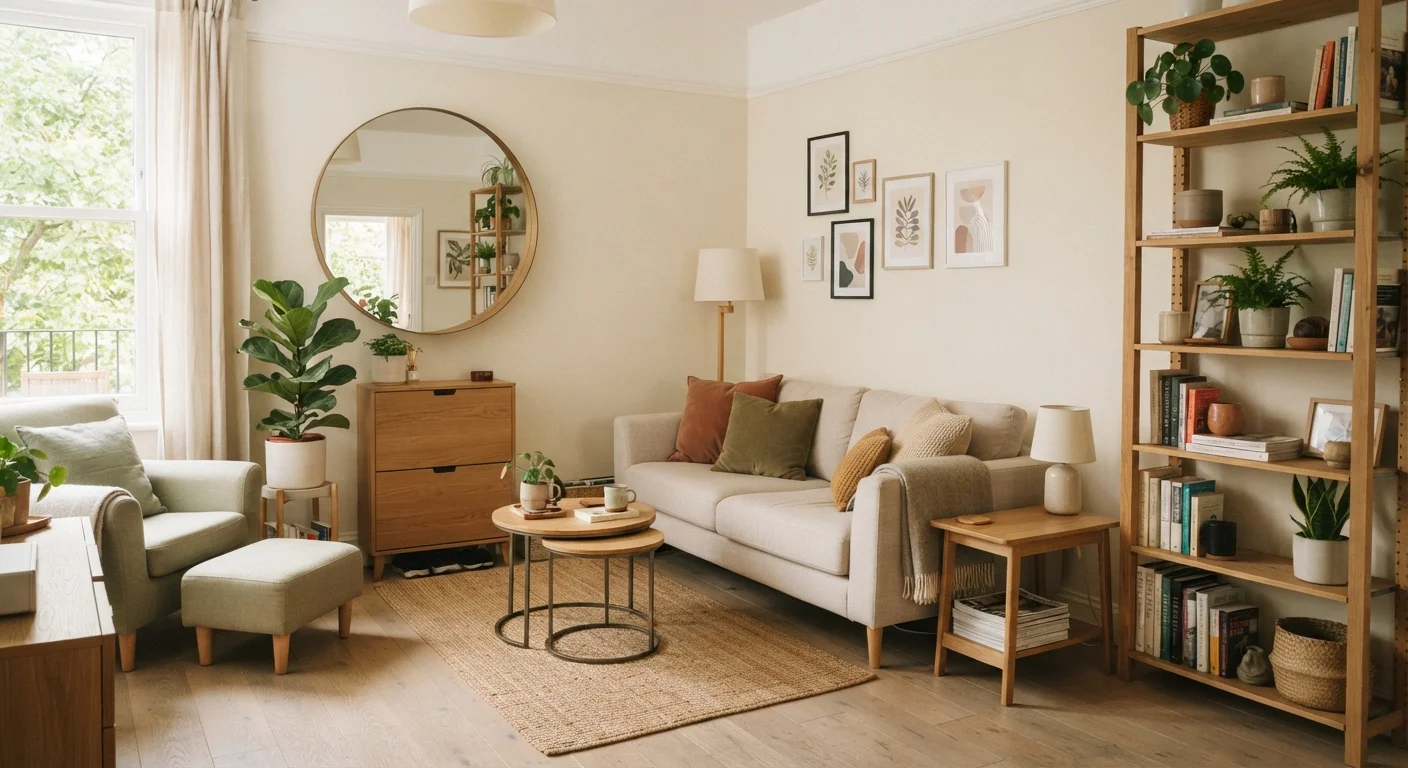
Why Small-Space Decorating Requires a Different Mindset
Decorating a small room isn't simply a scaled-down version of decorating a large one. The usual instinct — use smaller everything — is one of the most common mistakes people make. A room packed with tiny furniture can feel just as chaotic as one that's overcrowded with oversized pieces. What actually works is thinking about proportion, function, and visual flow in a more deliberate way.
If you're starting from scratch, the first-apartment decorating guide covers the order of decisions well. But even in an established room, applying a few grounded principles can shift how a space feels in a meaningful way. The goal isn't to trick the eye into thinking a room is bigger than it is — it's to make the room genuinely comfortable and functional for the people living in it.
Don't Confuse Sparse With Small
Small rooms don't have to feel bare to feel open. The goal is intentional selection, not minimalism for its own sake. A room with fewer, better-chosen objects — layered with texture, plants, and light — can feel warm and generous even at modest square footage. See how houseplants influence scale and texture for one approach to adding life without adding clutter.
Core Principles That Hold Up Across Room Types
The practices below apply whether you're working with a studio apartment, a narrow bedroom, or a compact living room. They're not trends — they reflect how people actually perceive and move through space.
Choose one anchor piece scaled to the room, then build around it.
A correctly proportioned sofa or bed establishes a visual foundation and prevents the fragmented look of many small mismatched pieces. Furniture that's too small collectively reads as clutter rather than openness.
Use vertical space deliberately for storage and visual height.
Most small rooms leave the upper third of their walls unused. Tall shelving and wall-mounted storage draw the eye upward, making ceilings feel higher while adding meaningful capacity.
Invest in multi-functional furniture that solves two problems at once.
Every piece in a small room should justify its floor footprint. Furniture with hidden storage or multiple uses reduces the total number of objects the room needs to contain.
Maintain visual continuity through a cohesive, limited color palette.
High contrast and many competing colors create visual stopping points that fragment a small room. A palette where tones clearly relate to each other allows the eye to move smoothly through the space.
Place at least one large mirror where it can reflect light or depth.
A well-placed mirror adds a perceived dimension to the room by creating a secondary sightline. The effect is most pronounced when the mirror reflects a window, a lamp, or an attractive part of the room rather than a wall or door.
Keep pathways and floor area as clear as possible.
Visible floor space makes a room read as larger. Even a modest increase in clear floor area — achieved by choosing furniture with legs rather than skirted pieces, or by removing one redundant item — noticeably changes how open a room feels.
Light, Color, and Visual Continuity
Color and light have an outsized effect in tight rooms. A limited, cohesive palette — not necessarily all-white, but one where tones relate clearly to each other — prevents the visual fragmentation that makes small rooms feel smaller. Contrast draws the eye and creates stopping points; too many stopping points in a small space feel like clutter even when the room is tidy.
Lighting deserves special attention. A single overhead fixture flattens a room and leaves corners in shadow, which visually shrinks the space. Layering ambient, task, and accent light adds depth and makes a room feel more considered. Mirrors placed opposite windows — or flanking them — bounce natural light and create a sense of depth without any structural work. This is one area where a single well-placed large mirror consistently outperforms several small decorative ones.
If you're renting, many of these changes are entirely reversible. The rental-friendly décor guide can help you identify what's safe to try without risking your security deposit.
79%
Renters living in units under 1,000 sq ft
According to U.S. Census Bureau American Housing Survey data, a large share of American renters occupy units well under 1,000 square feet, making small-space strategies broadly relevant.
2–3×
Light reflection increase from a well-placed mirror
Interior design educators note that a large mirror positioned opposite a natural light source can multiply perceived light levels significantly in a compact room.
Storage, Editing, and What to Let Go
In a small space, storage strategy directly shapes how the room feels day to day. Vertical storage — tall shelving, wall-mounted units, cabinets that reach toward the ceiling — adds capacity without consuming floor area. Whether that storage is open or concealed affects the room's visual weight. Open shelving versus closed cabinets each have genuine trade-offs, and the right choice depends on what you're storing and how tidily it can be maintained.
Beyond storage design, editing your possessions is a core decorating skill in small spaces. Every object in a small room competes for attention. A curated selection of things you use and value will consistently look better — and feel better to live with — than a full collection of things you've accumulated. For routines that support this on an ongoing basis, the small-space household management guide offers practical strategies.
The content on this site is for informational purposes only and is not a substitute for professional advice. Always consult a qualified professional for guidance specific to your situation.