

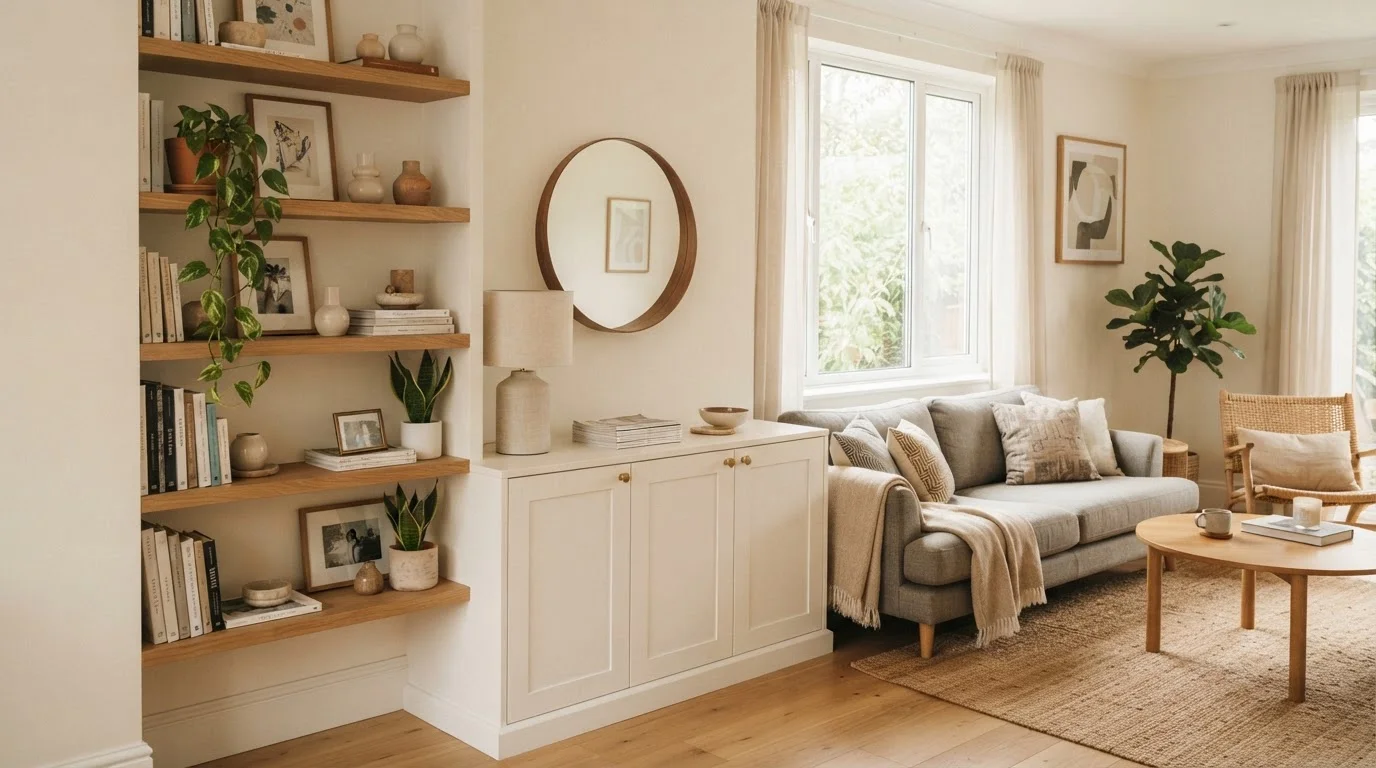
Option A
Open Shelving
The display-forward, visually airy approach.
Best for: Readers who keep belongings curated and tidy and want their storage to double as décor.
Option B
Closed Cabinets
The organized, clutter-concealing workhorse.
Best for: Readers who accumulate varied items and prefer a calm, uncluttered visual environment.
What Each Approach Actually Involves
Open shelving means storage without doors — brackets on a wall, freestanding bookcases, or built-in recessed units where everything on display is fully visible. Closed cabinets add a door, a drawer front, or both, concealing contents behind a finished surface.
That single difference cascades into real implications for how a room looks, how it functions day-to-day, and how much maintenance each solution demands. As our guide to common decorating myths notes, the instinct to follow trends rather than your own habits is one of the costlier mistakes in home design. The same principle applies here: neither option is objectively better. The right call depends on what you own, how you live, and how much time you're willing to spend maintaining the look you want.
| Criterion | Open Shelving | Closed Cabinets |
|---|---|---|
| Visual effect | Lighter, more open feel | Cleaner, more uniform look |
| Dust accumulation | Higher — items exposed | Lower — items enclosed |
| Maintenance required | Regular styling and dusting | Periodic interior organisation |
| Storage flexibility | Easy to reconfigure | More fixed, especially built-ins |
| Best-suited contents | Curated, display-worthy items | Functional, miscellaneous items |
| Room size impact | Can open up tight spaces | Can feel heavy in small rooms |
The Real Costs of Open Shelving
Open shelving earns its reputation for making rooms feel lighter and more spacious — a quality that matters especially in compact rooms. If you're working with limited square footage, see how vertical storage and display-led thinking fit into a broader strategy in our small-space decorating principles overview.
The trade-off is honest: open shelves demand consistent curation. Dust settles on everything — books, ceramics, plants, and whatever else lives there. Items need wiping down more frequently than they would behind a door. More importantly, the shelf is always performing. A cabinet with a cluttered interior is invisible; a shelf with a cluttered surface is a focal point in the wrong way.
~30 min
Estimated weekly styling time for open shelves
Home organization experts commonly suggest budgeting around 30 minutes per week to keep open shelving looking intentional rather than accumulated.
2–4×
More frequent dusting needed vs. closed storage
Items on open shelves typically require dusting two to four times more often than those stored behind cabinet doors, depending on the home environment.
That doesn't make open shelving impractical — it makes it selective. If your belongings are things you're proud to look at, and you're comfortable editing what goes on display, open shelving rewards that mindset with character and visual depth that closed storage rarely matches.
When Closed Cabinets Make More Sense
Closed cabinets exist to solve a specific problem: households accumulate things that are useful but not beautiful. Board games, extra chargers, spare linens, paper records — the inventory of daily life rarely photographs well. Doors allow you to store honestly without staging constantly.
Enclosed storage also does quiet work on the atmosphere of a room. Research in environmental psychology suggests that visual complexity — many different objects in the field of view — can contribute to a sense of cognitive overload, though individual responses vary. Reducing what's visible tends to make rooms feel more restful for many people. If managing a tidier home is already a challenge, our room-by-room decluttering framework can help you work through what you actually need to store before committing to a storage approach.
A Note on Visual Clutter and Wellbeing
Environmental psychologists have studied how visual complexity in a living space can affect perceived stress levels, though individual sensitivity varies widely. Some people find open, display-heavy rooms energizing; others find them mentally fatiguing. There is no universal answer, and this is general informational context rather than clinical guidance. Pay attention to how you actually feel in rooms that use each approach — your own reaction is the most useful data point.
The practical downside of closed cabinets is density and visual weight. A run of tall, solid-front units can make a room feel smaller and more formal than intended. Mixing cabinet heights, using glass-front doors on upper units, or pairing closed cabinets with open shelves above or beside them addresses this effectively.
Combining Both — and Making It Work
Most well-functioning living spaces use both approaches. A lower media console with closed doors handles cables, remotes, and storage boxes. Open shelves above display books and a few plants. The closed section earns its keep by hiding the practical; the open section earns its keep by adding personality.
The principle that makes mixed storage work is consistency of style. Matching finishes, aligned heights, and a shared color palette between open and closed units make a combination feel intentional rather than accumulated. If storage is a recurring challenge in a compact home, the organizing and cleaning strategies in our small-space household management guide apply directly to this kind of mixed-storage setup.
Before investing in either solution, take stock of what you're actually storing. Items you access daily and want to find quickly often belong on open shelves. Items used occasionally, things that are visually inconsistent, or anything that just needs a home but not a stage — those belong behind a door.
The content on this site is for informational purposes only and is not a substitute for professional advice. Always consult a qualified professional for guidance specific to your situation.