

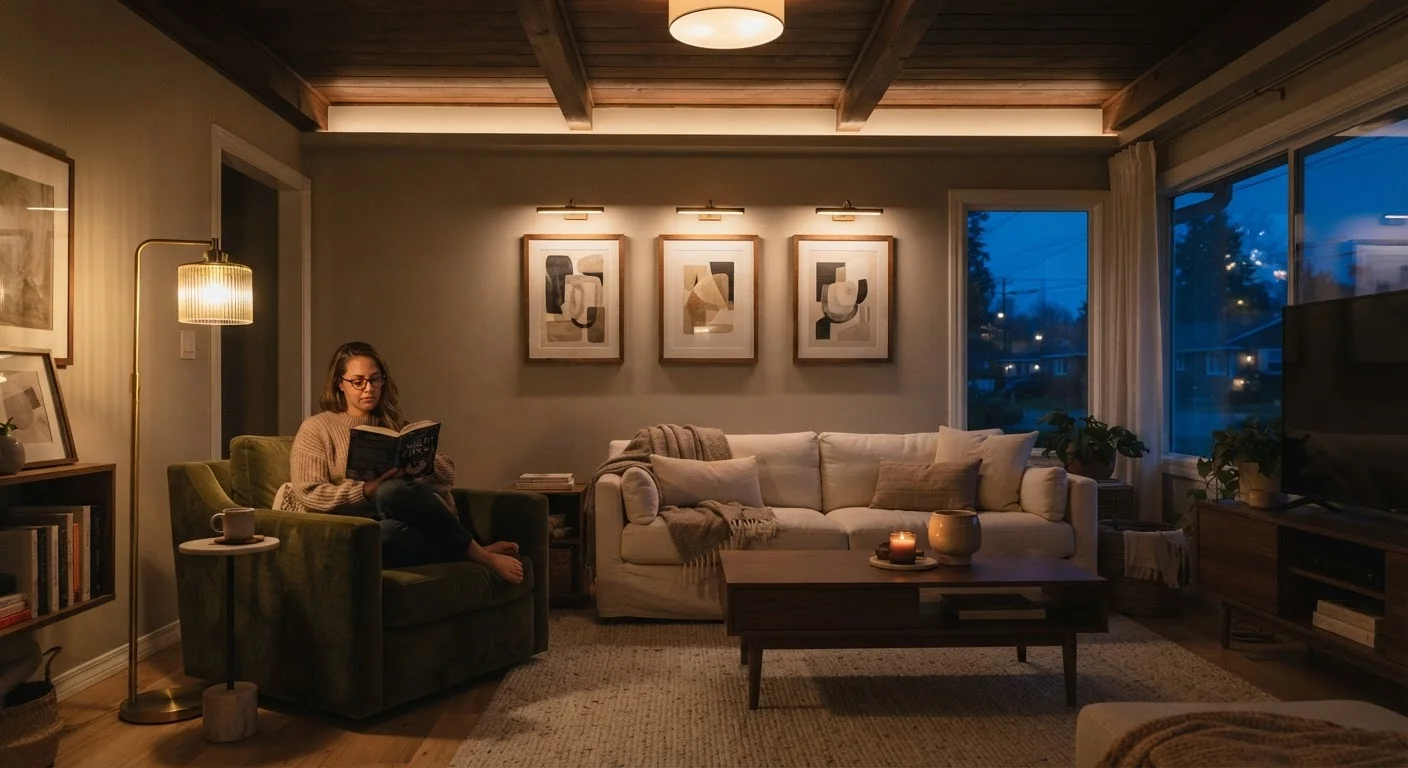
Why One Overhead Light Is Never Enough
Walk into a room lit by a single overhead fixture and something feels off — shadows collect in the corners, surfaces look flat, and the space feels either cave-like or harshly exposed. That fixture is working alone, doing a job that was designed to be shared across multiple sources.
Layered lighting solves this by assigning different jobs to different fixtures. When the three layers — ambient, task, and accent — are working together, the eye has variety and depth to rest on. The room stops feeling like a utility space and starts feeling like somewhere you actually want to be.
This approach is a core principle in interior design, and it's as relevant in a rented apartment with plug-in fixtures as it is in a custom-built home. See how lighting fits within the broader context of finishing a room in our full home décor walkthrough.
~15%
U.S. residential electricity used for lighting
According to the U.S. Energy Information Administration, lighting accounts for roughly 15% of household electricity consumption, making fixture choices a meaningful efficiency decision.
3x
Longer lifespan of LED vs. incandescent bulbs
The U.S. Department of Energy notes that LED bulbs can last roughly 15,000–25,000 hours compared to approximately 1,000–2,000 hours for traditional incandescent bulbs.
The Three Layers Explained
Ambient Light: The Foundation
Ambient light is the base layer — the general illumination that makes a room usable. It typically comes from ceiling-mounted fixtures, recessed lights, chandeliers, or large pendants. Its job is to provide enough brightness that you can move around and see comfortably without relying on natural daylight.
The goal isn't maximum brightness. A dimmable ambient source that can drop to 40% at night is far more useful than one set to full blast at all times.
Task Light: The Working Layer
Task lighting is focused and directional. It targets specific zones where you need concentrated light to perform an activity — reading, cooking, applying makeup, working at a desk. Examples include a swing-arm reading lamp beside a chair, under-cabinet strips above a kitchen counter, and a lighted mirror in a bathroom.
Without task light, people compensate by cranking ambient brightness, which creates glare and visual fatigue rather than actual clarity.
Accent Light: The Finishing Layer
Accent lighting does decorative work. It draws the eye toward something worth noticing — a piece of art, a bookcase, an architectural detail, or a textured wall. Track lights, picture lights, LED strip lights behind furniture, and small directional spotlights all fall into this category.
This layer isn't strictly functional, but it's what makes a room feel considered rather than accidental. It also interacts with your wall color and finishes — something worth keeping in mind if you're also thinking about how warm and cool color palettes affect atmosphere.
Start With What You Already Own
Before buying anything, audit your current fixtures. Move a table lamp to a dark corner, reposition a floor lamp toward a wall instead of the ceiling, or swap a bare bulb for a warmer-toned one. Repositioning existing lights costs nothing and often reveals how much room there is to improve before adding new fixtures.
Putting the Layers Together Room by Room
Understanding each layer separately is useful. Knowing how to combine them in real spaces is where the concept becomes practical.
- Living room: A ceiling fixture or recessed lights provide ambient coverage. A floor lamp beside the sofa handles reading. A picture light or strip light behind the TV unit serves as accent.
- Kitchen: Overhead recessed or pendant lights fill the ambient role. Under-cabinet strips light the countertop for prep work. A small pendant over an island can double as ambient and accent.
- Bedroom: A ceiling fixture or flush-mount light anchors the ambient layer. Bedside table lamps or wall-mounted reading lights handle task needs. Subtle lighting behind a headboard or inside an armoire adds accent warmth.
- Home office: Overhead ambient is joined by a dedicated desk lamp — the most critical task light in the house. A shelf light or small accent fixture reduces the visual monotony of a work-focused space.
In smaller rooms, two layers are often enough. In main living spaces where activities shift throughout the day, all three tend to work hardest. If you're working with a compact room, layered lighting is also one of the principles covered in our guide to small-space decorating.
Smart Bulbs and Layered Lighting
Smart bulbs that allow app or voice control of brightness and color temperature can replicate the effect of separate dimmers for each layer without any electrical work. They're particularly useful in rentals where you can't install wall dimmers. For a broader look at which connected home devices actually deliver everyday value, see our room-by-room home technology review.
Practical Tips for Getting the Layers Right
The mechanics of layering matter, but so does execution. A few principles help get the balance right:
- Put ambient light on a dimmer. This single change gives you more control than almost any other adjustment. Dimmed ambient light paired with task and accent sources creates evening warmth that a fixed-output fixture simply can't match.
- Match color temperatures within a room. Mixing a very warm bulb with a very cool one in the same space creates visual discord. Aim for consistency — typically 2700K–3000K in living areas, slightly cooler in kitchens and offices.
- Aim accent lights at a 30-degree angle. This is a widely cited designer guideline for picture and display lighting. It reduces glare while casting enough light to reveal texture and color.
- Don't neglect corners. A floor lamp angled into a corner bounces light back into the room and eliminates the flat, shadowless look of a room lit only from the center.
- Consider how paint finish interacts with light. Matte walls absorb light; glossier finishes reflect it back into the space. Our interior paint finishes comparison breaks this down in detail.
Frequently Asked Questions
Ambient lighting fills a room with general, overall illumination — think ceiling fixtures or recessed cans. Task lighting is focused and directed at a specific activity area, like a desk lamp for reading or under-cabinet lights over a kitchen counter. Both are necessary; ambient sets the baseline, task adds precision.
Most rooms benefit from at least three to five light sources across the three layers. A single overhead fixture can feel flat and cast harsh shadows. Even modest additions — a table lamp and one accent fixture — significantly improve how a room looks and functions.
Yes. Many layering solutions plug directly into standard outlets — floor lamps, table lamps, clip-on accent lights, and plug-in picture lights all require no wiring. You can meaningfully improve a room's lighting by repositioning existing lamps and adding a few plug-in fixtures.
For ambient and accent lighting in living spaces, warmer temperatures (around 2700K–3000K) tend to feel inviting and relaxed. Task lighting in work areas like kitchens or home offices can go slightly cooler (3000K–4000K) for better visibility. Consistency within a room matters more than any single number.
Dimmers are not strictly required, but they dramatically increase the usefulness of layered lighting. Being able to turn ambient light down while keeping task light bright — or vice versa — is what allows a room to transition between functions and moods. Smart bulbs with adjustable brightness offer a dimmer-like experience without rewiring.
Not at all. Kitchens benefit from ambient overhead light plus task lighting under cabinets. Bedrooms use ambient ceiling fixtures alongside bedside task lamps and possibly accent lighting behind a headboard. Even bathrooms gain from layering vanity task light alongside softer ambient sources.
The content on this site is for informational purposes only and is not a substitute for professional advice. Always consult a qualified professional for guidance specific to your situation.