

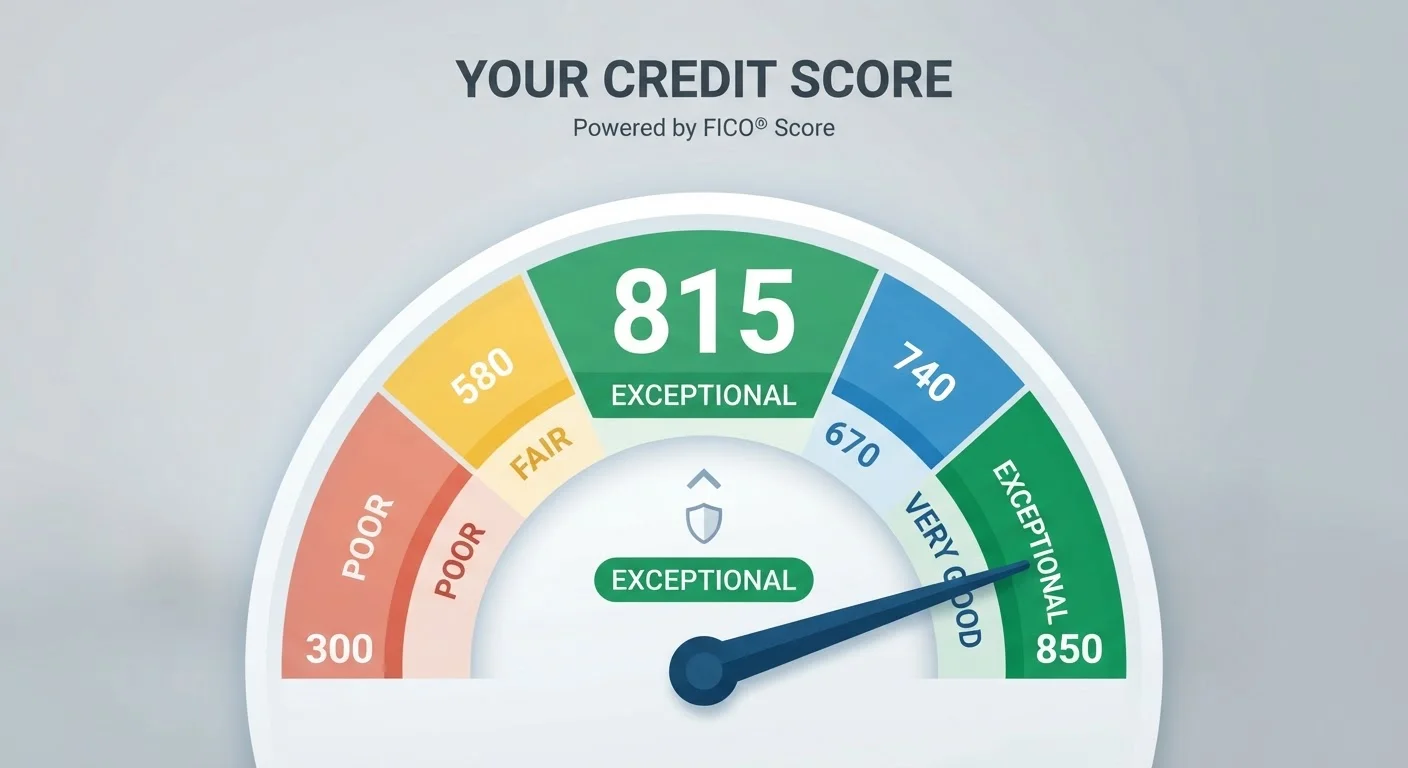
The Score Ranges: What Each Band Signals
Credit scores aren't a single pass/fail threshold — they fall along a spectrum that lenders interpret as a rough measure of lending risk. Under the FICO model, the ranges break down roughly as follows:
- 300–579 (Poor): Approval is unlikely for mainstream credit products; secured cards or credit-builder loans may be available.
- 580–669 (Fair): Some lenders will approve applications, but interest rates tend to be higher to offset perceived risk.
- 670–739 (Good): Most conventional lenders consider this an acceptable range; standard rates are generally accessible.
- 740–799 (Very Good): Borrowers here typically qualify for competitive rates and favorable terms.
- 800–850 (Exceptional): Reserved for those with long, spotless credit histories; lenders typically offer their best available terms.
It's worth noting that VantageScore uses the same 300–850 scale but draws its range boundaries slightly differently. The label on your score depends entirely on which model generated it. To understand the raw data behind any score, our field guide to your credit report walks through each section in detail.
~28%
U.S. adults with a FICO score below 670
According to Experian's State of Credit report, roughly one in four American adults falls in the fair or poor score range, making access to affordable credit a widespread challenge.
35%
Weight of payment history in FICO score
FICO's published model breakdown shows payment history is the single largest factor — making consistent, on-time payments the most impactful habit a consumer can build.
300–850
Full range of FICO and VantageScore scales
Both major scoring models use this same numeric range, though the definitions of each band and the precise factor weightings differ between them.
How Your Score Is Calculated: The Five Key Factors
Both FICO and VantageScore derive your number from categories of behavior, not individual transactions. Under FICO's widely cited model, the weighting looks like this:
- Payment history (35%): Whether you pay on time is the single heaviest factor. Even one missed payment can have a measurable impact.
- Amounts owed (30%): This includes your credit utilization ratio — how much of your available revolving credit you're using. Lower utilization generally helps. Our article on credit utilization explains why this factor trips up many borrowers.
- Length of credit history (15%): Older accounts signal a longer track record. Closing old accounts can reduce your average account age.
- Credit mix (10%): Having both installment loans (e.g., auto, mortgage) and revolving accounts (e.g., credit cards) can slightly boost your score.
- New credit (10%): Recent hard inquiries and newly opened accounts can cause a short-term dip.
Focus on Payment History First
Since payment history accounts for 35% of your FICO score, setting up automatic minimum payments on all accounts is one of the most straightforward ways to protect your score. Even if you can't pay the full balance, paying on time every month keeps your history clean. Missing just one payment can linger on your report for up to seven years.
Unfamiliar with some of these terms? The plain-language debt and credit glossary defines all the key vocabulary in one place.
Why the Same Score Means Different Things to Different Lenders
Scoring models produce a number, but lenders apply their own interpretation. A 700 might comfortably clear the bar at one bank and fall short at another, depending on the product, the lender's risk appetite, and other factors they weigh alongside your score.
Most lenders look beyond the score itself at elements like:
- Your income and debt-to-income ratio
- The type of credit you're applying for (mortgage, auto loan, credit card)
- Your employment stability
- The full picture in your credit report, not just the summary number
Scores Vary by Model and Bureau
The credit score you see through a free monitoring app may be calculated by a different model than the one a lender pulls when you apply. This is normal and expected. If you're preparing for a major application like a mortgage, it may be worth asking the lender which score model they use so you can check the most relevant version of your report.
If you spot information that seems wrong, you have the right to dispute it. Our guide to disputing errors on your credit report walks through the formal process step by step.
This article is for general informational purposes only and does not constitute personalized financial or legal advice. For guidance specific to your situation, consider consulting a licensed financial professional.
Frequently Asked Questions
Generally, a score of 670 or above is considered 'good' under most FICO models, while 740 and above is 'very good.' Scores of 800 or higher are typically labeled 'exceptional.' These thresholds aren't universal — individual lenders set their own cutoffs depending on the product and risk tolerance.
Credit scores can change whenever new information is reported to the bureaus, which typically happens monthly as lenders submit updated account data. A single late payment or a large new balance can shift your score noticeably within a billing cycle.
Equifax, Experian, and TransUnion each maintain their own data files, and not all lenders report to all three. Because the underlying data can differ, your calculated score may vary bureau to bureau even using the same model.
No. Checking your own score triggers what's called a soft inquiry, which has no effect on your score. Only hard inquiries — initiated when you apply for credit — can cause a small, temporary dip. See our guide on <a href="/money-finance/debt-and-credit/hard-inquiries-vs-soft-inquiries-on-your-credit-report">hard vs. soft inquiries</a> for more detail.
Yes — credit cards are just one type of account that generates a credit history. Installment loans like auto loans or student loans also build your file. That said, having no credit accounts at all typically means you have no scoreable history, sometimes called being 'credit invisible.'
Most negative marks — like late payments or collections — remain on your credit report for seven years. Chapter 7 bankruptcy can stay for up to ten years. Over time, the impact of older negative items tends to fade as you build a more recent positive track record.
The content on this site is for informational purposes only and is not a substitute for professional advice. Always consult a qualified professional for guidance specific to your situation.