

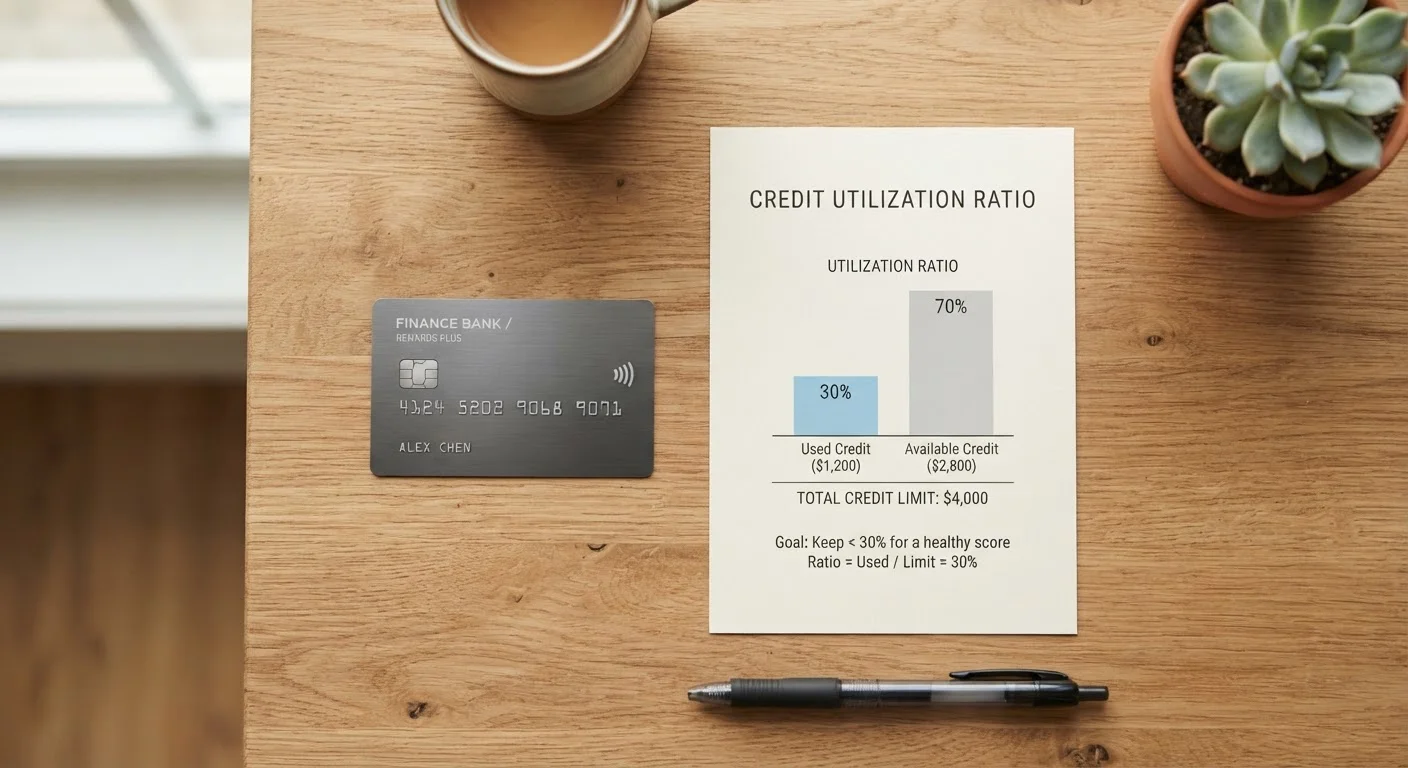
Why Utilization Carries So Much Weight
When lenders review a credit application, they're trying to answer a basic question: how responsibly does this person manage debt? Your credit score is their shortcut to that answer. As explained in our breakdown of credit score factors, payment history and credit utilization together account for roughly 65% of a typical FICO score. Utilization alone sits at approximately 30%.
The reason utilization matters so much is that it reflects real-time financial behavior. Payment history is a backward-looking record; utilization tells lenders what's happening right now. A consumer carrying high balances relative to their limits may be overextended — or may simply be unaware of how reporting timing works. Either way, the score responds.
~30%
Share of FICO score tied to utilization
According to FICO's published scoring factor breakdown, amounts owed — which includes credit utilization — represent approximately 30% of a FICO score.
<10%
Utilization range of high-scoring consumers
FICO has noted publicly that consumers with scores above 800 tend to carry utilization rates in the single digits on average.
Monthly
Frequency bureaus typically receive updated balances
Most card issuers report account data to the three major credit bureaus once per billing cycle, typically around the statement closing date.
How the Ratio Is Calculated — and When It's Measured
The formula itself is straightforward: divide your current revolving balances by your total revolving credit limits, then multiply by 100. If your three credit cards have limits of $5,000, $3,000, and $2,000 — and you're carrying balances of $1,500, $800, and $200 — your aggregate utilization is $2,500 ÷ $10,000, or 25%.
What many borrowers miss is when that snapshot is taken. Your card issuer typically reports your balance to the credit bureaus on your statement closing date — not your payment due date, which usually falls 21–25 days later. That means even if you pay your balance in full every cycle, a high statement balance can temporarily push your utilization up before the payment registers.
If you want to actively manage what gets reported, the most effective lever is paying down your balance before your statement closes, not just before it's due. Check your issuer's closing date — it's usually printed on your statement — and time any large payoffs accordingly.
Time Your Payments to the Closing Date
Your statement closing date and your payment due date are different days — usually separated by three weeks or more. If you want to lower your reported utilization, pay down your balance before the closing date, not just before the due date. Log into your account or check your paper statement to find your specific closing date, since it varies by issuer and account.
Individual vs. Aggregate Utilization
A detail that surprises many people: scoring models look at utilization on each card individually, not just the blended total. You could have an overall utilization of 18% and still take a score hit if one card is sitting at 90% of its limit.
This matters practically. Spreading a balance across multiple cards — rather than concentrating it on one — can reduce per-card utilization even when the total dollar amount stays the same. It's not a strategy that reduces what you owe, but it can change what the model sees. For a deeper look at how credit card balances interact with interest, see our guide on how credit card interest accumulates.
Practical Ways to Keep Utilization in Check
Utilization is one of the fastest-moving factors in your score — it can shift meaningfully within a single billing cycle. That makes it a useful lever if you're preparing to apply for a loan or want to strengthen your profile. A few approaches that borrowers commonly use:
- Pay down high-balance cards first. Reducing utilization on your most-used individual cards can have an outsized effect, since per-card ratios matter alongside the aggregate.
- Request a credit limit increase. If your income and account history support it, a higher limit lowers your ratio without changing your balance. Note that some issuers run a hard inquiry for this request — ask first whether it's a soft or hard pull. See our explanation of hard vs. soft inquiries for context.
- Avoid closing old, unused cards. Closing a card removes its limit from your available credit, which raises overall utilization. This runs counter to the instinct to tidy up your wallet — and is a common misconception addressed in our article on credit score myths.
- Set up mid-cycle payments. If you regularly charge large amounts to a single card, making a partial payment before the statement date can keep the reported balance lower.
This article is for general informational purposes only and does not constitute financial or credit advice. Consult a qualified financial professional for guidance specific to your situation.
Frequently Asked Questions
Most financial guidance suggests keeping utilization below 30%, though lower is generally better for your score. Consumers with the strongest scores often carry utilization in the single digits. This is a general benchmark, not a guarantee of any specific score outcome.
Not immediately. Your issuer typically reports your balance to credit bureaus on your statement closing date, before your payment due date. Even if you pay in full every month, a balance shown at statement close contributes to reported utilization. Paying early — before the closing date — reduces the balance that gets reported.
Yes. Utilization is recalculated each time your card issuers report updated balances to the credit bureaus, which generally happens monthly around your statement closing date. It's not a running average — your most recently reported balance is what counts.
Opening a new card increases your total available credit, which can lower your overall utilization ratio if your spending stays the same. However, a new account also generates a hard inquiry and reduces your average account age, so the net effect on your score depends on your full credit profile.
Installment loans — mortgages, auto loans, student loans — are generally not included in your revolving credit utilization calculation. Utilization applies specifically to revolving credit lines, primarily credit cards and lines of credit.
Having zero reported utilization can actually be slightly less favorable than carrying a very small balance, because it may signal to scoring models that you aren't actively using credit. A small, low balance — say, under 10% — is generally considered stronger than zero, though the difference is usually modest.
The content on this site is for informational purposes only and is not a substitute for professional advice. Always consult a qualified professional for guidance specific to your situation.