

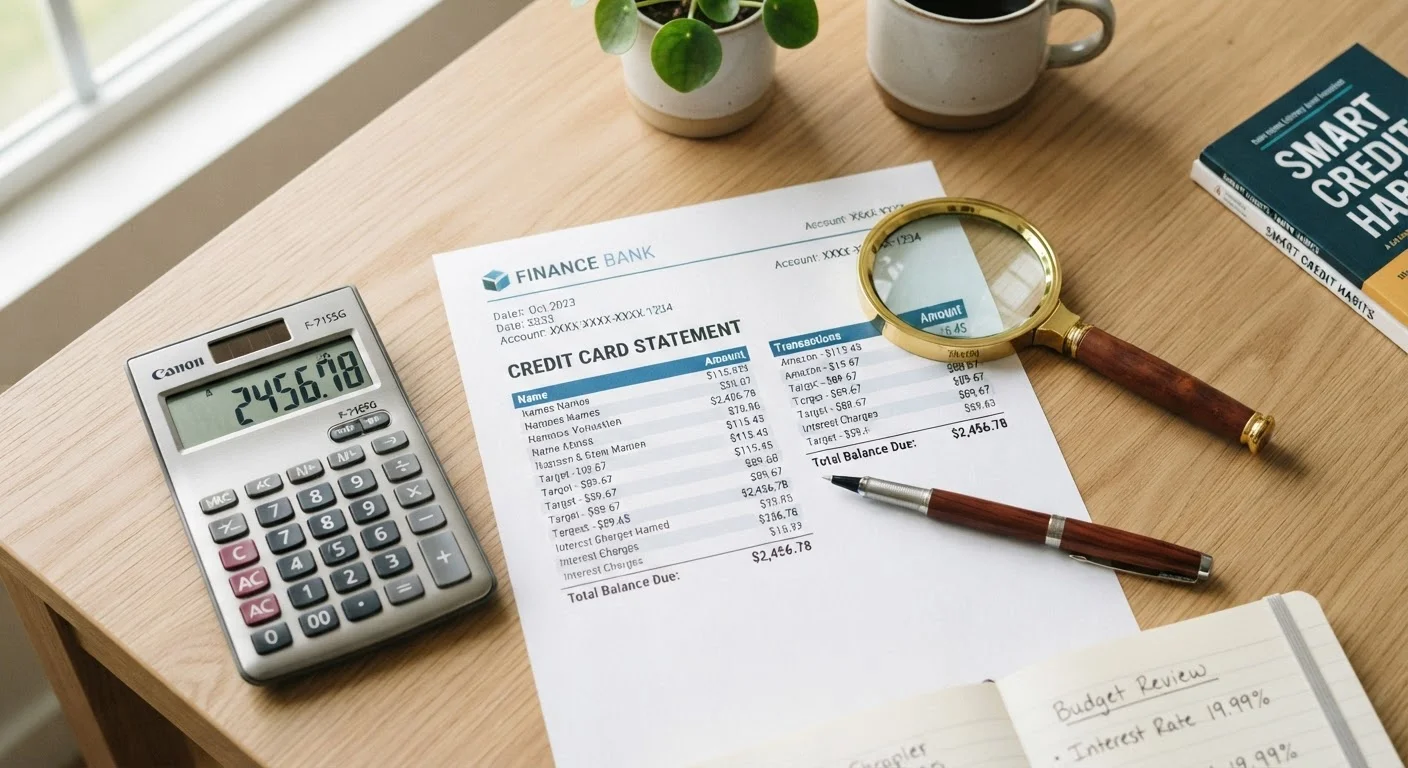
From APR to Daily Rate: The Math Behind the Charge
Your card's Annual Percentage Rate (APR) is the headline number — but interest isn't charged once a year. It accumulates daily. To find your Daily Periodic Rate (DPR), card issuers divide your APR by 365. If your APR is 22%, your DPR is roughly 0.0603% per day.
That daily rate is then applied to your average daily balance — a figure calculated by adding up your balance at the end of each day in the billing cycle, then dividing by the number of days. Here's a simplified example:
- Balance on days 1–15: $1,000
- Balance on days 16–30: $1,500 (after a new purchase)
- Average daily balance: approximately $1,250
Multiply $1,250 × 0.000603 × 30 days = roughly $22.61 in interest for that cycle. That amount is then added to your next statement. For plain-language definitions of these and other terms, see our Debt & Credit Glossary.
22%+
Average credit card APR in recent years
According to Federal Reserve data, average credit card interest rates have reached historically high levels in recent years, making debt management more costly.
~$22.61
Interest on $1,250 average balance at 22% APR
This illustrative example shows how daily compounding adds charges even on a moderate balance within a single 30-day billing cycle.
10+ years
Potential payoff timeline on minimum payments
A $3,000 balance at 22% APR paid at minimum payment rates can take over a decade to eliminate, dramatically increasing total cost.
The Grace Period: Your Interest-Free Window
Most credit cards offer a grace period — typically 21 to 25 days after the billing cycle closes — during which you can pay your full statement balance and owe zero interest on purchases. The grace period is the mechanism that allows responsible cardholders to use credit cards as a payment tool without paying a cent in interest.
However, the grace period disappears if you carry any balance from the previous month. Once you begin carrying a balance, new purchases start accruing interest immediately — there's no free window. This is one reason paying the full statement balance each cycle, not just the minimum, is financially meaningful.
Set Up Autopay for Your Full Balance
Automating payment of your full statement balance each month ensures you never accidentally carry a balance and lose your grace period. Most card issuers let you set autopay to the 'statement balance' option, which is distinct from 'minimum payment' or 'current balance.' Confirm which option applies before enabling it.
Why Minimum Payments Are a Debt Trap
Card issuers typically set minimum payments at around 1%–2% of your outstanding balance, or a small fixed dollar amount, whichever is greater. Paying only the minimum satisfies the issuer's requirement and protects your payment history — but it barely dents the principal.
Consider a $3,000 balance at 22% APR. Paying only the minimum each month could take over a decade to pay off and result in hundreds of dollars in total interest — potentially more than the original charges. The minimum payment disclosure on your statement is legally required to show you exactly how long payoff will take at that pace. Reading that number can be a motivating wake-up call.
Understanding how interest compounds also matters for your credit health. A high balance relative to your credit limit raises your credit utilization ratio, which is a significant factor in your score. Learn more in our article on credit utilization.
Transaction Types That Play by Different Rules
Not all credit card activity carries the same interest rules. Understanding these distinctions helps you avoid unexpected charges:
- Cash Advances
- Withdrawing cash from an ATM using your credit card typically triggers a higher APR — sometimes 25%–29% — and interest begins accruing immediately with no grace period. A transaction fee is usually charged on top.
- Balance Transfers
- Moving debt from one card to another often comes with a promotional rate, sometimes 0% for a set period. After the promotional window closes, the standard balance transfer APR applies. Transfer fees commonly range from 3%–5% of the transferred amount.
- Purchases vs. Promotional Rates
- Some cards offer deferred interest on promotional purchases. If the full balance isn't paid by the end of the promotional period, interest on the entire original amount may be retroactively applied.
For context on how credit card debt differs from installment borrowing, see our overview of auto loan interest and terms.
Deferred Interest Is Not the Same as 0% APR
Promotional financing offers through retailers sometimes advertise 'no interest if paid in full' — this is deferred interest, not a true 0% APR. If any balance remains at the end of the promotional period, interest on the entire original purchase amount may be charged retroactively. Always read the promotional terms carefully before using this type of financing.
How Your APR Is Set — and When It Can Change
Your APR is heavily influenced by your credit profile at the time you applied. Issuers assess your credit score, income, and existing debt to assign a rate within an advertised range. Consumers with stronger credit histories typically receive rates toward the lower end of that range. You can read more about how scores are assessed in our guide on what credit scores actually mean.
Most credit cards carry a variable APR, tied to a benchmark such as the U.S. prime rate. When that benchmark rises, your APR typically rises with it — meaning your interest charges can increase even if your borrowing behavior hasn't changed. Card issuers may also raise your rate after providing required advance notice, though existing balances are generally subject to specific rules. Reading your cardholder agreement is the most reliable way to understand your specific terms.
This article is for general informational and educational purposes only and does not constitute financial, tax, or legal advice. Please consult a qualified financial professional for guidance specific to your situation.
Frequently Asked Questions
Interest is calculated by dividing your APR by 365 to get a daily periodic rate, then multiplying that rate by your average daily balance and the number of days in the billing cycle. The result is added to your statement balance.
Paying only the minimum extends the time it takes to eliminate your debt and increases the total interest you pay. Most of a minimum payment goes toward interest rather than reducing your principal balance.
A grace period is the window between the end of your billing cycle and your payment due date — typically 21 to 25 days. If you pay your full statement balance during this window, no interest is charged on purchases.
No. Cash advances and balance transfers often carry different — usually higher — APRs and may not come with a grace period, meaning interest starts accruing immediately from the transaction date.
This is a common myth. Carrying a balance does not improve your credit score and costs you money in interest. On-time payments and low utilization are what positively affect your score.
Yes. Variable APRs are tied to a benchmark rate such as the prime rate and can increase when that benchmark rises. Card issuers may also raise your rate for other reasons, though they are generally required to give advance notice.
The content on this site is for informational purposes only and is not a substitute for professional advice. Always consult a qualified professional for guidance specific to your situation.