

Why Owners Misread This Behavior
Few things frustrate cat owners more than watching a beloved sofa get methodically shredded. The instinct is to assign motive — the cat is angry, bored, or acting out in retaliation for a recent scolding. This framing is almost always wrong, and acting on it leads to ineffective responses that can damage the owner-cat relationship.
Cats scratch because their nervous systems are wired to. It is not a behavioral problem to be eliminated; it is a biological drive to be redirected. Understanding what drives scratching — at a physiological and behavioral level — is the foundation for any successful response. For a broader look at how feline learning and behavior modification actually work, see how cats learn and respond to conditioning.
Myth
My cat scratches the furniture to get back at me for something I did.
Fact
Cats do not experience or act on spite. Scratching is driven by instinct, not grievance.
Spite requires the capacity to plan a retaliatory action in response to a perceived slight — a level of abstract social cognition cats do not possess. When scratching increases after a stressful event (a new pet, a move, a change in routine), it reflects anxiety-driven displacement behavior, not revenge. The target is usually a prominent, frequently used surface because those locations carry the strongest scent signals — not because of any association with the owner.
Myth
Declawing is a simple solution that causes no lasting harm.
Fact
Declawing is an amputation of the last bone of each toe and is associated with chronic pain, behavioral changes, and long-term complications.
The procedure — formally called onychectomy — removes not just the claw but the distal phalanx (the last bone segment) of each affected toe. Peer-reviewed research has linked declawing to increased rates of chronic pain, litter box avoidance, and stress-related aggression. Many veterinary and animal welfare organizations advise against it. The procedure is banned or heavily restricted in numerous countries. Behavioral redirection is both effective and humane; declawing is not a behavioral tool.
Myth
If a cat scratches the sofa, it doesn't like the scratching post you bought.
Fact
Post placement, orientation, height, and material all affect whether a cat will use it — location is often the deciding factor.
A post placed in a spare room will frequently be ignored regardless of quality. Cats prefer to scratch in socially significant locations — near sleeping areas, entry points, or wherever they spend the most time. A post placed directly adjacent to the furniture being targeted is far more likely to be adopted. Height also matters: a post must be tall enough for the cat to fully extend its body. Wobbly or short posts that don't allow a full stretch are routinely rejected.
Myth
Scratching means a cat is bored or under-stimulated — it will stop once you play more.
Fact
Play and scratching address different needs; increased play alone rarely eliminates scratching.
Interactive play addresses predatory drive and general enrichment, which are valuable. But scratching serves distinct purposes — claw maintenance and territorial marking — that play does not replicate. A well-exercised cat still needs appropriate scratching outlets. That said, environmental stress can increase scratching frequency, so overall enrichment (including play, vertical space, and routine predictability) does support a calmer behavioral baseline.
What Scratching Actually Does for a Cat
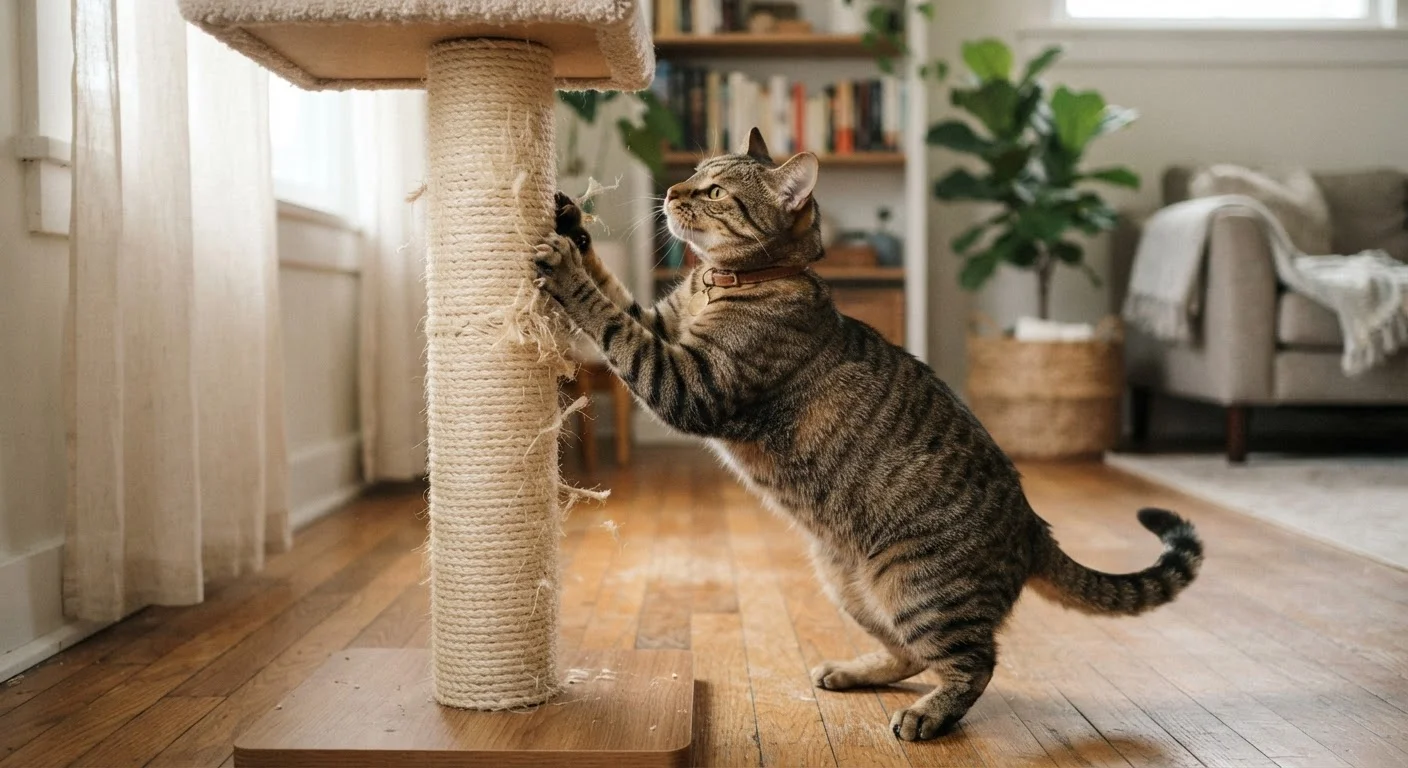
Scratching serves at least three distinct functions simultaneously. First, it removes the dead outer sheath of the claw — cats' claws grow in layers, and scratching strips away the dulled outer layer to reveal a sharper claw beneath. Second, cats have scent glands in the pads of their paws; scratching deposits pheromones onto surfaces, leaving both a visual and chemical territorial marker. Third, the physical act of scratching involves a full stretch of the forelimbs, shoulders, and back — it functions as a form of musculoskeletal maintenance.
This combination of claw care, scent communication, and physical exercise means scratching meets multiple needs in a single behavior. Removing it entirely isn't realistic. Redirecting it to appropriate surfaces is.
~58%
Indoor cats that scratch furniture regularly
Survey data from the American Pet Products Association and behavioral studies consistently find furniture scratching is among the most commonly reported feline behavior concerns in multi-cat and single-cat households.
3–4
Distinct functions scratching serves simultaneously
Veterinary behaviorists identify claw conditioning, scent marking, musculoskeletal stretching, and stress relief as overlapping functions of a single scratching bout.
Indoor cats in particular rely on scratching for environmental enrichment. An indoor lifestyle, while associated with longer lifespans, requires deliberate enrichment planning — a topic explored in depth in our article on indoor vs. outdoor cat health trade-offs.
Redirecting Effectively Without Punishment
Punishment — including yelling, spraying water, or physical correction — does not teach a cat where to scratch. It teaches the cat to scratch when you're not present. Stress and anxiety can actually increase scratching frequency, which means punitive responses often make the problem worse.
Avoid Punishment-Based Responses
Scolding, spraying, or startling a cat mid-scratch does not eliminate the behavior — it teaches avoidance of your presence, not of the surface. Cats under stress scratch more, not less, so punitive approaches can escalate the very behavior they aim to reduce. Focus on environmental management and positive redirection instead.
Effective redirection focuses on making appropriate surfaces more appealing and furniture less so. Placement matters: scratching posts placed next to the furniture a cat already targets have significantly higher adoption rates than posts placed in low-traffic corners. Post material and orientation also matter — some cats strongly prefer vertical sisal, others favor horizontal corrugated cardboard. Observing your cat's existing preferences is more useful than any single recommendation.
Double-sided tape or commercially available deterrent covers can temporarily reduce appeal on furniture while a cat builds a new scratching habit. These should be paired with an appealing alternative, not used in isolation. Once the new habit is established, deterrents can typically be removed.
The content on this site is for informational purposes only and is not a substitute for professional advice. Always consult a qualified professional for guidance specific to your situation.