

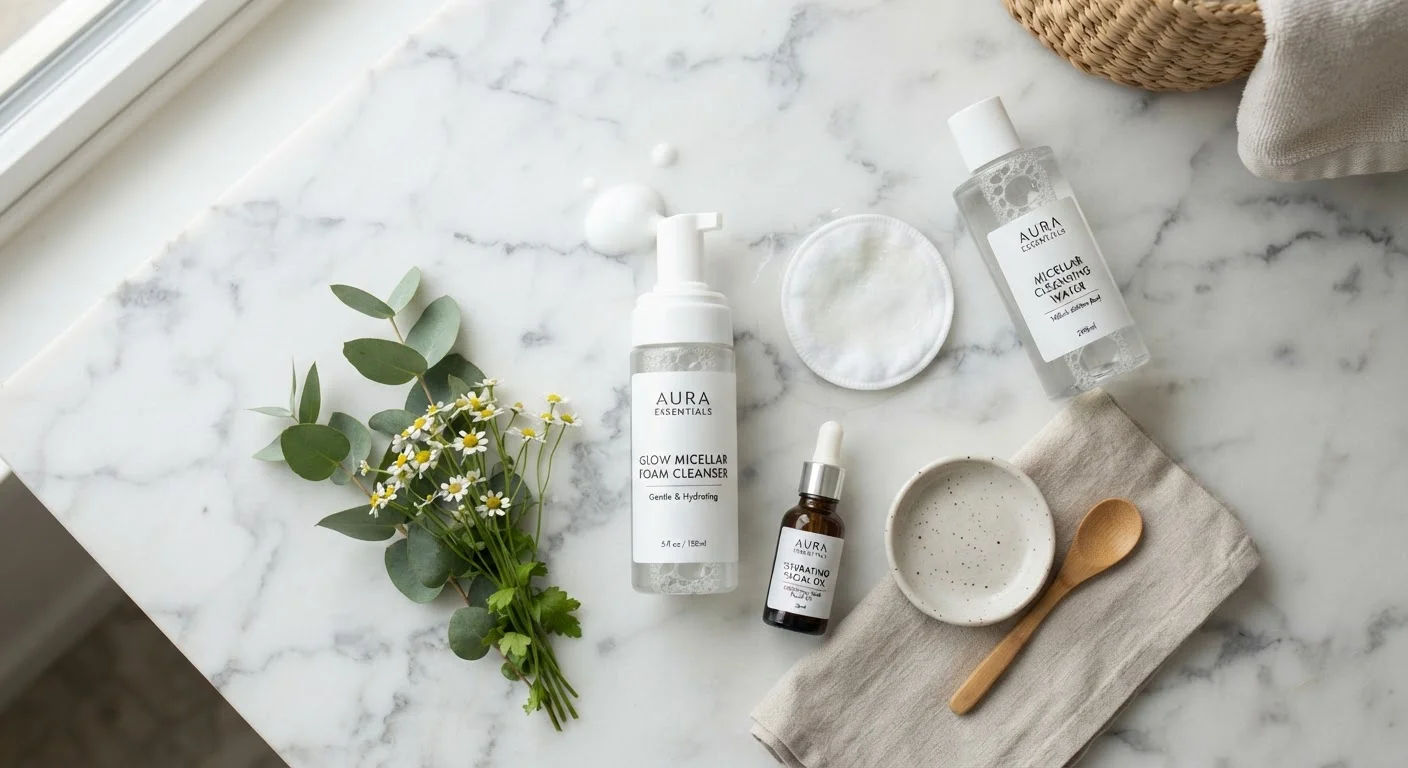
Option A
Traditional Cleanser
The thorough, deep-clean workhorse of skincare.
Best for: Best for anyone wearing full makeup, sunscreen, or dealing with oily or acne-prone skin who needs a more complete cleanse.
Option B
Micellar Water
The gentle, no-rinse option for quick and sensitive-skin cleansing.
Best for: Best for sensitive or dry skin types, travel, light makeup days, or as a first-step pre-cleanse in a double-cleansing routine.
How Each Method Actually Works
Understanding what's happening on your skin helps you pick the right tool — not just follow a trend.
Traditional cleansers rely on surfactants, which are molecules that attract both oil and water simultaneously. When you massage a cleanser onto damp skin, those surfactants surround oil, dirt, and debris, suspending them so water can rinse everything away. The formula varies — gels tend to suit oilier skin, cream cleansers favor dry or mature skin, and foaming cleansers fall somewhere in between — but the rinse-off mechanism is consistent across all of them.
Micellar water takes a different approach. Micelles are tiny spherical clusters of surfactant molecules suspended in soft water. When you press a soaked cotton pad against your skin, the micelles attract and trap impurities like a magnet, lifting them off the surface without any rinsing required. The result is a gentle, leave-on cleanse that preserves more of your skin's natural moisture barrier.
| Criterion | Traditional Cleanser | Micellar Water |
|---|---|---|
| Cleansing mechanism | Surfactants + water rinse | Micelles on cotton pad, no rinse |
| Removes heavy/waterproof makeup | Yes, effectively | Partially — may struggle |
| Suitable for sensitive skin | Depends on formula | Generally yes |
| Water access required | Yes | No |
| Risk of stripping moisture barrier | Higher with harsh formulas | Lower overall |
| Speed and convenience | Moderate — requires rinsing | Fast — wipe and done |
| Best skin types | Oily, combination, acne-prone | Dry, sensitive, normal |
For more context on building a full evening routine around these steps, see our beginner's nighttime skincare roadmap.
Where Each One Falls Short
Neither option is perfect for every situation, and knowing the limitations is just as useful as knowing the benefits.
Micellar water, despite its reputation as a one-step solution, may leave behind a thin film of surfactant residue if not followed by a rinse. Some dermatologists suggest that certain micellar formulas — particularly older or budget versions — can irritate sensitive skin if used heavily every day without rinsing. It also struggles with waterproof mascara, heavy-coverage foundation, and long-wear SPF, which tend to need more mechanical action to fully dissolve.
Traditional cleansers, meanwhile, can be over-stripping if the formula isn't matched to your skin type. A harsh foaming cleanser used twice daily on dry skin can compromise the moisture barrier, leading to tightness, flakiness, or paradoxically more oil production. They also require water access, making them less practical for travel or minimalist routines.
~60%
Adults who skip a full cleanse at night
Consumer surveys by skincare organizations have found that a significant portion of adults regularly go to bed without fully removing makeup or sunscreen — a habit that can contribute to pore congestion over time.
2-step
Double cleansing steps for thorough removal
Skincare educators commonly note that a two-step cleansing approach — a dissolving first step followed by a water-based wash — provides more complete removal of sunscreen and long-wear makeup than a single product alone.
The takeaway: neither replaces the other in every context. Think about your skin type, your usual makeup load, and how much time you realistically spend on cleansing each day.
The Case for Double Cleansing
Double cleansing — a method popularized in Korean beauty routines — uses micellar water (or an oil-based cleanser) first, followed by a traditional water-based cleanser. This approach gets the best of both worlds: the first pass dissolves makeup and sunscreen gently, and the second pass deep-cleans pores without having to work as hard.
It sounds like extra work, but for people who wear SPF daily (which most dermatologists recommend), it's a practical way to ensure sunscreen residue is fully removed before other skincare steps. If you're curious how exfoliation fits into this sequence, our article on chemical exfoliants vs. physical scrubs walks through where those steps belong in a routine.
A Note on Micellar Water and Rinsing
Some newer micellar water formulas are designed to be rinsed off after use, especially those marketed for daily wear or heavier makeup removal. Always check the product instructions. If your skin feels sticky or tight after using micellar water, a quick water rinse can help remove any residual surfactant film without negating the gentle cleanse.
Double cleansing isn't necessary for everyone — if you skip makeup and SPF on certain days, a single gentle cleanser or micellar wipe is likely sufficient.
The content on this site is for informational purposes only and is not a substitute for professional advice. Always consult a qualified professional for guidance specific to your situation.