

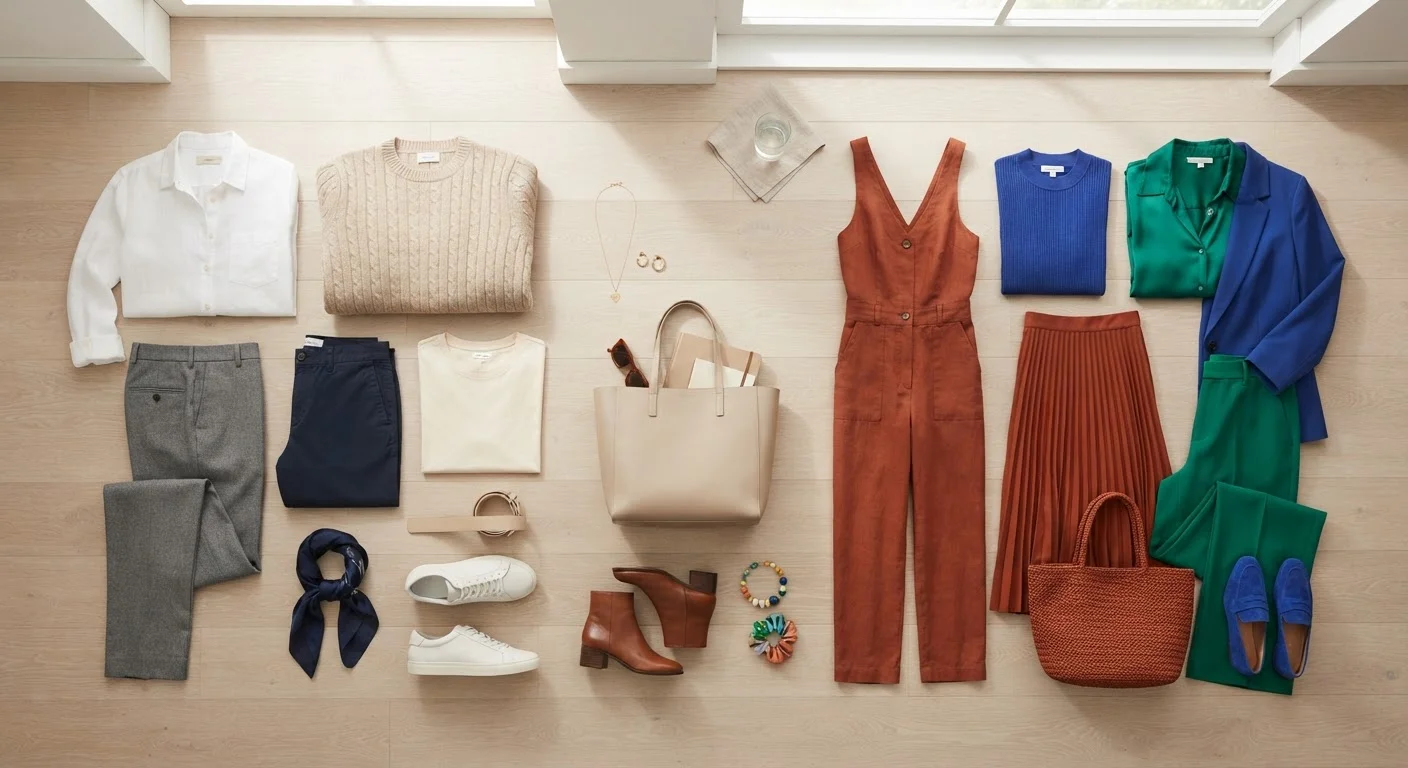
Option A
Neutral-Forward Wardrobe
The mix-and-match foundation built for versatility.
Best for: Shoppers who want maximum outfit combinations from the fewest pieces with minimal daily decision-making.
Option B
Bold-Color Wardrobe
The expressive, personality-driven approach to everyday dressing.
Best for: Individuals who use color intentionally to communicate mood, identity, and confidence through what they wear.
What Each Color Strategy Actually Means
A neutral-forward wardrobe centers on colors like white, cream, beige, grey, navy, black, and camel. These shades share an important quality: they rarely clash with each other or with most other colors. A grey trouser works with a white shirt, a camel jacket, or a navy sweater — almost without thinking. That visual harmony is the entire point.
A bold-color wardrobe leans into saturated, vivid, or high-contrast shades — think cobalt blue, rust orange, forest green, mustard yellow, or bright red. This approach treats color as a primary design tool, using it to build mood, signal personality, and create visual impact. Bold doesn't necessarily mean fluorescent; it means intentional color rather than color used as a background.
Understanding the enduring principles behind dressing well — fit, proportion, and color — helps clarify why this choice matters so much to how your wardrobe performs day to day.
| Criterion | Neutral-Forward Wardrobe | Bold-Color Wardrobe |
|---|---|---|
| Mix-and-match ease | Very high — pieces pair naturally | Requires deliberate coordination |
| Morning decision time | Low — fewer clashes to navigate | Higher — more planning involved |
| Outfits per item | High — each piece works broadly | Lower — bold items need specific partners |
| Personal expression | Subtle, understated | Immediate, expressive |
| Budget efficiency | Strong — fewer items needed | Requires more planning to avoid orphaned pieces |
| Trend sensitivity | Low — neutrals remain relevant longer | Higher — some bold colors feel dated faster |
| Workplace flexibility | Suits most environments | Best in casual or creative settings |
Versatility, Cost, and the Morning Routine
One of the most practical arguments for a neutral-forward strategy is math. When every piece can pair with every other piece, a ten-item wardrobe generates exponentially more outfit combinations than a ten-item wardrobe of clashing bold colors. For anyone building a wardrobe on a tight budget, that multiplier effect has real financial value — fewer items needed to feel fully dressed.
Bold wardrobes aren't necessarily expensive, but they do require more deliberate coordination. A cobalt blazer needs partners that complement rather than compete with it. This means either buying specific supporting pieces or accepting that some items will only appear in a handful of outfits — a trade-off worth knowing before you commit.
Morning decision fatigue is also real. Research in cognitive psychology consistently shows that decision-making becomes harder as the number of choices increases. A neutral-heavy closet reduces that friction: fewer clashes mean fewer hesitations. Bold wardrobes reward planners and people who genuinely enjoy the daily ritual of putting outfits together.
35%
People who report outfit stress on workday mornings
A survey by OnePoll found roughly a third of respondents experience stress or decision fatigue around daily outfit choices, often citing mismatched pieces as a primary cause.
~10
Outfits from 5 versatile neutral pieces
Style educators commonly illustrate that five mutually compatible neutral pieces can generate approximately ten distinct outfit combinations, demonstrating the multiplier effect of a cohesive palette.
For help building outfit systems that work regardless of your color strategy, explore these outfit formulas that work across most occasions.
The Case for Going Bold
Color psychology research suggests that the colors we wear can influence both how we feel and how others perceive us — though individual responses vary considerably and no outcomes are guaranteed. What's less contested is that wearing colors you love can support a sense of confidence and self-expression, which many people find genuinely worthwhile.
Bold wardrobes also solve a specific problem: looking generic. A sea of grey and beige can feel safe to the point of invisibility. If personal style and standing out feel important to you — in social settings, creative industries, or just in daily life — a color-forward wardrobe is a tool worth considering.
Color and Confidence: A Personal Variable
Research in environmental and behavioral psychology has explored links between color and mood, but individual responses to color vary widely based on culture, personal history, and context. There's no single color that universally boosts confidence or well-being. The most consistent finding is simpler: wearing what feels authentic to you tends to support positive self-perception more than following external rules. Let your own comfort and enthusiasm guide color choices — not prescriptive formulas.
It's also worth noting that "bold" is relative and personal. For someone who has always worn black, introducing a warm burgundy might feel bold enough. You don't need to commit to neon to adopt a more expressive color strategy.
Color choices also interact with how we dress for our body shape — contrast, placement, and saturation all affect proportion and visual focus.
Building a Strategy That Actually Works for You
The most practical color strategy for most everyday wardrobes isn't a binary choice — it's a conscious hybrid. Start with a neutral foundation (bottoms, outerwear, most layering pieces), then introduce color through tops, accessories, and occasional statement items. This approach preserves mix-and-match flexibility while still leaving room for personality and expression.
A few questions worth sitting with before you decide:
- How much time do you want to spend on outfit decisions? Less time = more neutrals.
- How expressive is your workplace or social environment? Creative and casual contexts support bolder choices more easily.
- How often do you buy new clothing? If rarely, neutral staples tend to stay relevant longer across seasonal shifts — something to consider if you're navigating seasonal wardrobe transitions on a budget.
- What genuinely makes you feel good? Style has a real relationship with mood and self-perception — a wardrobe that frustrates you daily is working against you regardless of its theoretical logic.
Neither strategy is objectively correct. Both can produce a wardrobe that's functional, affordable, and genuinely enjoyable to wear — when built with intention.
The content on this site is for informational purposes only and is not a substitute for professional advice. Always consult a qualified professional for guidance specific to your situation.